How to Choose an Audio System for Walking Tours
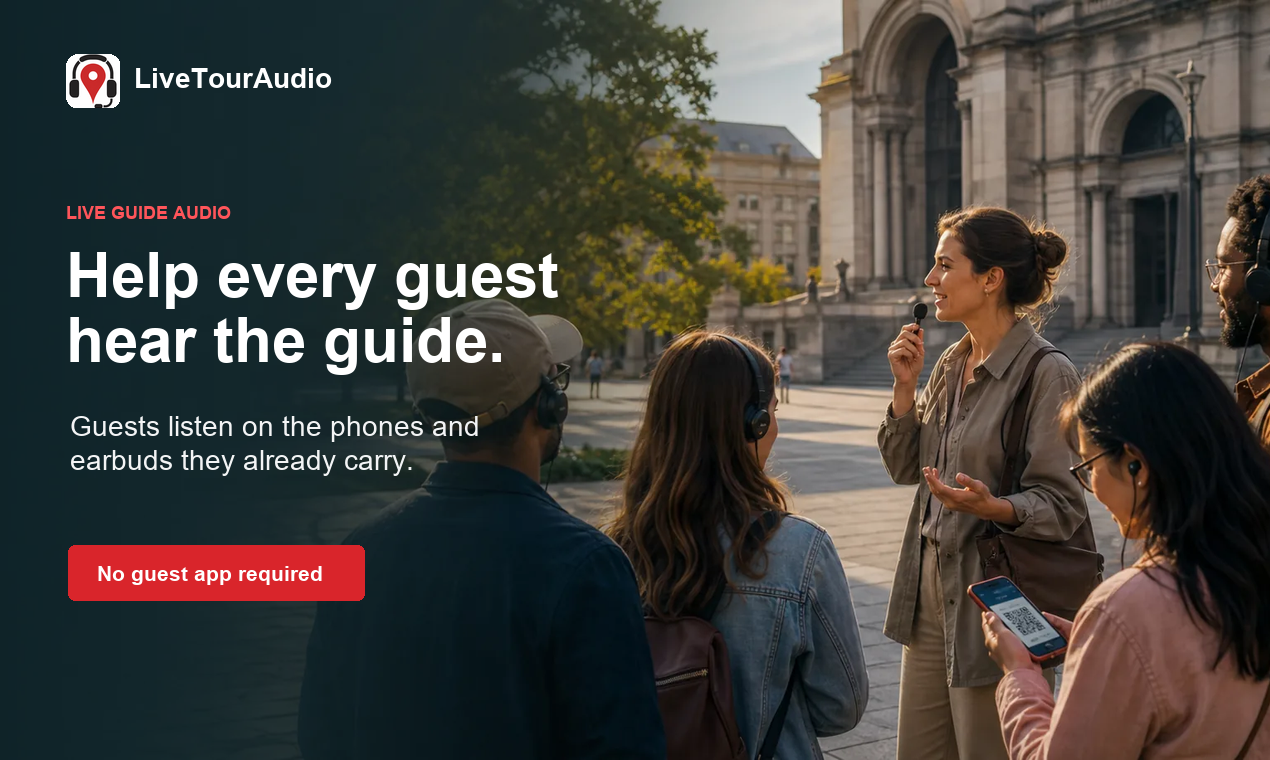
Disclosure: I own LiveTourAudio, a browser-based guest-phone audio system. This guide is a vendor-neutral way to test whether a tour needs amplification at all, and it includes situations where voice projection or dedicated radio receivers are the better choice.
Start With the Route, Not the Equipment
Audio problems on tours are rarely caused by one thing. Group size matters, but so do street width, traffic cycles, wind, crowd movement, guide position, hearing differences, and whether guests can stay close together. A quiet museum group of 30 can be easier to address than 12 guests spread along a narrow sidewalk beside buses.
That is why choosing an audio system from a feature list is risky. The useful question is not, "Which system has the most features?" It is, "At which points on this exact route do guests stop hearing the guide, and what is the least complicated way to fix those points?"
Run the test on the real route, at the same time of day as a normal departure. Rush-hour traffic, lunch crowds, construction, and evening wind can change the result. Ask one person to guide and place several testers at the front, middle, and back of the group. If possible, include someone who does not already know the script. Familiar listeners unconsciously fill in words that a paying guest would miss.
Map the Failure Points
Walk the route once without amplification. At every normal speaking stop, have the guide deliver 30 to 60 seconds of real material. The listeners should record whether they understood every sentence, most sentences, or only fragments.
Also test while the group is moving. Many tours sound fine at formal stops but fail during transitions, when the guide gives directions, adds context, or answers a question while guests are stretched over half a block. Those moments matter because a missed direction can separate a guest from the group.
Mark each failure point on a simple route map and note the likely cause:
- Traffic or mechanical noise
- A group that naturally spreads out
- A narrow or shared pedestrian area
- Wind exposure
- A guide who must face an object rather than the group
- Indoor rules that discourage raised voices
- Guests with different hearing needs
- Frequent transitions between indoor and outdoor spaces
This map becomes a better buying document than a generic list of requirements. It shows whether the problem is occasional, route-wide, or limited to one section that can be handled operationally.
Establish a Baseline With No Technology
Before adding equipment, test the simplest corrections. Change the guide's position. Put the guide at the edge of the group instead of the center. Ask guests to form a shallow semicircle. Move 20 feet away from a running vehicle. Wait for the traffic-light cycle before beginning an important explanation. Deliver longer stories at protected stops and keep movement commentary short.
Voice technique can also help. Clear pacing and consonants usually improve comprehension more than simply shouting. A guide who speaks too quickly may still be difficult to understand through an excellent audio system.
If these changes solve the problem on a small, quiet tour, stop there. No hardware, app, or subscription is more reliable than a route that works without one. Technology should remove a persistent barrier, not become a ritual every group must complete.
Test the Three Main Audio Approaches
When the baseline still fails, compare the options under the same route conditions.
Voice Projection
A compact voice amplifier or speaker can be useful when everyone may hear the content and local rules permit amplified sound. It is simple for guests because they do nothing. It can work well for stationary presentations, open sites, and groups that remain compact.
Its limits are privacy, sound spill, feedback, and uneven coverage. Increasing volume can disturb nearby businesses, residents, other guides, or visitors. It may also make the guide louder without making speech clearer at the back of a moving group. Check venue and municipal rules before relying on it.
Dedicated Radio Receivers
Traditional tour-guide radio systems remain the strongest choice when a tour needs predictable operation without depending on guest phones or mobile data. They can be especially appropriate for premium programs, industrial sites, ships, factories, secure facilities, or groups whose guests should not handle phone setup during the experience.
Test the entire operational cycle, not just the audio. Count the time required to charge, label, distribute, explain, sanitize, collect, and inventory receivers. Include spare earpieces, missing units, battery failures, transport cases, and the staff member responsible for the equipment. The audio may be excellent while the operating burden is still too high for the business.
Guest-Phone Audio
Browser-based guest-phone audio lets the guide speak from a phone while guests listen on their own phones and earbuds. A QR code can make joining fast, and a browser approach avoids requiring every guest to install an app or create an account.
This approach can remove receiver inventory and is useful for tours that already encourage guests to carry phones and headphones. It is not automatically the right answer everywhere. It depends on compatible devices, sufficient battery, usable connectivity, and guests being willing to listen through their phones. A route with unreliable coverage needs a system specifically designed for local-network operation or dedicated radios.
Test phone locking, background playback, reconnection, incoming calls, Bluetooth earbuds, wired headphones, low-power mode, and transitions between Wi-Fi and mobile data. Use both iPhone and Android listeners. Do not accept a test where every phone remains awake on a table; that does not represent a walking tour.
Measure What Guests Actually Experience
Audio quality is only one measurement. Track five practical outcomes during each test:
1. Join time: How long does a new guest need to start listening?
2. Comprehension: Can the person at the back repeat the key point accurately?
3. Interruption recovery: What happens after a locked phone, temporary signal loss, or app switch?
4. Guide workload: Can the guide start, monitor, and end the session while still welcoming the group?
5. End-of-tour work: What must staff collect, clean, charge, reconcile, or troubleshoot?
Use ordinary guests or staff who have not seen the setup before. Give them only the instructions a real guest would receive. If the test succeeds only because a technical person is standing nearby, the process is not ready.
Record the slowest join time rather than the average. A group cannot leave while one person is still stuck. Record the longest interruption and whether it recovered without guide intervention. For a commercial tour, those outliers define the experience more than a smooth demonstration does.
Test the Failure Plan
Every audio approach needs a graceful fallback. A guide should know what to do if the system fails at the busiest stop, not just how to start it at the meeting point.
For voice projection, carry a charged spare or know which stops can work without amplification. For radio receivers, define how many spare units and batteries travel with the group. For phone audio, decide whether the guide pauses, asks the group to reopen the listening page, moves to a quieter stop, or continues without audio.
The fallback should be short enough to explain in one sentence. Complicated recovery steps make the technology the center of the tour. Guests are there for the guide and the place, not for a support session.
Include the Full Cost
Compare costs over a realistic season rather than using only the purchase price or monthly fee. Dedicated systems have equipment, cases, replacements, earpieces, cleaning supplies, charging space, and staff time. Phone-based systems have subscriptions, data use, connectivity risk, and guest-support time. Voice amplifiers have batteries, maintenance, and possible restrictions on where they can be used.
Estimate the cost per departure and the cost per guest. Then add the cost of failure: refunds, poor reviews, guide stress, delayed starts, or a missed explanation at the most important site. The cheapest system on paper is not cheap if it creates a recurring operational problem.
At the same time, do not overbuy for a problem that occurs twice a month. A company with varied routes may use different approaches: no amplification for small private tours, guest-phone audio for busy walking routes, and dedicated radios for high-control or low-connectivity environments.
Make the Decision With a One-Page Scorecard
After comparing, score each approach from one to five for audibility, join speed, recovery, guide workload, guest comfort, route coverage, operating work, and total cost. Give extra weight to the two or three factors that matter most for the route.
Write down the conditions of the decision. For example: "Use no amplification below 12 guests on the morning route," or "Use dedicated receivers at the factory because guest phones are restricted," or "Use guest-phone audio on downtown departures when the group exceeds 15 and mobile coverage passes the lock-screen test."
A conditional decision is more useful than declaring one technology the universal winner. Routes, guests, and operating models differ. The goal is not to adopt audio everywhere. The goal is to make sure every guest can follow the guide without creating more work than the solution removes.
Run the same field test again after a route change, major phone update, new venue rule, or repeated guest complaint. A system that worked last season should still earn its place this season.