1
Welcome!
Hey guys welcome to TForum - Tolodora Lets make our community togheter! tolodora.com
The Tolodora community — discuss, launch, and share.
Hey guys welcome to TForum - Tolodora Lets make our community togheter! tolodora.com
Over the last few months, I’ve been looking closely at how websites show up inside ChatGPT, Google AI Overviews, Gemini and Perplexity. One thing became clear pretty quickly: Traditional rankings and AI visibility are related, but they are not the same thing. A site can rank well on Google and still barely appear when someone asks an AI tool: “What’s the best company for X?” “Which provider should I choose?” “What are the best alternatives to Y?” “Who is trusted for Z?” Here are five patterns I keep seeing. 1. AI engines often cite very specific pages, not just the strongest domain Broad authority helps, but retrieval usually happens at the page and passage level. A focused comparison, definition, pricing breakdown or how-to page can become more useful to an AI answer than a generic high-authority homepage. That means content should answer a clear question directly instead of trying to cover everything at once. 2. Brand mentions and backlinks are different signals Backlinks still matter for search authority. But AI systems also learn from how brands are described across the web. A contextual mention such as: “Company X specializes in AI visibility for local businesses” can teach a model more about the entity than a link with no useful surrounding context. So the question is no longer only: “Who links to us?” It is also: “Where are we being talked about, and what is being said?” 3. Comparison and decision-stage content is especially important A lot of AI prompts are not simple informational searches. People ask: X vs Y best tools for a specific use case what should I buy under a certain budget which provider has the best fit alternatives to a certain company If your site only publishes top-of-funnel educational content, AI may understand your topic but still not know when to recommend your business. 4. Structure matters more than most people think AI systems need clean, extractable answers. Pages tend to be easier to reuse when they have: clear headings direct definitions concise answer paragraphs comparison tables FAQs evidence attached to claims consistent entity information It does not mean writing robotic content. It means making the answer easy to identify. 5. Getting cited is not the same as getting recommended This is probably the biggest distinction. An AI system can: cite your page mention your brand describe your business recommend your business Those are four different outcomes. A company can have strong citations while a competitor still gets the actual recommendation. That is why I think AI SEO / GEO will increasingly be measured by more than rankings or traffic. The useful metrics will be things like: citation rate brand mention rate competitor recommendation share prompt coverage source influence recommendation share I’ve been building Citedly around this exact problem: understanding the real questions buyers ask, seeing which sources and competitors AI engines rely on, and then improving the content and authority signals that affect those answers. If anyone here is working on AI search visibility, I’d be interested to hear what patterns you’re seeing.
I built ApplyForMe to help job seekers spend less time on repetitive application work. It finds relevant roles, helps tailor resumes, automates repetitive steps across supported application flows, and keeps applications and replies organized. The goal is not to spray applications everywhere. Job seekers set their criteria, review the story they are telling, and keep control while ApplyForMe reduces the administrative work around discovery, preparation, and follow-up. I am sharing it here to get practical feedback from founders and builders: what part of the job search still feels unnecessarily manual to you?
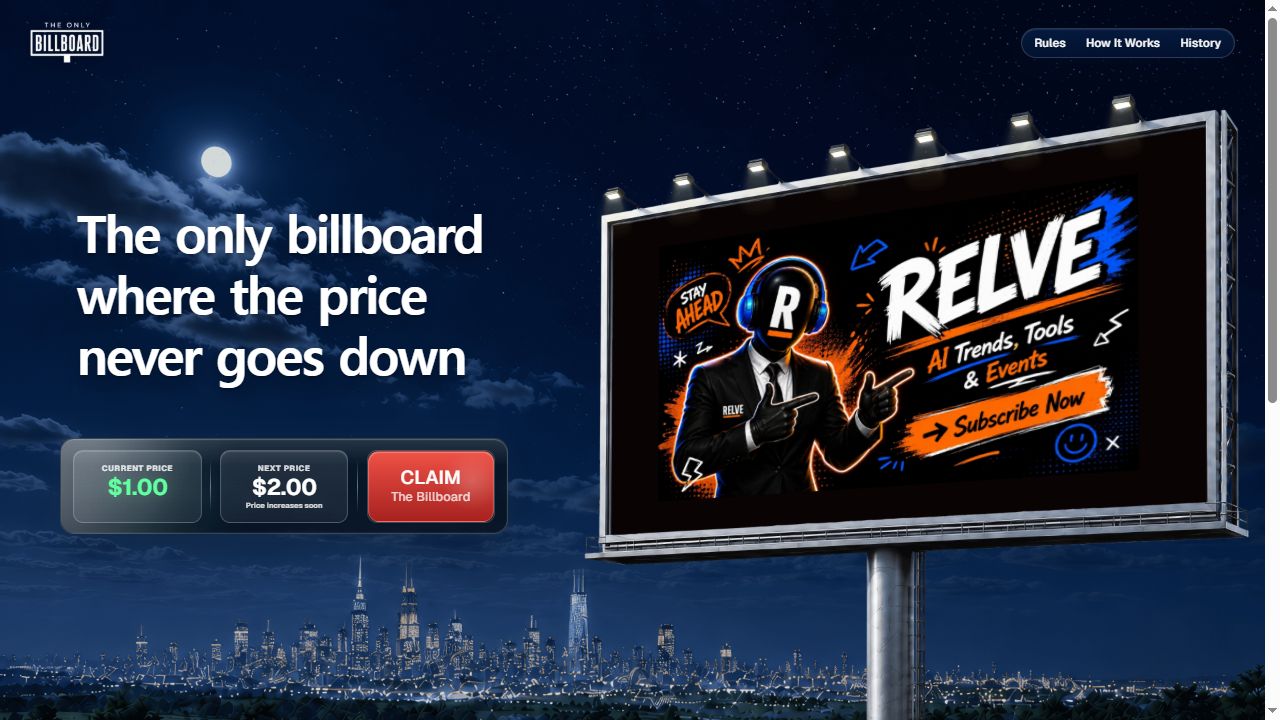
RELVE became the first paid owner of The Only Billboard. Their ad is live on the whole board, not tucked into a grid of banners. The rule is deliberately simple: one billboard, one live ad. A new buyer replaces it, the next price rises by $1, and the old ad stays in History. So RELVE bought the first chapter for $1. The next person can take it for $2. I have no idea who will decide that this tiny piece of internet history belongs to them, and that is exactly why the experiment is interesting.
If your product is live but signups are flat, check these before buying more traffic: 1. Can a new visitor name the buyer and outcome after five seconds? 2. Does the hero show the product instead of a generic promise? 3. Is one clear CTA repeated across the page? 4. Do the screenshots explain the workflow in a useful order? 5. Are you tracking visits, clicks and conversations by channel? I turned this into a free three-minute scorecard with no email or signup. It returns one repair priority you can act on. Disclosure: I run RELAUNCH DEPT. This post was drafted with AI assistance and reviewed for accuracy.