The Best Supabase Alternatives in 2026 (Backend & Postgres Platforms)
Tolodora Editorial Team
Tolodora's editorial team — we research, compile and regularly update these software guides from public sources and product documentation.
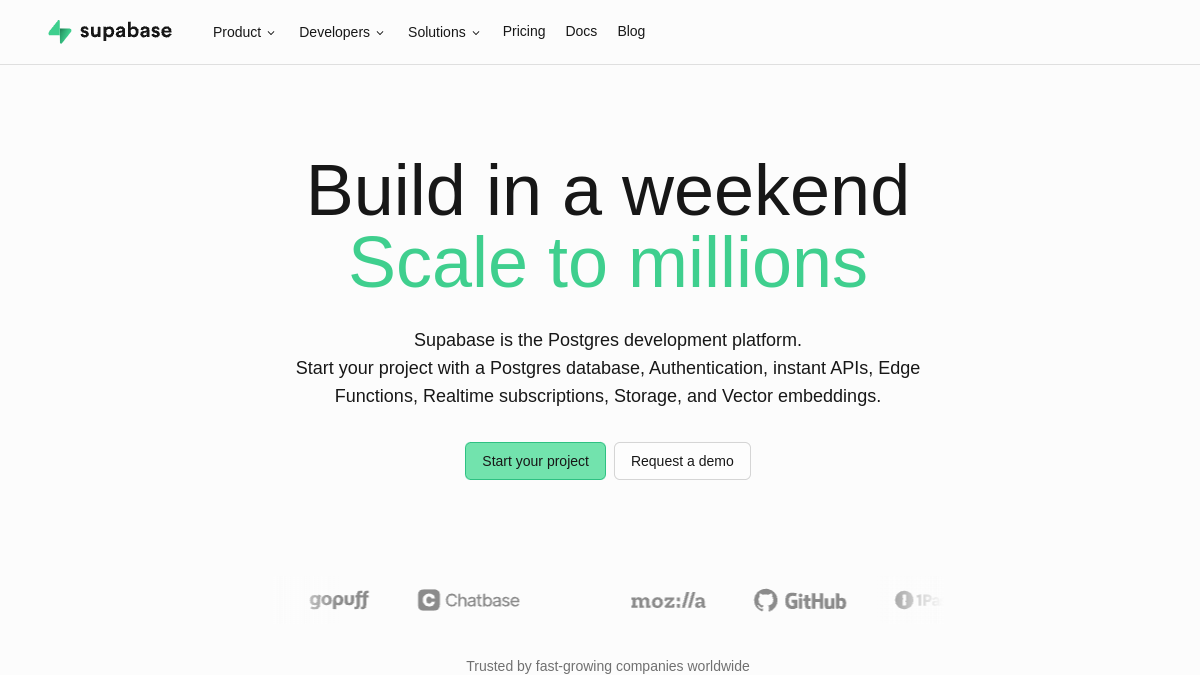
Supabase gives you a Postgres database, auth, storage and more in one open-source package. But depending on whether you prefer a NoSQL model, serverless database scaling, or a different backend philosophy, another platform may fit your app better.
These provide app backends or managed databases; they differ on database type, serverless scaling, and how much they bundle.
We rated every pick on four things — pricing and value, functionality, ease of use, and support. Here's the rundown.

Comparing against the original?
See Supabase's profile, rating & reviews on Tolodora →
| # | Tool | Best for | Rating |
|---|---|---|---|
| 1 | Firebase | Teams wanting a proven, fully managed backend (and who are fine with NoSQL). | 4.3/5 |
| 2 | Appwrite | Developers who want an open-source all-in-one backend they can host themselves. | 4.4/5 |
| 3 | Neon | Teams that want just a serverless Postgres database, not a full BaaS. | 4.4/5 |
| 4 | Nhost | GraphQL-first developers who want a Postgres backend. | 4.3/5 |
| 5 | PocketBase | Solo devs and small apps that want the simplest self-hosted backend. | 4.3/5 |
| 6 | AWS Amplify | Teams on AWS who want a managed backend with room to grow. | 4.1/5 |
Firebase
- Pricing
- 8.0/10
- Functionality
- 9.2/10
- Ease of use
- 9.0/10
- Support
- 8.4/10
What I like
Google's mature BaaS — realtime NoSQL database, auth, storage, functions and analytics, with a fast path from idea to app.
Best for
Teams wanting a proven, fully managed backend (and who are fine with NoSQL).
Firebase is the incumbent Supabase alternative: a polished, managed backend with Firestore (NoSQL), auth, storage, functions and hosting. It's fast to build on and scales, though it's closed-source and NoSQL rather than Supabase's open-source Postgres. The default for many mobile and web apps. For your business, it's one of the stronger options on this shortlist.
Appwrite
- Pricing
- 9.2/10
- Functionality
- 9.0/10
- Ease of use
- 8.6/10
- Support
- 8.4/10
What I like
An open-source, self-hostable backend covering databases, auth, storage, functions and messaging, with SDKs for everything.
Best for
Developers who want an open-source all-in-one backend they can host themselves.
Appwrite is the closest open-source rival to Supabase's philosophy: a full BaaS you can self-host or run in their cloud, with auth, databases, storage, functions and messaging. If you like Supabase's openness but want a different stack, Appwrite is a strong alternative. For your business, it's one of the stronger options on this shortlist.
Neon
- Pricing
- 9.0/10
- Functionality
- 9.0/10
- Ease of use
- 8.8/10
- Support
- 8.4/10
What I like
Serverless Postgres with scale-to-zero and instant database branching — perfect for modern, cost-efficient workflows.
Best for
Teams that want just a serverless Postgres database, not a full BaaS.
That focus makes it a natural fit for many your business. Neon is serverless Postgres done beautifully: it scales to zero when idle (so you pay for what you use) and offers Git-like branching for databases. If you love Supabase's Postgres but want a pure, serverless database layer to pair with your own stack, Neon is excellent.
Nhost
- Pricing
- 8.6/10
- Functionality
- 8.8/10
- Ease of use
- 8.6/10
- Support
- 8.2/10
What I like
Open-source backend with Postgres, an instant GraphQL API (Hasura), auth, storage and functions.
Best for
GraphQL-first developers who want a Postgres backend.
Nhost is a GraphQL-centric Supabase alternative: Postgres plus a auto-generated GraphQL API via Hasura, with auth, storage and serverless functions, open-source and self-hostable. If your app is built around GraphQL, it's one of the smoothest options. For your business, it's one of the stronger options on this shortlist.
PocketBase
- Pricing
- 9.8/10
- Functionality
- 8.2/10
- Ease of use
- 8.8/10
- Support
- 7.8/10
What I like
A whole backend in one file — SQLite database, auth, storage, realtime and admin UI, open-source and free.
Best for
Solo devs and small apps that want the simplest self-hosted backend.
PocketBase packs a backend into a single Go binary: database, auth, file storage, realtime and an admin dashboard, all free and open-source. It's trivially easy to deploy and perfect for prototypes and small apps — a delightfully simple Supabase alternative. For a your business setup, it's well worth a closer look.

AWS Amplify
- Pricing
- 7.8/10
- Functionality
- 9.2/10
- Ease of use
- 7.6/10
- Support
- 8.4/10
What I like
Backend building blocks on top of AWS — auth, APIs, storage and hosting that scale to enterprise.
Best for
Teams on AWS who want a managed backend with room to grow.
It tends to suit your business that want exactly this balance. AWS Amplify offers a Firebase/Supabase-style developer experience backed by AWS services (Cognito, AppSync, S3, Lambda). It's more complex but far more scalable and keeps you in the AWS ecosystem. Best when you'll grow into AWS regardless.
The verdict
Want Google's mature NoSQL BaaS? Firebase. A flexible open-source backend? Appwrite. Serverless Postgres that scales to zero? Neon. The lightest self-hosted option? PocketBase.
Frequently asked questions
What is the main alternative to Supabase?
Firebase is the biggest alternative (Google's NoSQL BaaS), while Appwrite is the closest open-source, self-hostable rival. For just the database, Neon offers serverless Postgres.
Is there a serverless Postgres alternative to Supabase?
Yes — Neon offers serverless Postgres with scale-to-zero and branching, and PlanetScale offers a similar serverless model (on MySQL). They focus on the database rather than a full BaaS.
Can I self-host a Supabase alternative?
Yes — Appwrite, Nhost and PocketBase are all open-source and self-hostable, as is Supabase itself, so you can avoid vendor lock-in.
Keep exploring
Building one of these alternatives?
List your tool on Tolodora and get discovered by buyers comparing options.
Launch Your Product