Xano vs Supabase: Which Backend Should You Build On in 2026?
Building the backend — the database, the business logic, the APIs — is often the hardest, slowest part of shipping a product. Two very different tools promise to take that pain away: Xano, a powerful no-code backend, and Supabase, a developer-friendly backend-as-a-service. Both let you skip building infrastructure from scratch, but they target different people and work in different ways. I've built with both, so this is my honest Xano vs Supabase comparison for 2026 — the real differences, what I like about each, and which one I'd actually choose depending on who you are.
The quick version
Short answer: Xano is a no-code backend that lets you build database, business logic and APIs visually, without writing server code, while Supabase is a developer-focused backend-as-a-service built around a real Postgres database with auto-generated APIs, auth and more. If you want a powerful backend without writing code — ideal for no-code builders and non-traditional developers — Xano is brilliant. If you're a developer who wants a real Postgres database with great tooling and the freedom to write code, Supabase is superb. The core difference: Xano is no-code-first, Supabase is developer-first. That largely decides which is right for you.
What they both do
Both solve the same fundamental problem: giving your app a backend without you building and managing servers from scratch. Each provides a database to store your data, a way to expose that data through APIs, authentication for user accounts, and the scalability to grow — all hosted and managed so you focus on your product rather than infrastructure. Both dramatically speed up building a real, data-driven application with users, logic and APIs. So at the core, either one frees you from the heavy lifting of backend infrastructure. The big difference is the approach and audience: Xano lets you build it all visually with no code, while Supabase gives developers a real database and tooling to build with code (and some no-code-friendly features too).
Where Xano shines
Xano's superpower is delivering serious backend power without code. You build your database, design complex business logic with a visual function builder, and create custom APIs — all through a no-code interface, no server programming required. This is genuinely powerful: it's not just simple CRUD, but real, complex logic that would normally need a backend engineer. For no-code builders, non-technical founders, and teams pairing it with no-code front-ends (like Webflow via Wized, as many agencies do), Xano is a revelation — a way to ship a real, scalable backend for a SaaS, app or MVP without hiring engineers or writing code. If 'I need a powerful backend but can't or don't want to code it' describes you, Xano is built for exactly that.
Where Supabase shines
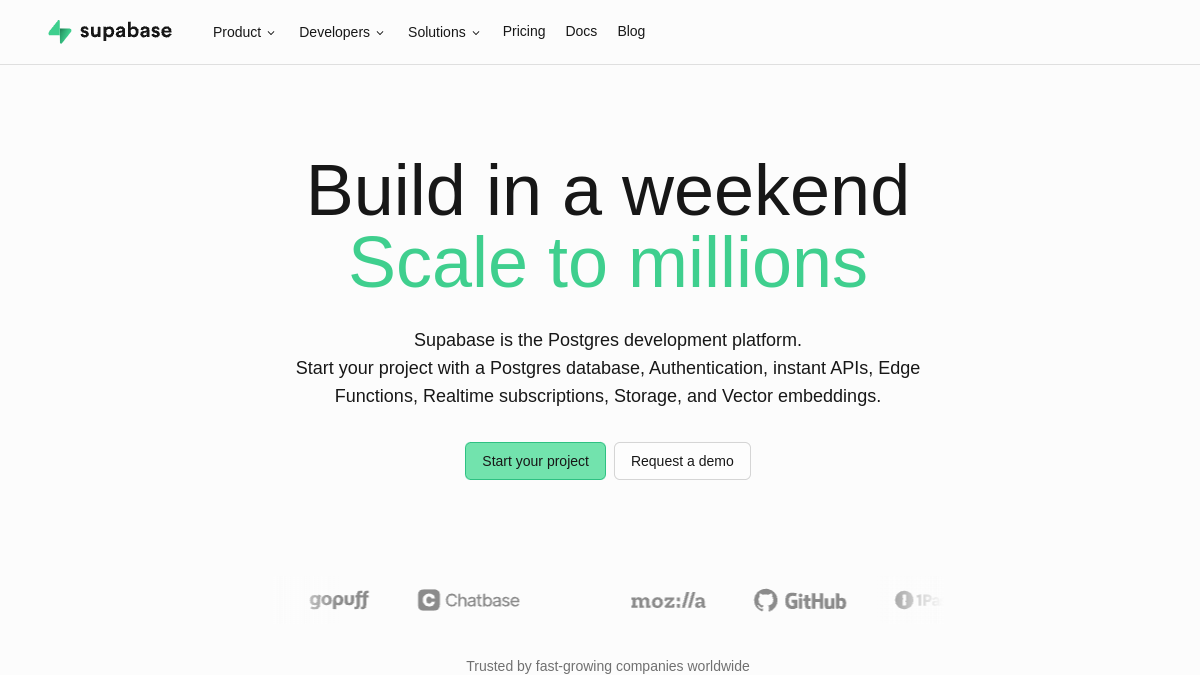
Supabase is a developer's dream backend-as-a-service. It's built around a real Postgres database — a powerful, standard, portable database you fully control — and automatically generates APIs from it, while adding authentication, file storage, realtime subscriptions, edge functions and more. It's open source, with a self-hosting option, and it's a joy for developers who want to move fast without giving up the power and portability of real code and a real database. For developers building anything from an MVP to a serious app, Supabase offers the speed of a managed backend with the control and standardization of Postgres — and because it's open source and standards-based, you're never locked into a proprietary system. For people who can code and want a great database with excellent tooling, it's outstanding.
The core difference: no-code vs developer-first
The fundamental difference is who each is for. Xano is no-code-first: you build everything visually, which is empowering if you can't or don't want to write backend code, but means working within a no-code paradigm. Supabase is developer-first: it gives you a real Postgres database and expects you to build with code (though it has friendly tooling and some no-code-ish features), which is empowering if you're a developer but less suited to non-coders. So the decision largely comes down to a simple question: do you want to build your backend without code (Xano), or are you a developer who wants a real database and the freedom to code (Supabase)? That single distinction points most people clearly to one or the other, regardless of the finer feature comparisons.
Scalability and control
Both can scale to real production workloads, but they offer different kinds of control. Supabase, being built on standard Postgres and open source, gives you maximum portability and control — your data lives in a real database you could move elsewhere, you can self-host, and you're working with industry-standard technology developers everywhere understand. Xano abstracts the infrastructure away so you don't manage it, which is wonderfully convenient, but means working within its platform and paradigm rather than raw, portable database access. For developers who prioritize owning standard, portable infrastructure, Supabase's Postgres foundation is a major advantage. For builders who prioritize not having to think about infrastructure at all and getting power without code, Xano's managed abstraction is exactly the point. Both scale; they just offer different balances of convenience versus control.
Pricing
Both have free tiers to start and paid plans that scale with usage, and the right one for your budget depends on your needs and scale. Supabase's pricing is generally developer-friendly and its free tier is generous for getting started, plus self-hosting offers a route to run it at infrastructure cost if you handle it yourself. Xano's pricing reflects the no-code power it provides and tends to step up as you need more scale and features. Roughly, developers who can self-host or work within Supabase's tiers often find it very cost-effective, while Xano's value is in what it saves you by not needing to code or hire a backend engineer — which can easily justify its cost for no-code teams. Compare current tiers against your expected usage, and weigh Xano's no-code time savings against Supabase's developer-friendly pricing.
Which I'd pick for you
My recommendation: choose Xano if you can't or don't want to write backend code and need real, powerful backend logic and APIs — it's ideal for no-code builders, non-technical founders, and teams building on no-code front-ends, and it lets you ship a serious backend without engineers. Choose Supabase if you're a developer who wants a real Postgres database, great tooling, open source and the freedom to code — it's my pick for anyone comfortable writing code who wants speed without sacrificing control. Personally, as someone who codes, I reach for Supabase, but I genuinely admire Xano for what it unlocks for non-coders, and I'd recommend it without hesitation to a no-code team. The deciding factor is simply whether you code.
Can you use both, or switch?
They serve different enough audiences that 'switching' is less common than simply choosing based on whether you code — but it's worth knowing your situation can change. A non-technical founder might start on Xano to ship an MVP fast, then, if they bring on developers, consider Supabase for its code-based control as the product matures. Conversely, a developer would rarely move to Xano. Because Supabase is built on standard Postgres, your data there is especially portable, which reduces lock-in if you ever migrate. With Xano, you're more embedded in its platform, so factor that in. In practice, most people pick the one that matches their skills and stick with it, but knowing that Supabase's standards-based foundation keeps your options open is a point in its favor if future flexibility matters to you.
The honest caveats
For balance, each has real trade-offs. Xano, being no-code, abstracts away the infrastructure, which is convenient but means less raw control and portability than a real database, and at the extreme edges of scale or highly unusual requirements, a no-code paradigm can hit limits that custom code wouldn't — though it covers far more than people expect. You're also more tied to its platform. Supabase's caveat is that it's developer-first: if you can't write code, it's not really for you, and while it's friendly, you do need to build with it. Both are managed services you depend on (mitigated for Supabase by open source and self-hosting). And as with any backend choice, migrating later is non-trivial, so picking the right paradigm up front matters. Knowing whether you want no-code power or developer control — and being honest about your team's skills — is what makes this decision straightforward.
A practical way to decide
The decision here is unusually clear once you answer one honest question: can you (or your team) comfortably write code? If the answer is no, or you're committed to a no-code approach and pairing this with no-code front-ends, choose Xano — it's purpose-built to give non-coders real backend power, and trying to force a developer-first tool on a no-code team leads to frustration. If the answer is yes, and you want a real database with the control, portability and tooling developers value, choose Supabase — it'll feel natural and you'll move fast without hitting the ceilings a no-code paradigm can impose. Don't overthink the feature-by-feature comparison; your team's actual skills and approach point clearly to one or the other, because these tools are designed for fundamentally different builders.
Beyond that core question, consider where you're headed. If you're a non-technical founder shipping an MVP to validate an idea fast and cheaply, Xano lets you build something real without hiring engineers — a huge advantage early on. If you're building something you expect to scale with a development team and want standards-based infrastructure you fully control, Supabase's Postgres foundation and open-source nature give you portability and longevity. Both have free tiers, so you can prototype on either before committing. But the honest truth is that this isn't a close call for most people the way some comparisons are — it's a clear fork in the road determined by whether you build with code or without it. Answer that, pick the matching tool, and you'll skip the hardest part of shipping a product: building the backend from scratch.
Frequently asked questions
Is Xano or Supabase better? Neither is universally better — they're for different people. Xano is a no-code backend ideal for non-coders and no-code builders; Supabase is a developer-first backend-as-a-service built on Postgres, ideal for those who can code. The deciding factor is simply whether you want to build your backend with code or without it.
Is Supabase no-code? Not really — Supabase is developer-first. It gives you a real Postgres database with auto-generated APIs and friendly tooling, but you generally build with code. If you want a truly no-code backend where you design logic visually without programming, Xano is the better fit.
Can Xano handle complex backend logic? Yes. Xano's visual function builder handles real, complex business logic and custom APIs, not just simple data operations — which is why no-code teams can ship serious SaaS apps and MVPs on it without writing server code. It covers far more than people expect from 'no-code'.
Is Supabase open source? Yes. Supabase is open source and built on standard Postgres, with a self-hosting option, so you get a portable, standards-based database you can fully control and even run yourself. That openness and portability are a key advantage over more proprietary, closed backends.
The bottom line
Xano vs Supabase comes down to one question: do you code? Xano is a powerful no-code backend that lets non-coders and no-code builders ship real, scalable backends with visual logic and APIs — brilliant for non-technical founders and no-code front-end teams. Supabase is a developer-first, open-source backend-as-a-service built on Postgres, offering speed with the control and portability developers want. Both free you from building infrastructure from scratch. Pick Xano if you want backend power without writing code, or Supabase if you're a developer who wants a real database and the freedom to code — and ship your product far faster either way. Be honest about whether your team codes, choose the matching tool, and you'll have removed the single biggest obstacle between your idea and a working, scalable product.
Building a backend, no-code or developer tool? List it on Tolodora — get discovered by the founders and builders searching for it, earn a backlink, and collect real reviews.