
Atmosly
SoftwareAtmosly is an AI-native platform for teams running Kubernetes in production.
About Atmosly
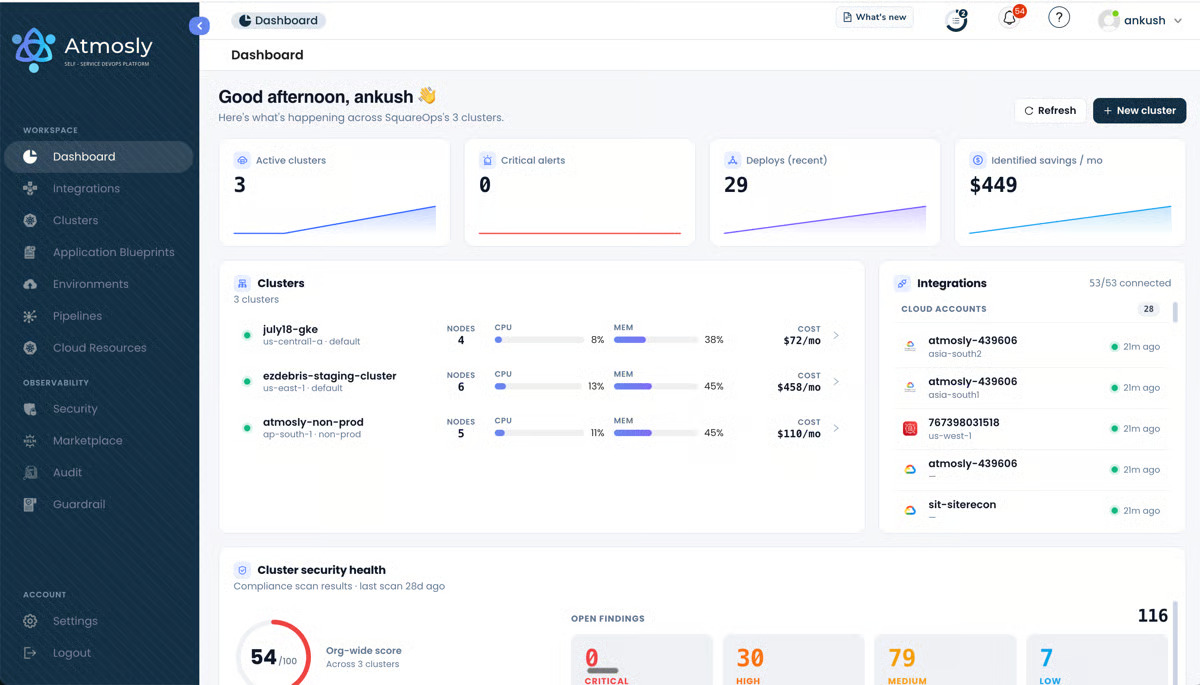
Atmosly is an AI-native internal developer platform for teams running Kubernetes in production. It brings delivery, security, cost, and incident response into one control plane instead of four separate tools.
Self-service delivery. Developers create environments, deploy applications, and read logs and metrics from a single interface. Deployments run through GitOps, so every change is a commit. Platform teams define the guardrails once and stop handling routine requests.
Security across two layers. Atmosly scans Kubernetes clusters continuously — workload configuration, RBAC, exposed services, container images — and scans the connected cloud account for misconfigurations and over-permissive access. Findings are ranked by severity and tracked over time, so posture is a live view rather than a point-in-time audit.
Cost intelligence. Spend is broken down by resource type, with an efficiency score and the portion of spend that is actually recoverable. Atmosly covers workload rightsizing against p95 usage, idle and unused capacity, node bin-packing and spot eligibility, and cost allocation by team or namespace. Rightsizing changes can be applied as a GitOps pull request. Node and pricing recommendations are surfaced for an engineer to action.
Astra, the AI SRE agent. During an incident, Astra correlates cluster signals, states the likely root cause in plain language, and proposes a fix as a reviewable change. It does not act on production on its own.
Built by SquareOps Technologies, an AWS Advanced Consulting Partner with DevOps and EKS competencies. Free tier: one cluster, one environment.
Pricing
399$
Tags
Ratings & reviews
No ratings yet
Be the first to rate Atmosly — your honest take helps others decide.
- No reviews yet — be the first to rate Atmosly.
Similar softwares
DevDock
A local Windows workspace for projects, commands, Git, Docker, project health, and security checks.

Routebase
Design your API in a visual editor instead of YAML, and your docs, mocks, contract tests and monitoring all derive from that one spec.
ADL Connect
ADL Solution | Building ADL Connect — Salesforce-native integrations for Jira, Azure DevOps, ServiceNow, Zendesk & Xurrent. Connect. Automate. Accelerate.
Compare Atmosly
Similar software

DEVRlAN
Privacy-first browser tools for developers: JSON, JWT, Base64, UUID, Regex, URL encoding, hashing and more. Fast utilities that run locally.
DevDock
A local Windows workspace for projects, commands, Git, Docker, project health, and security checks.
NeuraKeep
Auditable, source-cited memory for AI agents with review-gated durable updates, conflict visibility, and preserved failure lessons.
DomScan
DomScan provides domain availability, DNS, WHOIS/RDAP, valuation, and security through REST APIs, MCP tools, browser tools, OpenAPI, SDKs, and a CLI.
SchemaShield
Catch breaking database schema changes before deployment with deterministic impact analysis and compatibility actions.
LemWatch
See what's silently breaking on your website — in 30 seconds.
Community discussion (0)
Ask questions, share tips, or compare notes with other Atmosly users.