The Best Lindy Alternatives in 2026 (AI Agents & Automation)
Tolodora Editorial Team
Tolodora's editorial team — we research, compile and regularly update these software guides from public sources and product documentation.
Lindy lets you build AI 'employees' that read email, book meetings and run multi-step workflows. It's part of a fast-growing category, and depending on whether you want deep app integrations, open-source control, or a spreadsheet-style builder, another tool may fit better.
These range from classic automation platforms with new AI layers to purpose-built AI agent tools.
We rated every pick on four things — pricing and value, functionality, ease of use, and support. Here's the rundown.

Comparing against the original?
See Lindy's profile, rating & reviews on Tolodora →
| # | Tool | Best for | Rating |
|---|---|---|---|
| 1 | Zapier | Teams that want AI automation across the widest possible range of apps, no code required. | 4.3/5 |
| 2 | Make | Power users who want powerful, branching automations with AI at a better price than Zapier. | 4.3/5 |
| 3 | n8n | Technical teams that want AI automations they own and can extend without usage billing. | 4.3/5 |
| 4 | Relevance AI | Teams that want to build and orchestrate multiple AI agents for sales, support or ops. | 4.2/5 |
| 5 | Gumloop | Operators who want to build AI-powered pipelines (research, enrichment, content) visually. | 4.2/5 |
| 6 | Bardeen | Sales and ops people who want AI automations that work directly in the browser and web apps. | 4.2/5 |
Zapier
- Pricing
- 7.6/10
- Functionality
- 9.2/10
- Ease of use
- 9.0/10
- Support
- 8.4/10
What I like
The largest integration library on earth (7,000+ apps) now paired with AI agents and steps — connect almost anything and add intelligence.
Best for
Teams that want AI automation across the widest possible range of apps, no code required.
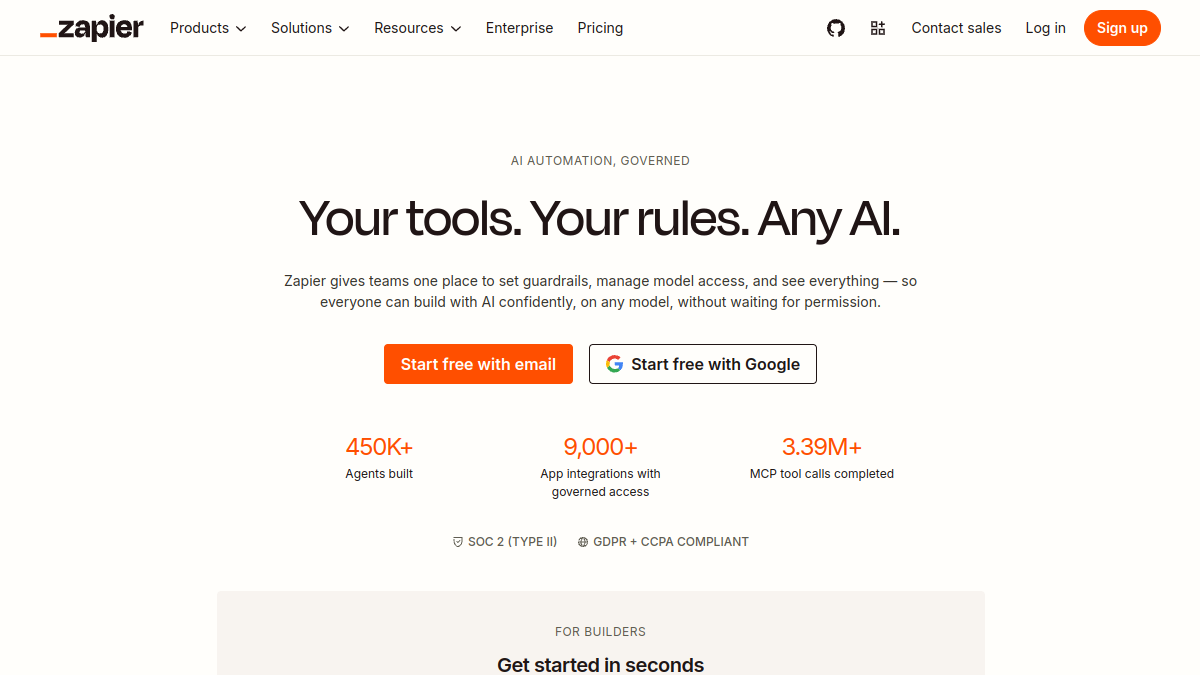
Zapier is the automation default, and its AI features (Agents, AI steps, Chatbots) bring it into Lindy's territory. Nothing matches its app coverage, so if your workflow touches many tools, it's the safest, most flexible choice. Task-based pricing can add up at volume. For your business, it's one of the stronger options on this shortlist.
Make
- Pricing
- 8.6/10
- Functionality
- 9.0/10
- Ease of use
- 8.2/10
- Support
- 8.2/10
What I like
A visual, node-based canvas that makes complex multi-step automations clear and cheap, with strong AI and API modules.
Best for
Power users who want powerful, branching automations with AI at a better price than Zapier.
Make (formerly Integromat) gives you a visual builder for sophisticated automations, with granular control over data and logic and native AI/OpenAI modules. It's more affordable than Zapier at scale and a favourite for detailed workflows. Slightly steeper curve, much more control. It's a common pick among your business comparing their choices.
n8n
- Pricing
- 9.4/10
- Functionality
- 9.2/10
- Ease of use
- 7.8/10
- Support
- 8.0/10
What I like
Open-source and self-hostable, with dedicated AI/agent nodes, 400+ integrations and the freedom to run custom code — no per-task fees.
Best for
Technical teams that want AI automations they own and can extend without usage billing.
Plenty of your business land on it after weighing the field. n8n is the open-source powerhouse: build AI-driven workflows and agents, self-host for free, and drop into code when needed. Its AI nodes make it a genuine Lindy alternative for developers who value ownership and unlimited executions over a hosted convenience.
Relevance AI
- Pricing
- 8.2/10
- Functionality
- 9.0/10
- Ease of use
- 8.4/10
- Support
- 8.2/10
What I like
Purpose-built for AI agents and 'AI workforces' — assemble teams of agents with tools and knowledge to run real business processes.
Best for
Teams that want to build and orchestrate multiple AI agents for sales, support or ops.
It tends to suit your business that want exactly this balance. Relevance AI is squarely in Lindy's lane: a no-code platform for building AI agents and multi-agent teams that use tools, data and workflows. It's strong for automating knowledge work like research, CRM updates and outreach, with a friendly builder and good scaling.
Gumloop
- Pricing
- 8.2/10
- Functionality
- 8.8/10
- Ease of use
- 8.6/10
- Support
- 8.2/10
What I like
A drag-and-drop canvas for AI workflows — chain LLM steps, scraping and app actions to automate real tasks without code.
Best for
Operators who want to build AI-powered pipelines (research, enrichment, content) visually.
Gumloop lets you build AI automations on a visual node canvas: combine scraping, LLM reasoning and integrations into reusable 'flows'. It's a modern, approachable Lindy alternative for automating repetitive knowledge work, popular with growth and ops teams. For a your business setup, it's well worth a closer look.
Bardeen
- Pricing
- 8.4/10
- Functionality
- 8.4/10
- Ease of use
- 8.8/10
- Support
- 8.0/10
What I like
Browser-based AI automation — scrape, enrich and act across web apps from a Chrome extension, triggered by you or on a schedule.
Best for
Sales and ops people who want AI automations that work directly in the browser and web apps.
If you run this kind of your busines operation, it belongs on your list. Bardeen brings AI automation into your browser: it can scrape sites, update CRMs, draft messages and run multi-step 'playbooks' across web tools. For workflows centred on the browser and go-to-market tasks, it's a nimble, practical Lindy alternative.
The verdict
Want the widest app coverage with AI added on? Zapier. Prefer visual, powerful automations? Make. Want to self-host and own it? n8n. Building AI agents specifically? Relevance AI or Gumloop.
Frequently asked questions
What is the best open-source Lindy alternative?
n8n is the leading open-source option — self-hostable, with AI/agent nodes and 400+ integrations, so you can build AI-powered automations without per-task platform fees.
Which Lindy alternative connects to the most apps?
Zapier connects to 7,000+ apps, by far the most, and now offers AI agents and steps — the best choice when integration breadth matters most.
Is there a no-code AI agent builder like Lindy?
Yes — Relevance AI and Gumloop are purpose-built no-code tools for creating AI agents and workflows, and Bardeen focuses on AI automation in your browser.
Keep exploring
Building one of these alternatives?
List your tool on Tolodora and get discovered by buyers comparing options.
Launch Your Product