KLOCKai
KLOCKai: Building the AI Workforce for Modern Businesses
Artificial intelligence is changing the way businesses operate. Over the last few years, companies have moved from experimenting with AI to actively using it for marketing, customer service, software development, research, content creation, analytics and business operations. However, while AI adoption is growing rapidly, many organizations are still approaching artificial intelligence as a collection of individual tools rather than as a complete workforce.
A company may have one AI tool for writing, another for customer support, another for generating sales emails, another for coding, another for analyzing data and another for managing projects. Each tool can be useful on its own, but businesses can quickly find themselves managing dozens of disconnected applications.
This creates an important question: What if businesses could build an AI workforce instead of simply buying more AI tools?
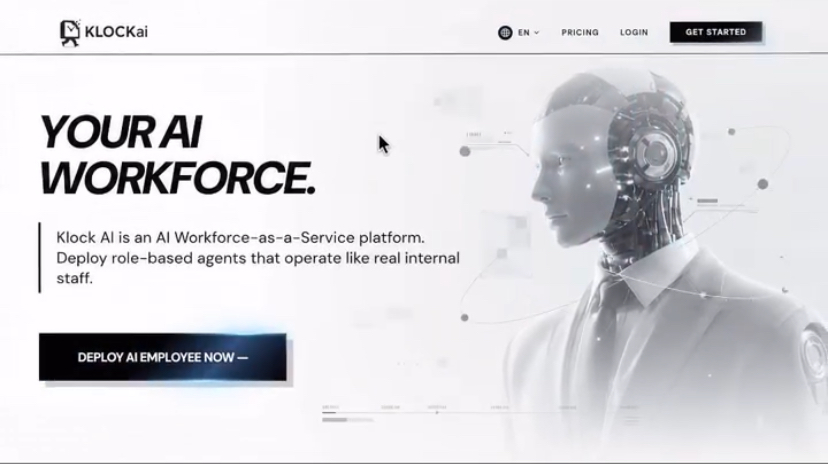
This is the idea behind KLOCKai, an AI Workforce-as-a-Service platform designed to help businesses deploy specialized AI employees across different areas of their organization.
Rather than asking one general-purpose AI assistant to perform every task, KLOCKai approaches artificial intelligence as a workforce made up of specialized AI employees. Each AI employee can be designed around a particular business role, responsibility or workflow, allowing companies to combine AI capabilities with their existing human teams.
What Is KLOCKai?
KLOCKai is an AI workforce platform that enables businesses to employ AI employees across a wide range of business functions.
These functions can include:
Sales
Customer service
Marketing
Social media management
Accounting
Project management
Product management
Software development
UI/UX design
Video editing
Research
Administration
Business operations
Lead generation
Customer engagement
Business analysis
The concept is simple: instead of treating AI as something employees occasionally open to ask a question, KLOCKai enables businesses to think of AI as an additional layer of their workforce.
A company can identify the areas where it needs support, select the appropriate AI employees and incorporate those AI employees into its workflows.
The goal is not simply to generate text, answer questions or create images. The broader objective is to enable AI to participate in the actual work of a business.
From AI Tools to an AI Workforce
One of the biggest challenges businesses face in the modern software environment is the growing number of disconnected tools.
A typical business might use a CRM for managing customers, a project-management platform for managing tasks, a communication platform for internal conversations, an email platform for customer communication, accounting software for finances, marketing tools for lead generation and several AI applications for different tasks.
Each tool solves a particular problem.
The challenge comes from making all of these systems work together.
Employees often become the connection between the tools. A person might take information from one application, copy it into another, analyze it somewhere else and then communicate the result to another member of the team.
KLOCKai takes a different approach.
Instead of thinking about AI as one tool that employees occasionally use, KLOCKai approaches AI as a workforce that can operate alongside the human workforce.
An AI sales employee, for example, can be focused on sales-related responsibilities. An AI customer-service employee can focus on customer interactions. An AI marketing employee can assist with marketing activities, while an AI developer can support technical teams.
This creates a more structured approach to business AI.
AI Employees Working With Humans
KLOCKai is designed around the idea that the future of work will involve humans and AI working together.
AI employees can assist teams with research, customer communication, prospect follow-up, content creation, project coordination, software development, business analysis and operational tasks.
The human team remains an important part of the organization.
The objective is not to suggest that every human responsibility should immediately be handed over to artificial intelligence. Instead, KLOCKai can help businesses delegate appropriate repetitive, time-consuming and intellectual workloads to AI while allowing people to concentrate on responsibilities where human judgment, relationships, creativity, leadership and accountability are particularly important.
For example, a human sales manager may spend less time manually researching prospects and preparing repetitive follow-ups because an AI sales employee can assist with those activities.
A human marketing manager can use an AI marketing employee to accelerate research, campaign development and content production.
A software-development team can use AI developers to assist with coding, debugging, documentation and other technical work.
The result is not necessarily an AI-only business. It is a human-AI organization.
Connecting AI to Business Tools
An AI employee becomes significantly more useful when it can work within the systems that a business already uses.
KLOCKai is designed to connect AI employees with business tools, workflows and external systems, including communication platforms, CRM systems, APIs, productivity applications and other business software.
This allows AI to become part of an organization’s operating environment rather than remaining isolated inside a chatbot.
Imagine a business receiving a new customer inquiry.
Instead of an employee having to manually review the inquiry, determine the customer’s needs, search the CRM, prepare a response and create a follow-up task, specialized AI employees could assist with different parts of the workflow.
A customer-service AI employee could help respond to the inquiry.
A sales AI employee could identify whether the person represents a potential sales opportunity.
A CRM-connected workflow could update the relevant customer information.
A project or operations AI employee could help coordinate the next steps.
The human team can then review, approve, modify or take over where appropriate.
This is the difference between simply using AI and integrating AI into the way a business operates.
More Than Individual AI Agents
KLOCKai’s larger vision goes beyond individual AI agents.
The platform is built around the concept of an AI workforce, where multiple specialized AI employees can contribute to different areas of the same organization.
This means a company could potentially have an AI sales team, AI marketing team, AI customer-service team, AI development team, AI finance support team and AI operations team working alongside its human employees.
Each AI employee can have a particular purpose rather than attempting to become a universal assistant.
This specialization is important because businesses are themselves specialized.
A sales employee has different objectives from an accountant. A project manager has different responsibilities from a software developer. A customer-service employee operates differently from a marketing specialist.
KLOCKai brings this organizational structure into the world of artificial intelligence.
Organizational Intelligence
Another important part of KLOCKai’s vision is moving beyond individual task automation toward organizational intelligence.
Businesses generate enormous amounts of information every day. Customer conversations, sales activity, projects, financial information, marketing performance and operational decisions all contribute to a larger picture of how an organization is performing.
AI can potentially help businesses understand this information and identify patterns that humans may not immediately notice.
KLOCKai explores capabilities such as an Organizational Decision Intelligence Engine, designed around helping organizations make better decisions using the information available across their operations.
Instead of simply asking an AI, “What should I write?” businesses can increasingly ask questions such as:
What is happening in my business?
Where are we losing customers?
Which opportunities should we prioritize?
What work is falling behind?
Where should we invest more resources?
Do we need another human employee?
This represents a shift from AI as a content generator to AI as part of the organization’s decision-making infrastructure.
Self-Improving AI Employees
KLOCKai also explores the concept of AI employees that can become more useful over time as they gain access to business context, workflows, feedback and organizational knowledge.
A newly deployed AI employee may initially have limited knowledge about a company. As it becomes integrated into the organization’s processes, it can potentially become more aligned with the company’s products, customers, communication style, workflows and objectives.
This creates the possibility of an AI workforce that becomes increasingly useful as a company grows.
Instead of repeatedly explaining the same context to an AI tool, businesses can build AI employees around specific responsibilities and organizational requirements.
AI for Revenue and Growth
Revenue generation is another area where AI workforces can have a significant impact.
Sales and marketing teams spend considerable amounts of time researching prospects, creating campaigns, communicating with potential customers, following up on leads and analyzing results.
KLOCKai can support these activities through specialized AI employees focused on sales, marketing, customer engagement and revenue operations.
The platform also explores Autonomous Revenue Launch Mode, where AI can assist businesses with activities designed to move prospects through the revenue process.
The objective is not simply to send more messages.
The objective is to create more intelligent workflows around finding opportunities, engaging prospects, following up and helping businesses convert opportunities into customers.
AI Employees for Small Businesses
Large organizations have traditionally had an advantage because they can afford larger teams and specialized departments.
A small business might have only a few employees responsible for sales, marketing, customer service, administration and operations.
This can make growth difficult.
An AI workforce can potentially give smaller companies access to capabilities that would otherwise require several specialized employees.
A small company could have AI assistance for sales, marketing, customer support, administration and technical work while its human team focuses on customers, strategy and business growth.
This does not eliminate the importance of hiring people. Instead, it can allow small businesses to use their existing human resources more efficiently.
AI Employees for Growing Companies
As companies grow, complexity grows with them.
More customers create more customer-service requests. More sales create more follow-ups. More employees create more administrative work. More products create more development and support requirements.
Businesses often respond by hiring more people and adding more software.
KLOCKai offers another possibility: scale certain capabilities through AI employees.
A growing company can potentially add AI roles as its needs change.
Instead of viewing AI as a single subscription that provides a generic assistant, businesses can begin thinking about AI as an expandable workforce.
The Role of Human Talent
Interestingly, an AI workforce does not make human talent less important.
In many cases, it can make the right human talent more valuable.
KLOCKai’s vision includes the ability for AI to recommend when a business may need human talent.
There are tasks that require leadership, empathy, physical presence, relationship building, negotiation, specialized expertise and human accountability.
The most effective organization may therefore not be one with the most AI or the most humans.
It may be the organization that understands which work should be performed by AI and which work should be performed by people.
This creates a workforce where humans and AI complement one another.
Why AI Workforces Matter
Businesses have always scaled by building teams.
A company starts with a founder. Then it may hire a salesperson, an accountant, a marketer, a developer, a customer-service representative and additional specialists.
The emergence of capable AI creates the possibility of another category of workforce member: the AI employee.
AI employees can potentially work continuously, operate at digital speed and assist with large volumes of information and repetitive workflows.
This could fundamentally change how businesses think about productivity.
Instead of asking only, “How many people do we need to hire?” businesses may increasingly ask:
What combination of human and AI employees do we need to accomplish our goals?
That is the larger opportunity KLOCKai is pursuing.
The Future of Work
The future of work is unlikely to be as simple as humans versus AI.
A more interesting possibility is humans working with AI employees as part of the same organization.
People can provide leadership, creativity, relationships, judgment and accountability.
AI can provide scale, speed, automation, analysis and continuous assistance.
Together, these capabilities can create a new type of organization.
KLOCKai is building toward this future by giving businesses a platform for creating and managing an AI workforce across multiple business functions.
The objective is straightforward: reduce the cost and complexity of getting work done, provide businesses with access to more capabilities and help human teams move faster.
As artificial intelligence continues to evolve, the companies that benefit most may not simply be the ones that use AI.
They may be the companies that learn how to organize, deploy and manage AI effectively as part of their workforce.
KLOCKai is built around that idea.
AI is no longer just a tool sitting on the desk of an employee. It can become part of the team.
And KLOCKai’s vision is to help businesses build that team.