Best Email Marketing for Ecommerce Stores (2026)
For an ecommerce store, email (and increasingly SMS) is often the single most profitable marketing channel — it recovers abandoned carts, brings customers back to buy again, and turns one-time shoppers into loyal repeat buyers, all at a fraction of the cost of ads. The right email platform connects to your store, understands what customers do, and automates the campaigns that drive revenue while you sleep.
This guide covers the best email marketing software for ecommerce stores in 2026 — from data-rich powerhouses to affordable, easy tools. We'll focus on what matters for a store: cart recovery, automations, segmentation, SMS and revenue.
What ecommerce stores need from email software
- Store integration — connect to Shopify, WooCommerce and others to use real purchase data.
- Abandoned-cart automation — recover the sales shoppers nearly made.
- Segmentation — target by purchase behaviour, spend and engagement.
- Email + SMS — reach customers on multiple channels for launches and offers.
- Revenue reporting — see which campaigns actually drive sales.
- Fair pricing — costs that make sense as your list grows.
The best email marketing software for ecommerce
| Tool | Best for | Standout |
|---|---|---|
| Klaviyo | Data-driven stores maximising revenue | Best-in-class segmentation & data |
| Omnisend | Ecommerce email + SMS made easy | Ready-made store automations + SMS |
| MailerLite | Value and simplicity | Generous free plan, easy editor |
| Mailchimp | Familiar all-rounder | Broad features + integrations |
| Brevo | Email + SMS billed by send | Pay per send, not list size |
| Drip | Ecommerce-first automation | Deep behaviour-based flows |
Klaviyo — the data powerhouse
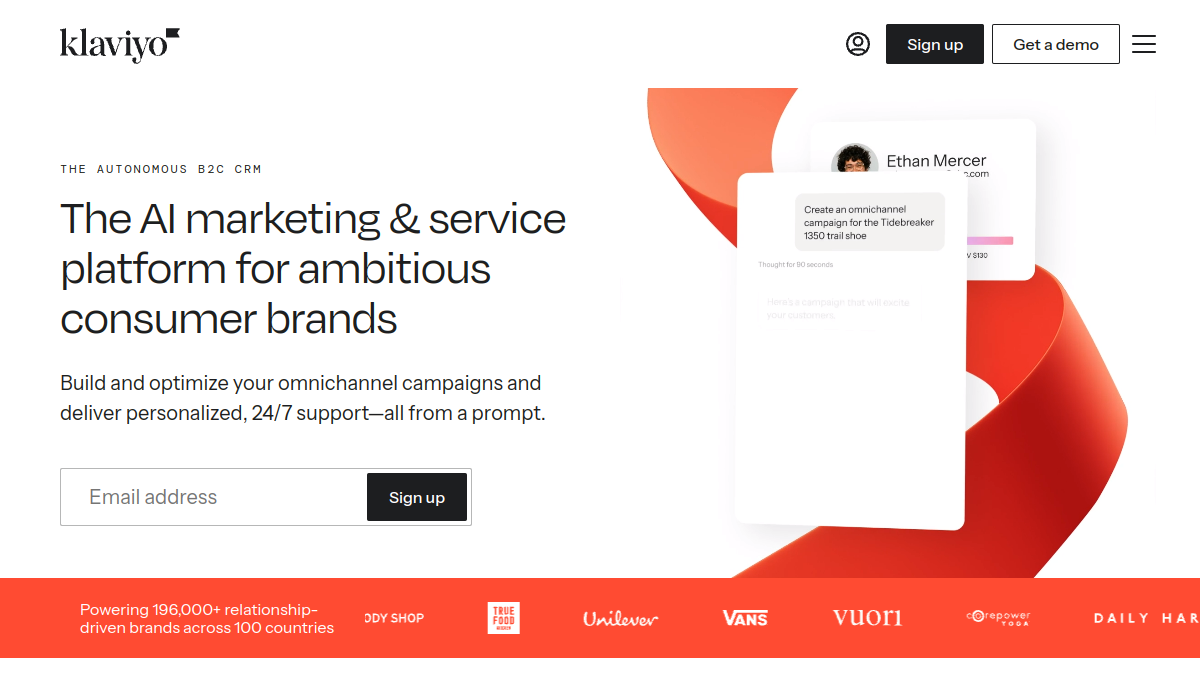
Klaviyo is the leading choice for stores that live on email revenue, with best-in-class segmentation, deep store integration and revenue-focused reporting. It's more advanced and pricier, but for maximising sales through precise targeting across email and SMS, it's the benchmark.
Omnisend — ecommerce email and SMS made easy
Omnisend is purpose-built for ecommerce, with ready-made automations (cart, welcome, browse abandonment) and email plus SMS in one place. It's more approachable and often more affordable than Klaviyo, making it a top pick for stores that want power without complexity.
MailerLite — the value all-rounder
MailerLite offers lovely emails and simple automations at a great price, with a generous free plan and store connections for core flows. Less ecommerce-specialised than Klaviyo or Omnisend, but a favourite for smaller stores watching costs.
Mailchimp — the familiar option
Mailchimp is the well-known all-rounder with ecommerce automations, product recommendations and broad integrations. Pricing climbs as your list grows, so weigh it against value picks, but it remains a capable, recognisable choice.
Brevo — email plus SMS on a budget
Brevo bills by emails sent, not subscribers, which suits stores with a large list emailed periodically. It bundles email, SMS, automation and store integration, offering flexible, budget-friendly multi-channel marketing.
Drip — ecommerce-first automation
Drip is built specifically for online stores, with powerful behaviour-based automations, rich segmentation and revenue reporting across email and SMS. For a store that wants deep ecommerce automation without the top-tier price, it's a strong, sales-driven option.
How to choose the right one
Want the deepest data and maximum revenue? Klaviyo. Ecommerce power made easy with SMS? Omnisend. Best value and simplicity? MailerLite. A familiar all-rounder? Mailchimp. Email in bursts and want SMS by send? Brevo. Ecommerce-first automation? Drip. Most connect to your store and offer free plans or trials — set up a cart-recovery flow in your top choice first.
Getting started and the automations that matter
Connect your store first so the tool can use real purchase data. Then set up the core ecommerce automations in order of impact: an abandoned-cart flow (the highest-return automation there is), a welcome series for new subscribers, a post-purchase flow to drive repeat orders and reviews, and a win-back for lapsed customers. Add a browse-abandonment flow if supported. These run on their own and quietly generate a large share of email revenue. Only after the automations are live should you focus on regular campaigns and SMS for launches and sales.
Common ecommerce email mistakes
No abandoned-cart flow. You're leaving nearly-made sales on the table. This is the first automation to turn on.
Blasting everyone the same email. Segmentation by behaviour and spend dramatically lifts results. Don't send one-size-fits-all.
Ignoring post-purchase. The best time to sell again is right after a purchase. Automate follow-ups and review requests.
Only emailing, never texting. SMS drives urgency for launches and offers. Use email and SMS together where it fits.
Not tracking revenue. Opens and clicks don't pay the bills. Measure revenue per campaign and flow, and optimise for it.
Segmentation: the biggest lever on email revenue
If there's one habit that separates stores making serious money from email and those barely covering the subscription, it's segmentation. Sending every subscriber the same message wastes your best asset; segmenting by behaviour and value multiplies results. The high-impact segments are straightforward: recent buyers (ripe for a complementary product), repeat and VIP customers (worth special treatment and early access), one-time buyers (nudge toward a second purchase), and lapsed customers (win them back before they're gone). You can also segment by product interest, so someone who bought running shoes hears about running gear, not unrelated items. Tools like Klaviyo and Drip excel at this with deep, data-driven segmentation, while Omnisend and others cover the essentials well. The payoff is emails that feel relevant and personal rather than spammy, which lifts open rates, click rates and — the number that matters — revenue per email. For any store, moving from batch-and-blast to even basic segmentation is one of the fastest ways to increase what email earns you.
Balancing email and SMS without annoying customers
SMS has become a powerful ecommerce channel because texts get opened almost instantly, making it ideal for time-sensitive launches, flash sales and shipping updates — but it's also more intrusive than email, so it must be used with care. The winning approach is to use each channel for what it does best: email for richer content, storytelling, newsletters and detailed offers; SMS sparingly for urgent, high-value moments where immediacy matters. Always get proper consent for texts, make opting out easy, and don't over-send, since a customer who feels bombarded will unsubscribe from both channels. Tools like Omnisend, Brevo and Klaviyo let you coordinate email and SMS in the same automations, so a cart-recovery flow might send an email first and a text only if the cart's still abandoned. Used thoughtfully, combining email and SMS reaches customers wherever they're most responsive and lifts conversions; used carelessly, it drives them away. The key is respect: message with genuine value, at a sensible frequency, on the channel that fits the moment.
Frequently asked questions
What is the best email marketing software for a small ecommerce store?
Omnisend and MailerLite are excellent for small stores — Omnisend for ecommerce-native automations and SMS made easy, MailerLite for value and simplicity. Klaviyo and Drip are best if you want the deepest data and automation as you scale.
Which tool is best for abandoned-cart recovery?
All the ecommerce-focused tools here — Klaviyo, Omnisend, Drip, Mailchimp and Brevo — include abandoned-cart automations that connect to your store. Cart recovery is the highest-return ecommerce automation, so make sure whichever tool you choose supports it (they all do).
Do I need email and SMS, or just email?
Email is essential and the highest-priority channel; SMS is a powerful addition for urgent, time-sensitive moments like launches and flash sales. Tools like Omnisend and Brevo combine both, letting you add SMS selectively. Start with strong email automations, then layer in SMS where immediacy adds value — without over-messaging.
Deliverability: getting your emails into the inbox
None of your beautifully-designed campaigns and automations matter if they land in spam, so deliverability — actually reaching the inbox — is a foundational concern for ecommerce email. The good news is that the reputable platforms here invest heavily in it, but your own practices matter just as much. Start by only emailing people who opted in; buying or scraping lists tanks your sender reputation and can get you blocked. Authenticate your domain (SPF, DKIM and DMARC records, which tools like Klaviyo, Omnisend and Mailchimp guide you through) so mailbox providers trust that emails are genuinely from you. Keep your list clean by removing or re-engaging subscribers who never open, because sending to dead addresses hurts your reputation and a smaller engaged list outperforms a large stale one. Avoid spammy subject lines and content, make unsubscribing easy (ironically, this protects deliverability by reducing spam complaints), and warm up gradually rather than blasting a huge list from a brand-new account. Segmentation helps here too, since sending relevant emails to engaged people improves your open rates and, in turn, your standing with inbox providers. Deliverability isn't glamorous, but it's the difference between email being your most profitable channel and it quietly underperforming, so it's worth getting the fundamentals right from the start.
The bottom line
The best email marketing software for an ecommerce store turns purchase data into automated revenue — recovering carts, driving repeat sales and building loyalty. Choose Klaviyo for data and scale, Omnisend for easy ecommerce email and SMS, MailerLite for value, Mailchimp as a familiar all-rounder, Brevo for send-based pricing, or Drip for ecommerce-first automation. Turn on your automations, segment your list, and measure revenue.
Building a tool for this niche? List it free on Tolodora and get found by buyers searching for exactly what you make — with a do-follow backlink, real reviews and buyer-intent traffic.