The 6 Best Vector Databases in 2026 (for RAG & AI Search)
Behind almost every serious AI feature — RAG chatbots, semantic search, recommendations, agent memory — sits a vector database doing the quiet work of finding the most relevant needles in enormous haystacks. The category has exploded, and the options genuinely differ in performance, features, hosting and cost. Here are the six best in 2026, with who each one is really for.
What to look for
The things that actually matter: performance (latency and scale), whether it's open source and self-hostable or managed-only, support for hybrid search (combining vectors with keywords and filters), the quality of the developer experience, and cost at your scale. Weight those by your needs and the right pick usually becomes clear.
1. Pinecone — the managed default
Pinecone is the fully managed, serverless vector database many teams reach for first. It's reliable, scales effortlessly, and requires zero infrastructure work — you just call the API. The trade-off is that it's closed and usage-priced, which can get expensive and gives you less control. If you want the simplest possible path and don't mind a managed service, Pinecone is the safe choice; if you'd rather own your stack, read on (and see our Pinecone alternatives roundup).
2. Weaviate — best all-in-one AI database
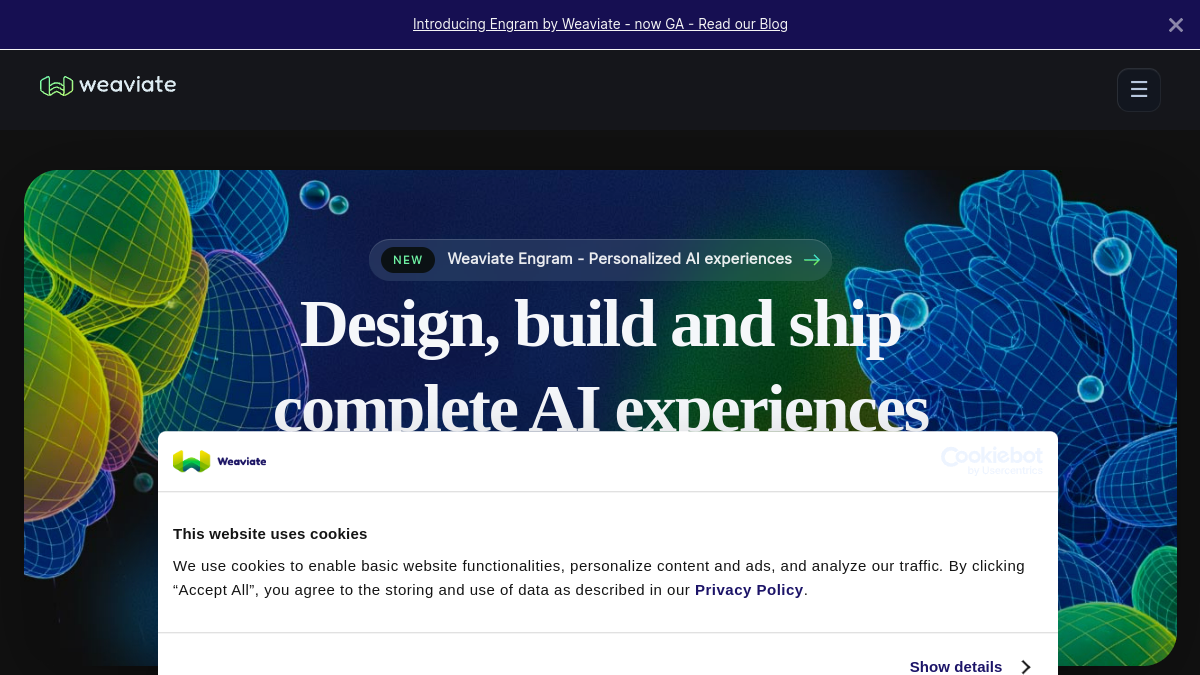
Weaviate is a beloved open-source vector database that unifies vector search, RAG and memory in one system, with AI-native features like built-in embeddings generation and a query agent. It scales to billions of vectors and handles multi-tenancy, high availability and enterprise security. Available as managed cloud or self-hosted, it's a superb pick when you want a production-ready, feature-rich AI database rather than just raw vector storage.
3. Qdrant — best performance and precision
Qdrant is a high-performance vector database written in Rust, prized for speed, memory efficiency (quantization cuts usage up to 64x) and precise filtering during search. It offers native hybrid search and real-time indexing, and it's open source with a managed cloud. For teams that care about raw performance and efficient scaling of RAG and semantic search, Qdrant is a standout.
4. Chroma — best for developer experience
Chroma is the open-source search infrastructure developers love for how gently it scales from local prototype to production. It handles vector, full-text, regex and metadata search in one serverless, zero-ops system with strong latency numbers. If you want to start experimenting on your laptop and grow smoothly into a serverless cloud, Chroma's DX is hard to beat.
5. LanceDB — best for multimodal and training data
LanceDB takes a broader angle as an 'AI-native multimodal lakehouse,' managing training data from raw files to features alongside vector, full-text and hybrid search. Built on the open-source Lance format, it scales to 100+ billion rows and supports dataset versioning and branching. For ML teams working with multimodal data (text, images, video) who need data management plus search, it's a distinctive choice.
6. Milvus — best for massive open-source scale
Milvus is a mature, open-source vector database built for massive scale, widely used in large production deployments. It's highly performant and battle-tested for billions of vectors, with a strong ecosystem. If you need proven open-source scale and don't mind more operational involvement, Milvus is a solid, established option.
Quick recommendations
- Simplest managed: Pinecone
- Best all-in-one AI database: Weaviate
- Best performance: Qdrant
- Best developer experience: Chroma
- Best for multimodal/training data: LanceDB
Frequently asked questions
What is the best vector database?
For a managed, zero-ops option, Pinecone is the default. For open-source, Weaviate (all-in-one AI features), Qdrant (performance) and Chroma (developer experience) are the top picks. The best choice depends on whether you prioritize convenience, performance, features or cost.
What is the best open-source vector database?
Weaviate, Qdrant, Chroma, LanceDB and Milvus are all open source and self-hostable. Qdrant leads on raw performance, Weaviate on all-in-one AI features, and Chroma on ease of getting started.
Do I need a vector database for RAG?
Effectively yes — RAG relies on retrieving relevant chunks via vector similarity, which is exactly what vector databases are built for. Any of these will serve a RAG pipeline well; some (like Weaviate) bundle RAG features directly.
Which vector database is cheapest?
Self-hosting an open-source option like Qdrant, Chroma or Weaviate avoids per-query pricing entirely, making them the most cost-effective at scale. Managed services trade higher cost for zero operational work.
What's the difference between a vector database and a search engine?
They increasingly overlap. Vector databases focus on semantic similarity search over embeddings; modern ones (and search engines like Meilisearch and Typesense) now offer hybrid search combining vectors with keyword and filter queries.
The bottom line
The best vector database depends on your priorities: reach for Pinecone for zero-ops convenience, Weaviate for all-in-one AI features, Qdrant for performance, Chroma for developer experience, and LanceDB for multimodal training data. Most are free to self-host, so prototype with your own data and pick the one that fits your stack.