The 5 Best Open-Source Authentication Tools in 2026
Authentication is too important — and too expensive at scale — to hand entirely to a closed service. Open-source auth tools let you own your users' data, self-host on your own infrastructure, and escape the per-user pricing that makes managed providers costly as you grow. Here are the five best in 2026, with who each one is for.
Why open-source auth?
Three big reasons: data ownership (your users' credentials stay on your infrastructure), cost (no per-MAU bill that balloons with success), and control (customize flows and inspect the code). The trade-off is that you take on more operational responsibility — though several of these also offer managed clouds if you want the best of both.
1. SuperTokens — best self-hosted control
SuperTokens is a leading open-source auth platform built around a self-hosted architecture, giving you full control over user data. It offers pre-built UI or customizable SDKs, supports email/password, passwordless and social login, integrates with 25+ frameworks, and includes SSO, multi-tenancy and account linking. It's a top pick for teams that specifically want to keep authentication on their own infrastructure as an Auth0 or Clerk alternative.
2. Logto — best developer experience and free tier
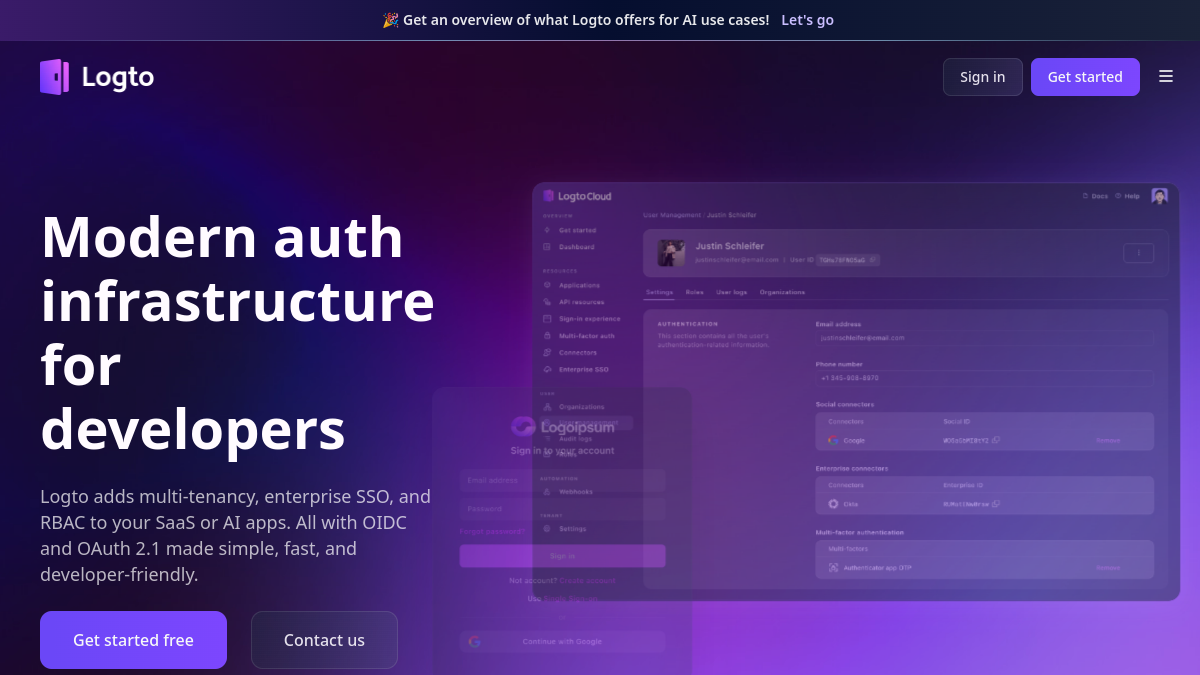
Logto is modern, open-source auth infrastructure with OAuth 2.1/OIDC, passwordless, social login, MFA and enterprise SSO, plus polished pre-built sign-in experiences. It's cloud-hosted or self-hosted, and its cloud includes a remarkably generous 50K monthly-active-user free tier. For a great developer experience with real cost savings, Logto is a standout.
3. Better Auth — best for TypeScript
Better Auth is a composable, plugin-based auth framework for TypeScript that lives inside your app with no vendor lock-in. It supports 35+ methods (social, passkeys, magic links, MFA), multi-tenancy and enterprise SSO/SAML, across Next.js, Nuxt, SvelteKit and 20+ frameworks. If you're building in TypeScript and want auth in your codebase, it's the community favorite.
4. Ory — best for enterprise scale
Ory is cloud-native, API-first, composable IAM that scales from consumer login to enterprise B2B (SAML, SCIM) and even machine identity for AI agents. Open-source and self-hostable with enterprise and managed options, and engineered for massive-scale performance, it's the pick when you need serious, composable identity infrastructure.
5. Keycloak — best battle-tested incumbent
Keycloak is the long-established, Red Hat-backed open-source identity and access management server, widely used in enterprises. It's extremely capable — SSO, social login, user federation, fine-grained authorization — and completely free and self-hostable. It's heavier and more Java-centric than the newer tools, but for organizations that want a proven, fully open IAM they can run themselves, it remains a rock-solid choice.
Quick recommendations
- Best self-hosted control: SuperTokens
- Best DX + free tier: Logto
- Best for TypeScript: Better Auth
- Best for enterprise: Ory
- Most battle-tested: Keycloak
Frequently asked questions
What is the best open-source authentication tool?
SuperTokens and Logto are the top picks for most teams — both self-hostable, with Logto adding a generous free cloud tier. Better Auth is best for TypeScript apps, Ory for enterprise scale, and Keycloak for a battle-tested incumbent.
Are these real alternatives to Auth0 and Clerk?
Yes. SuperTokens, Logto, Ory and Better Auth are frequently chosen as open-source alternatives to Auth0 and Clerk — see our Clerk alternatives and Auth0 alternatives roundups.
Is open-source auth secure?
Yes — mature open-source auth tools are widely audited and used in production by many companies. Open source can actually aid security since the code is inspectable, though you're responsible for keeping self-hosted deployments updated.
Which is cheapest at scale?
Self-hosting any of these avoids per-user pricing, so they're all far cheaper than managed per-MAU services at scale. Logto's cloud also offers 50K free monthly active users if you prefer managed.
Do I have to self-host?
No — SuperTokens, Logto and Ory all offer managed cloud options alongside self-hosting, so you can get open-source flexibility without running the infrastructure yourself if you'd rather not.
The bottom line
Open-source auth gives you ownership, control and better economics. Start with SuperTokens or Logto for most projects, reach for Better Auth in a TypeScript stack, Ory for enterprise, or Keycloak for a proven incumbent. All are free to self-host, so try one on a real app and keep the one that fits.