Hugging Face AI: The Complete Guide to AI Models, Transformers, and Open Source Machine Learning (2026)
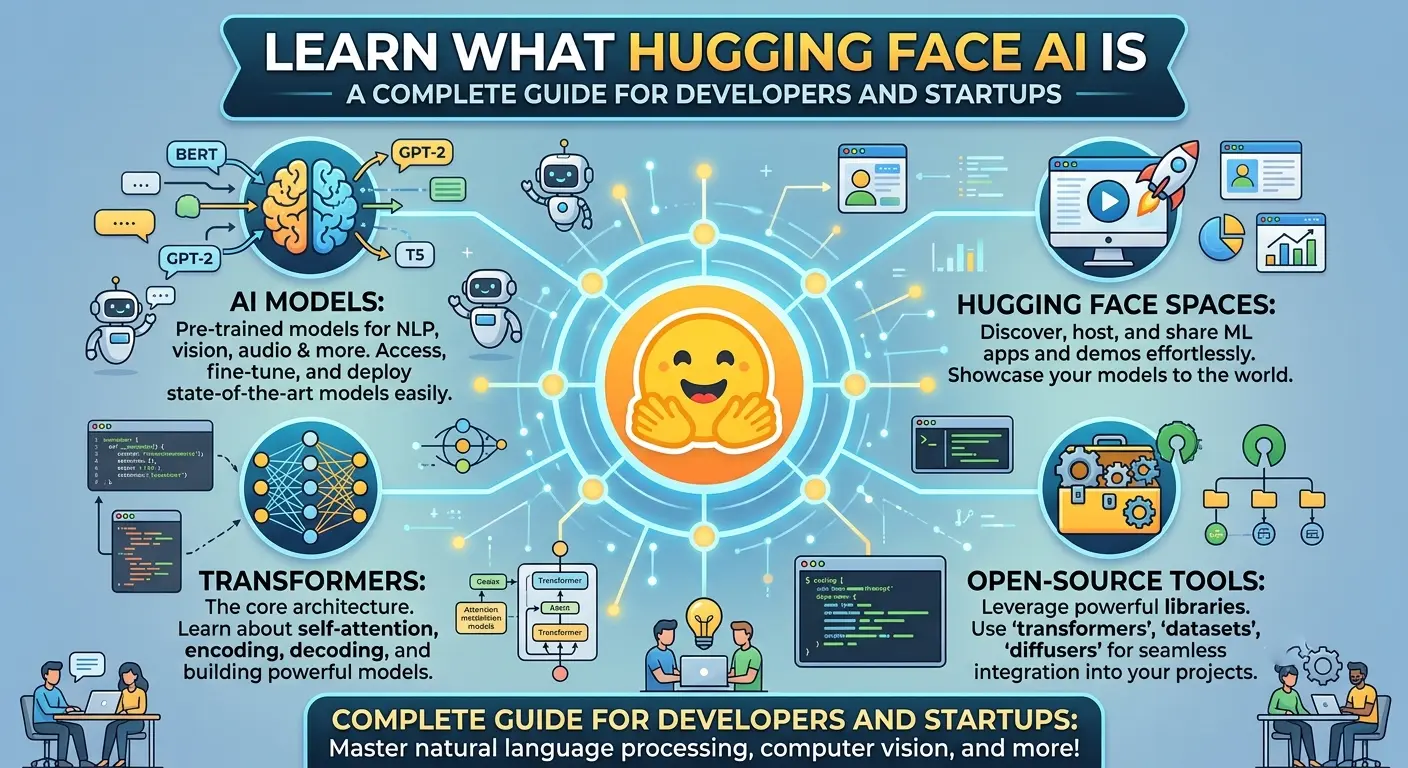
Hugging Face AI: The Complete Guide to AI Models, Transformers, and Open Source Artificial Intelligence
Introduction: Why Hugging Face AI Is Becoming the Backbone of Open Source Artificial Intelligence
Artificial intelligence is evolving faster than ever. In just a few years, AI has moved from being a technology used mainly by research laboratories into a powerful tool available to developers, startups, businesses, and everyday users.
Companies are now building AI-powered applications for almost every industry: customer support, healthcare, marketing, software development, education, finance, and productivity.
While companies like OpenAI, Google, and Anthropic have introduced powerful closed AI systems, another movement has been growing rapidly: open-source artificial intelligence.
At the center of this movement is Hugging Face AI.
Hugging Face has become one of the most important platforms in the AI ecosystem by providing developers and researchers with access to thousands of machine learning models, datasets, tools, and ready-to-use applications.
Today, Hugging Face is often described as the GitHub of artificial intelligence because it allows people to share, discover, modify, and deploy AI models.
For startups and developers, Hugging Face has changed the way AI products are created. Instead of spending millions of dollars training an AI model from scratch, companies can now use existing models, customize them, and build innovative applications much faster.
In this complete guide, we will explain:
What Hugging Face AI is
How Hugging Face works
What Hugging Face Transformers are
The most popular AI models available
How developers use Hugging Face
How startups can build products with Hugging Face AI
Hugging Face vs OpenAI and other AI platforms
The future of open-source AI
What Is Hugging Face AI?
Hugging Face AI is an artificial intelligence platform that provides tools, models, datasets, and infrastructure for building and deploying machine learning applications.
Founded in 2016, Hugging Face originally started as a company focused on conversational AI and chatbots. Over time, it transformed into one of the largest communities for open-source AI development.
The platform allows users to:
Upload AI models
Download and test existing models
Share datasets
Create AI applications
Deploy machine learning demos
Build custom AI solutions
The main idea behind Hugging Face is simple:
Make artificial intelligence accessible to everyone.
Instead of AI research being limited to large technology companies, Hugging Face allows independent developers, researchers, students, and startups to participate in AI development.
The Hugging Face ecosystem includes:
Model Hub – a marketplace and library of AI models
Transformers library – tools for working with modern AI models
Datasets library – access to training datasets
Spaces – a platform for hosting AI applications
Inference API – tools for running AI models without managing infrastructure
Together, these tools create a complete environment for building AI-powered products.
Why Is Hugging Face So Important in AI?
The biggest challenge in artificial intelligence is not only creating models but making them accessible and usable.
Training large AI models requires:
Massive computing power
Expensive GPUs
Large amounts of data
Expert machine learning teams
For many startups, this is impossible.
Hugging Face solves this problem by creating an ecosystem where developers can use existing models and focus on building products instead of rebuilding AI infrastructure.
For example:
A startup wants to create an AI customer support assistant.
Before platforms like Hugging Face, they might need:
A team of AI researchers
Millions of dollars in computing costs
Months of development
Today, they can:
Choose an existing language model from Hugging Face
Fine-tune it with their own company data
Connect it to their application
Launch an AI product much faster
This has accelerated the growth of thousands of AI startups.
How Does Hugging Face Work?
Hugging Face works as an ecosystem with several important components.
Let's explore each one.
1. Hugging Face Model Hub
The Hugging Face Model Hub is the largest collection of machine learning models available online.
Developers can search for models based on:
Language
Task
Size
License
Performance
Popularity
There are models for almost every AI task imaginable.
Examples include:
Natural Language Processing (NLP)
Models that understand and generate human language:
Text generation
Translation
Summarization
Question answering
Sentiment analysis
Example:
A company can use a language model to automatically summarize customer reviews.
Computer Vision
AI models that understand images and videos.
Examples:
Image classification
Object detection
Face recognition
Image generation
A retail company could use computer vision models to analyze product images automatically.
Speech AI
Models that work with audio.
Examples:
Speech recognition
Voice assistants
Audio translation
Text-to-speech
Applications include:
AI meeting assistants
Voice search
Automatic transcription tools
2. Hugging Face Transformers
One of the biggest reasons Hugging Face became famous is the Transformers library.
Transformers are a type of neural network architecture that changed artificial intelligence.
Before transformers, AI models struggled with understanding long sequences of information.
Transformers introduced a mechanism called attention, which allows models to understand relationships between different parts of data.
For example:
When reading a sentence, humans understand that words relate to each other.
Transformers allow AI models to do something similar.
This technology powers many modern AI systems, including:
Chatbots
Translation tools
AI writing assistants
Code generation systems
The Hugging Face Transformers library makes these models available to developers through simple programming interfaces.
A developer does not need to build the mathematics behind the model.
They can simply load an existing model and integrate it into their application.
Popular Hugging Face AI Models
The Hugging Face ecosystem contains thousands of models, but some have become especially popular.
Llama Models
Llama is a family of large language models developed by Meta.
They are widely used because they provide strong performance while being available for researchers and developers.
Common uses:
AI assistants
Chatbots
Content generation
Research projects
Mistral AI Models
Mistral models are known for providing strong performance with relatively smaller model sizes.
This makes them attractive for startups that want powerful AI without extremely high infrastructure costs.
Applications include:
Business assistants
Document analysis
AI search systems
BERT
BERT was one of the most influential language models in AI history.
Developed by Google, BERT helped improve how machines understand human language.
It is commonly used for:
Search optimization
Text classification
Sentiment analysis
Stable Diffusion
Stable Diffusion models focus on AI image generation.
Users can create images from text descriptions.
Applications include:
Marketing visuals
Product design
Creative content
Advertising
Whisper
Whisper is an AI speech recognition model originally developed by OpenAI.
It can convert spoken language into text and supports many languages.
Businesses use speech models for:
Transcription
Video subtitles
Voice applications
How Developers Use Hugging Face AI
For developers, Hugging Face has become one of the easiest ways to experiment with artificial intelligence and integrate AI features into applications.
Instead of building complex machine learning systems from zero, developers can use pre-trained models and focus on creating useful products.
Some of the most common developer use cases include:
Building AI Chatbots
One of the most popular applications of Hugging Face AI is creating intelligent chatbots.
Businesses use AI chatbots for:
Customer support
Internal knowledge assistants
Sales automation
FAQ answering
Personal productivity
A developer can combine:
A language model from Hugging Face
A company knowledge base
A search system
A user interface
to create a customized AI assistant.
For example:
A SaaS company could create an AI assistant that understands its documentation and automatically answers customer questions.
AI Content Generation
Generative AI has become one of the fastest-growing areas in technology.
Hugging Face models can help generate:
Blog articles
Product descriptions
Marketing copy
Social media posts
Email responses
Startups can use these capabilities to automate repetitive content tasks and improve productivity.
Text Analysis and Classification
Many businesses have thousands or millions of text documents that need analysis.
Hugging Face models can help with:
Customer feedback analysis
Review monitoring
Market research
Document classification
Spam detection
Example:
An e-commerce company can analyze thousands of customer reviews and automatically identify common complaints.
AI Search Systems
Modern search is moving beyond traditional keyword matching.
AI search systems understand meaning and context.
Using Hugging Face models, developers can create:
Semantic search engines
Document assistants
Internal company search tools
This technology is especially useful for companies with large amounts of information.
Hugging Face AI for Startups: Why Entrepreneurs Are Using It
For startups, artificial intelligence creates enormous opportunities.
However, building AI products can be expensive and technically challenging.
Hugging Face reduces many of these barriers.
Today, a small startup can create an AI-powered product with a much smaller team compared to previous years.
Faster MVP Development
One of the biggest advantages of Hugging Face is speed.
Startups can:
Find an existing AI model
Test it immediately
Customize it
Build an MVP
Validate their idea
This allows founders to experiment quickly without spending months developing infrastructure.
Lower Development Costs
Training a large AI model from scratch can cost millions of dollars.
Most startups do not need to do this.
Instead, they can use:
Open-source models
Fine-tuning
APIs
Existing AI infrastructure
This creates opportunities for smaller companies to compete with larger organizations.
Building AI SaaS Products
Hugging Face has helped accelerate the growth of AI SaaS.
Examples of AI SaaS products that can be built using open-source models:
AI Writing Assistants
Tools that help users create:
Articles
Emails
Reports
Marketing content
AI Customer Support Platforms
Software that automatically:
Answers questions
Categorizes tickets
Suggests responses
AI Document Analysis Tools
Applications that:
Read contracts
Analyze reports
Extract information
AI Productivity Tools
Examples:
Meeting summaries
Personal assistants
Research tools
For platforms like Tolodora, which focus on discovering and showcasing software products, Hugging Face represents an important part of the new AI startup ecosystem.
Many emerging AI startups are now built around open-source models, APIs, and developer tools rather than traditional software approaches.
What Are Hugging Face Spaces?
Hugging Face Spaces is a platform where developers can create and share AI applications.
It works similarly to hosting platforms where users can publish interactive demos.
A Space can be:
An AI image generator
A chatbot
A document analyzer
A voice assistant
An AI research demo
The advantage is that users can try AI applications directly in the browser without installing anything.
Why Hugging Face Spaces Matter
Spaces make AI experimentation accessible.
A developer can build a small AI application and share it with thousands of people.
For example:
A developer creates an AI logo generator.
Instead of building a complete website first, they can publish it as a Space and collect feedback.
This is especially useful for:
Indie hackers
Researchers
Startup founders
AI enthusiasts
Hugging Face AI vs OpenAI vs Google Gemini vs Anthropic
The AI industry has several major players.
Each platform has different strengths.
Hugging Face AI vs OpenAI
OpenAI focuses mainly on powerful closed AI systems such as ChatGPT and GPT models.
Hugging Face focuses more on open-source AI collaboration.
OpenAI advantages:
Very powerful models
Easy API access
Excellent user experience
Strong reasoning capabilities
Hugging Face advantages:
Thousands of open models
More customization options
Greater developer control
Ability to run models locally
For startups, the choice depends on the goal.
If a company needs a ready-to-use AI assistant, OpenAI may be easier.
If a company needs customization and control, Hugging Face can be better.
Hugging Face AI vs Google Gemini
Google develops Gemini, a family of advanced AI models.
Gemini benefits from Google's huge infrastructure and research capabilities.
Google Gemini strengths:
Multimodal AI
Integration with Google products
Large-scale infrastructure
Hugging Face strengths:
Open ecosystem
Community-driven development
Thousands of available models
Hugging Face AI vs Anthropic Claude
Anthropic created Claude, an AI assistant known for strong language understanding.
Claude is popular among:
Developers
Researchers
Businesses
Hugging Face provides more flexibility because developers can choose from many different models.
Is Hugging Face AI Free?
Yes, many Hugging Face resources are free.
Users can access:
Open-source models
Public datasets
Community projects
Some free Spaces
However, costs may appear when using:
Private models
Large-scale inference
Cloud computing resources
Premium infrastructure
For experimentation and learning, Hugging Face provides a very accessible starting point.
How to Start Using Hugging Face AI
Beginners can start with a few simple steps.
Step 1: Create a Hugging Face Account
Creating an account allows you to:
Save models
Create Spaces
Follow developers
Access tools
Step 2: Explore the Model Hub
Search for models based on your goal.
Examples:
Need text generation?
Search for language models.
Need image creation?
Search for image generation models.
Need audio processing?
Search speech models.
Step 3: Test AI Models
Many models include:
Examples
Documentation
Demo applications
You can test them before building anything.
Step 4: Integrate Models Into Your Application
Developers can use:
Python
JavaScript
APIs
to connect AI models with websites and software products.
The Future of Hugging Face AI and Open Source Artificial Intelligence
The future of artificial intelligence will likely include both closed and open AI systems.
Large companies will continue creating powerful models, but open-source AI will continue giving developers more freedom.
Hugging Face is positioned at the center of this movement.
Future developments may include:
Smaller AI models running on personal devices
More specialized AI assistants
AI agents for business automation
More private AI solutions
Industry-specific AI models
For startups, this means creating AI products will become easier and more affordable.
The next generation of successful software companies may not build AI models themselves.
Instead, they will combine existing AI technologies into unique products that solve real problems.
Frequently Asked Questions About Hugging Face AI
What is Hugging Face AI used for?
Hugging Face AI is used for creating and deploying machine learning applications, including chatbots, AI assistants, image generators, translation tools, and data analysis systems.
Is Hugging Face better than ChatGPT?
Hugging Face and ChatGPT serve different purposes.
ChatGPT provides a ready-to-use AI assistant.
Hugging Face provides access to thousands of AI models that developers can customize and integrate into applications.
Can businesses use Hugging Face AI?
Yes. Businesses use Hugging Face models for customer support, automation, document analysis, search systems, and AI-powered software products.
Do I need programming skills to use Hugging Face?
Not always.
Many models can be tested through browser-based demos.
However, programming knowledge is useful for building custom AI applications.
Why is Hugging Face important for startups?
Hugging Face helps startups reduce AI development costs, experiment faster, and build products using existing open-source technology.
Final Thoughts: Why Hugging Face AI Matters
Hugging Face has become one of the most influential platforms in the artificial intelligence revolution.
By making AI models, datasets, and tools accessible, it has allowed developers and startups around the world to participate in building the future of technology.
The biggest impact of Hugging Face is not only the technology itself.
It is the idea that artificial intelligence should be available to everyone.
For entrepreneurs, developers, and software creators, Hugging Face represents a new era where building AI-powered products is faster, cheaper, and more accessible than ever.
As AI continues transforming industries, platforms like Hugging Face will play a major role in shaping the next generation of software innovation.
Discover More AI & SaaS Products on Tolodora
Looking for the newest AI tools, SaaS platforms, and startup products?
Explore Tolodora — a growing discovery platform where founders, developers, and businesses find innovative software solutions.
Submit your product, discover emerging startups, and follow the future of technology.