Fathom vs Plausible: Which Privacy-First Analytics Should You Use? (2026)
If you've decided to ditch the complexity and privacy baggage of Google Analytics, two simple, privacy-first alternatives top almost everyone's list: Fathom Analytics and Plausible. They're so similar in philosophy that people genuinely struggle to choose between them. I've used both on real sites, so this is my honest Fathom vs Plausible comparison for 2026 — where they're nearly identical, where they quietly differ, and how I'd actually pick between two genuinely good tools.
The quick version
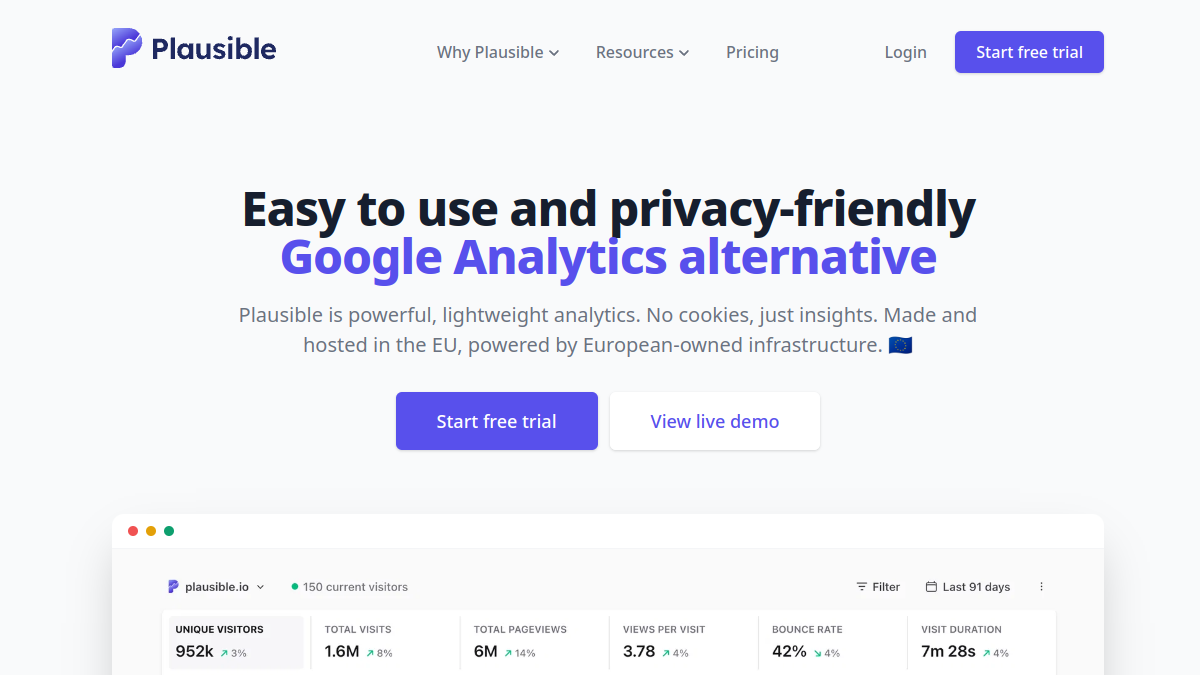
Short answer: Fathom and Plausible are both excellent, simple, privacy-first, cookieless analytics tools that do roughly the same thing extremely well, so you can't really go wrong with either. The differences are small: Plausible is open source and self-hostable, which appeals to the technically inclined and privacy purists; Fathom is a polished, fully-hosted product with some of its own niceties. If open source and self-hosting matter to you, lean Plausible. If you want a slightly more turnkey hosted experience, Fathom is great. For most people, it honestly comes down to small preferences and which dashboard you like more.
Why they're so similar
It helps to understand why this comparison is genuinely close. Both Fathom and Plausible were built on the same conviction: that Google Analytics is too complex, too invasive, and saddled with cookie-consent baggage, and that most sites just want simple, clear, privacy-respecting numbers. So both deliver a single, clean dashboard showing your key metrics — visitors, top pages, sources, devices, countries — at a glance. Both are cookieless and privacy-friendly, meaning you usually don't need a cookie consent banner. Both are lightweight, with tiny scripts that won't slow your site. They arrived at nearly the same product from the same philosophy, which is exactly why choosing between them is so hard and why you really can't make a bad choice here.
What they both do well
Both nail the core job. You get a beautiful, simple dashboard you can understand at a glance with no training — the antithesis of GA4's confusing maze. Both respect visitor privacy by not tracking personal data or using invasive cookies, so you generally avoid the cookie-banner hassle and stay on the friendlier side of privacy regulations. Both load fast thanks to lightweight scripts, which is good for performance and even indirectly for SEO. Both count visitors that ad blockers and consent-declines would hide from GA4, often giving a truer picture of real traffic. In short, both deliver exactly what privacy-first analytics promises: clean, honest, fast, respectful measurement. Whichever you pick, you get these benefits.
Where Plausible has the edge
Plausible's standout differentiator is that it's open source and self-hostable. If you want to run your analytics on your own server for complete data ownership and control — or you simply prefer supporting and using open-source software — Plausible offers that, and Fathom doesn't. This appeals strongly to developers, privacy purists, and organizations with strict data-residency needs. Being open source also means transparency (you can inspect exactly what it does) and the reassurance of a community-backed project rather than a single closed vendor. For the technically inclined and the open-source-minded, this alone can be the deciding factor. If self-hosting or open source matters to you at all, Plausible is the natural pick between these two.
Where Fathom has the edge
Fathom's strengths are in being a polished, fully-managed hosted product with its own thoughtful touches. It's known for an excellent, refined hosted experience, fast support, and features like easy management of multiple sites and email reports, all delivered without you ever thinking about infrastructure. Some people simply prefer its dashboard and the feel of its product. Because it's fully hosted and focused on that experience, there's nothing to maintain — you add the script and you're done. For those who want a turnkey, polished, well-supported analytics tool and don't care about self-hosting, Fathom is a delight. Its edge is in product polish and the smoothness of a fully-managed experience rather than in openness.
Pricing
Both are paid (with the key distinction that Plausible can be self-hosted for free if you handle the hosting yourself). Their hosted pricing is broadly comparable — both charge based on your monthly pageviews, with similar, reasonable tiers, and both are modestly priced for the value of clean, private analytics. There's no dramatic price gap that would decide it for most people; you should check the current tiers for your traffic level, but expect them to be in the same ballpark. The real pricing difference is philosophical: Plausible offers a free self-hosted route for those willing to run it themselves, while Fathom is hosted-only. If free self-hosting appeals, that's a Plausible advantage; if you'd pay for hosted either way, the cost is similar.
Accuracy and features
On accuracy, both are similar and both tend to beat GA4 for counting real traffic, since their cookieless, lightweight approach is blocked far less often than GA's scripts and isn't undermined by consent-declines. On features, both deliberately keep things simple — they're not trying to match GA4's depth, and that's the point. Each has its own small set of features (goals/events, UTM tracking, email reports, multiple-site management) with minor differences in specifics and presentation, but neither is dramatically more capable than the other for the simple analytics they're built for. If you need deep, GA4-level behavioral analysis, neither is your tool — but for clean, honest, privacy-first metrics, both deliver, with only small feature nuances separating them.
Which I'd pick for you
My recommendation: if open source or self-hosting matters to you even a little, choose Plausible — it's the one that offers that, and it's excellent. If you want a polished, fully-hosted, well-supported product and don't care about self-hosting, choose Fathom — it's equally excellent in its own way. Honestly, for most people the deciding factor is which dashboard and product feel you prefer, so I'd try both (each offers a way to test it) and go with the one you simply like more. You truly cannot make a bad choice here; both will give you clean, private analytics you'll actually understand and enjoy, which is a far better place to be than wrestling with GA4.
Either way, you win versus GA4
It's worth stepping back: the most important decision isn't Fathom versus Plausible, it's choosing either of them over the complexity and privacy baggage of Google Analytics. Both give you simplicity instead of confusion, privacy instead of invasive tracking, no cookie banner instead of consent friction, a faster site, and often more accurate traffic counts. Whichever you pick, you're getting analytics you'll actually look at and understand, while respecting your visitors. So don't agonize over the choice between two genuinely great tools — the real win is leaving GA4's maze behind. Pick whichever of these appeals more, and enjoy how much nicer web analytics can be when a tool is built for clarity and privacy.
The wider privacy-analytics field
Fathom and Plausible are the two most recommended privacy-first analytics tools, but they're not the only ones, and the broader field is worth knowing — privacy-friendly analytics has become a whole category rather than a single product. If you want open source and free (and you're happy to self-host), Umami is a popular, lightweight option that appeals to technical people who want privacy analytics without any subscription at all. Simple Analytics takes the same clean, privacy-first philosophy as Fathom and Plausible, so it's another close cousin worth a look. And if you eventually want privacy-friendliness but more depth — events, funnels, session insight, feature flags — PostHog is a far more powerful product-analytics platform that respects privacy more than Google Analytics while sitting closer to the powerful end of the spectrum.
The reason to mention these is that the choice isn't binary. If Fathom and Plausible feel like too little for your needs, PostHog offers depth without GA4's baggage; if their pricing doesn't suit you, Umami's free self-hosted route might. The encouraging story here is that escaping Google Analytics no longer means giving up good tooling — there's now a privacy-respecting analytics tool for nearly every need and budget, from the beautifully simple (Fathom, Plausible, Simple Analytics) to the free and self-hosted (Umami) to the genuinely powerful (PostHog). So while Fathom versus Plausible is the right question for most simple sites, it's worth knowing the neighbors in case your needs are a little different. For the great majority of people, though, I'd still start with Fathom or Plausible — they hit the sweet spot of simple, private, and pleasant, and you can always graduate to something more powerful later if you genuinely need it.
The honest caveats
For balance, it's worth being clear about what both Fathom and Plausible give up, because their simplicity is a deliberate trade-off. Neither offers anything close to Google Analytics' depth — if you need detailed funnels, granular behavioral analysis, sophisticated audience segmentation, or deep e-commerce tracking, these tools will leave you wanting, because that's simply not what they're built for. Both are also paid (Plausible's free route requires self-hosting), so unlike GA4 you're spending money, even if it's modest. And if you run Google Ads, neither integrates with it the way GA4 does, which is a real loss for ad-driven businesses. So the honest framing is that you're trading depth and ad integration for simplicity, privacy, speed, and a dashboard you'll actually understand. For most content sites, blogs, and small businesses, that's a wonderful trade — the depth of GA4 is overkill they never used anyway. But if you genuinely need heavy behavioral analysis or live in Google Ads, recognize that Fathom and Plausible, for all their charm, aren't trying to serve you, and a more powerful tool (or running one alongside) is the right call.
Frequently asked questions
Is Fathom or Plausible better? Both are excellent and very similar. Plausible is open source and self-hostable, ideal if those matter to you; Fathom is a polished, fully-hosted product some simply prefer. For most people it comes down to which dashboard you like more — you genuinely can't make a bad choice between them, since both are excellent, simple, and privacy-respecting alternatives to Google Analytics.
Are both Fathom and Plausible cookieless? Yes. Both are privacy-first and cookieless, so you generally don't need a cookie consent banner with either, and both avoid tracking personal data. That's a core shared advantage over Google Analytics, which typically requires a consent banner due to the personal data it collects, adding friction for your visitors.
Can I self-host Fathom or Plausible? Plausible is open source and can be self-hosted for free (you handle the hosting); Fathom is hosted-only. So if self-hosting or open source is important to you at all, Plausible is clearly the one to choose between the two.
Are they more accurate than Google Analytics? Often, yes. Their cookieless, lightweight scripts are blocked far less than GA's, and they aren't undermined by visitors declining a consent banner, so they frequently count real traffic that GA4 misses — giving a truer picture for many sites. It surprises people that the "simpler" tool can actually report more accurate visitor numbers, but for typical content sites that's often exactly what happens.
The bottom line
Fathom vs Plausible is a close contest between two genuinely excellent privacy-first analytics tools that do the same thing beautifully. The main difference: Plausible is open source and self-hostable, while Fathom is a polished, fully-hosted product. Pricing and capability are broadly similar, so for most people the choice comes down to whether open source matters (pick Plausible) or you want pure hosted polish (pick Fathom) — and otherwise, simply which dashboard you prefer. The real win is choosing either over Google Analytics. Try both, pick the one you like, and enjoy analytics that are finally simple and private. Whichever you land on, you'll likely wonder why you put up with Google Analytics' clutter and cookie banners for so long — and your visitors, spared the tracking and the consent pop-up, will quietly thank you too.
Built an analytics or privacy tool? List it on Tolodora — get discovered by the people comparing options, earn a backlink that boosts your SEO, and collect real reviews from day one.