Plausible vs Google Analytics: Why I'd Choose Privacy-First Analytics in 2026
Every website needs to know what's working — which pages get traffic, where visitors come from, what they do. For two decades the default answer was Google Analytics, and now GA4. But a wave of privacy-first alternatives, led by Plausible, has people rethinking that default. I've run both on real sites, so this is my honest Plausible vs Google Analytics comparison for 2026 — what each does well, the real trade-offs, and why, for most sites, I lean toward the simpler, privacy-first option.
The quick version
Short answer: Google Analytics (GA4) is powerful, free, and deeply integrated with Google's ecosystem, but it's complex, privacy-invasive, and often requires cookie consent banners. Plausible is simple, privacy-friendly, lightweight, and usually needs no cookie banner — but it's paid and far less feature-deep. If you want exhaustive data, advanced segmentation, and ad-platform integration, GA4 wins. If you want clean, instantly-understandable analytics that respect privacy and load fast, Plausible wins. For most content sites and small businesses, I think Plausible is the better fit — but it genuinely depends on what you need.
What Google Analytics does well
Let's be fair to the incumbent. GA4 is extraordinarily powerful and it's free, which is a huge combination. It tracks an enormous amount — detailed user behavior, events, conversions, funnels, audiences — and integrates tightly with Google Ads and the rest of Google's marketing stack, which is invaluable if you run ads. It can answer almost any question about your traffic if you know how to ask, and there's a vast ecosystem of knowledge and tooling around it. For data-hungry marketers, e-commerce operations doing serious conversion analysis, or anyone deeply invested in Google Ads, GA4's depth and integration are genuinely hard to replace. When you need to slice your data a hundred ways, it's the tool that can.
What drives people away from GA4
So why are people leaving? A few reasons, and I feel all of them. First, complexity: GA4 is notoriously confusing, with a steep learning curve and an interface many find unintuitive — even experienced users get lost. Second, privacy: GA4 collects a lot of personal data and feeds Google's ecosystem, which raises real privacy and regulatory concerns, especially under laws like GDPR. Third, cookies and consent: because of that data collection, you typically need a cookie consent banner, which adds friction and annoyance for visitors. Fourth, it's heavy. And fifth, much of its depth is overkill for ordinary sites that just want to know what's working. For a lot of people, GA4 is more complexity and privacy baggage than they signed up for.
What Plausible does well
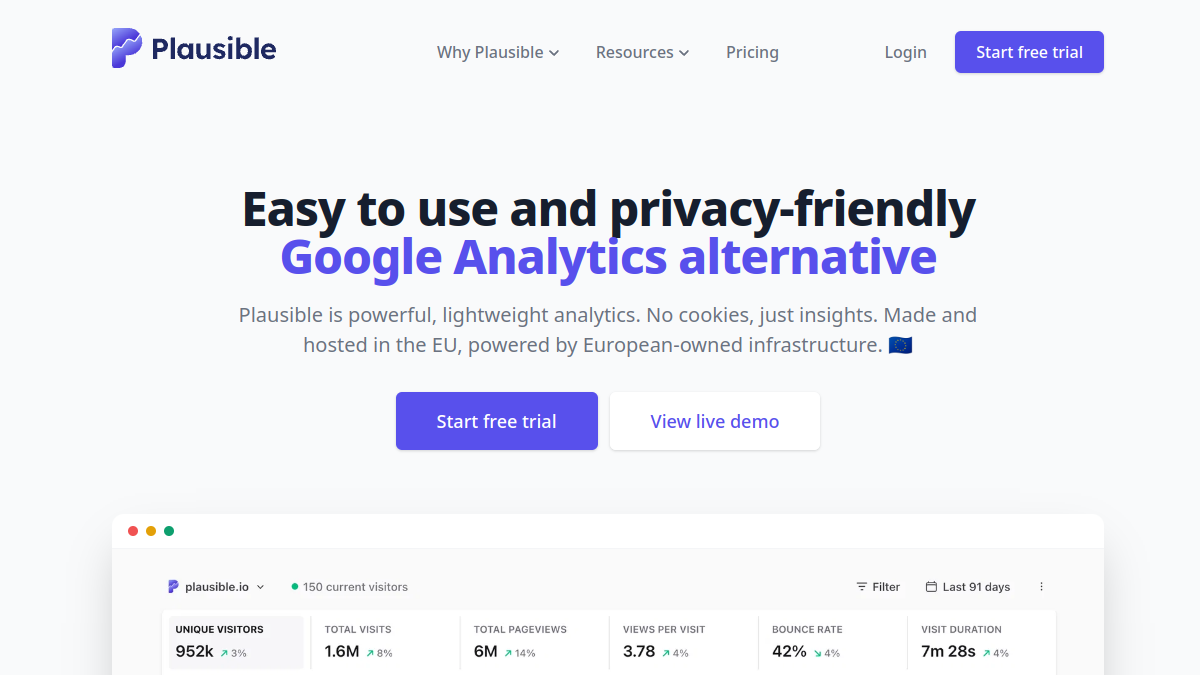
Plausible's whole philosophy is the opposite, and it's refreshing. It's radically simple — a single, clean dashboard that shows you what matters (visitors, top pages, sources, devices, countries) at a glance, with no learning curve. It's privacy-friendly by design: it doesn't track personal data or use cookies the way GA4 does, which means you usually don't need a cookie consent banner at all — a genuine relief. It's lightweight, so the tracking script is tiny and won't slow your site down (which even helps performance and, indirectly, SEO). And it's open source, with a self-hosting option for full data ownership. For anyone who just wants clear, honest analytics without the bloat or the privacy headaches, Plausible is a joy.
The privacy and cookie-banner difference
This is the difference that tips it for many people, including me. Because Plausible is built to avoid collecting personal data and to work without invasive cookies, you can generally run it without a cookie consent banner — which means a cleaner experience for visitors and far less compliance worry. GA4, by contrast, typically requires that consent banner and careful configuration to stay on the right side of privacy regulations, and even then it's collecting data many visitors would rather you didn't. If respecting your visitors' privacy matters to you — ethically, or just to avoid the legal and UX baggage of consent banners — Plausible's approach is a real, tangible advantage, not just a talking point.
The accuracy angle people overlook
Here's something subtle but important: privacy-first analytics can actually be more accurate for many sites. GA4 relies on cookies and scripts that ad blockers and privacy tools increasingly block, plus visitors who decline the consent banner simply aren't counted — so a meaningful chunk of your traffic can go missing from GA4's reports. Plausible's cookieless, lightweight approach is blocked far less often and counts visitors who'd be invisible to GA4. So the "less data" tool can paradoxically give you a truer picture of your real traffic. It won't give you the deep behavioral detail GA4 can, but for the basic question of "how many people actually visited and from where," it's often closer to reality than people expect.
Where GA4 still wins
I don't want to oversell Plausible, because GA4 genuinely wins in real scenarios. If you run Google Ads, GA4's integration is hugely valuable for understanding and optimizing campaigns — Plausible can't match that. If you need deep, granular behavioral analysis, complex funnels, detailed e-commerce tracking, or sophisticated audience segmentation, GA4's depth is in another league. And it's free, which matters if budget is tight and you're willing to trade money for the complexity and privacy cost. For data-heavy operations and ad-driven businesses, GA4 remains the more capable tool, and the honest answer is that Plausible would leave them wanting. Simplicity is a feature, but so is depth when you genuinely need it.
Cost: free vs paid (and what "free" costs)
The obvious difference is price: GA4 is free, Plausible is paid (with a self-hosting option if you'd rather invest effort than money). But "free" deserves scrutiny. GA4's cost isn't dollars — it's the complexity you absorb, the privacy data you hand to Google, the cookie banner you inflict on visitors, and the time spent wrestling with its interface. Plausible's modest subscription buys simplicity, privacy, and time saved. For a business, the few dollars a month Plausible costs is trivial against the value of clean analytics you actually understand and use, without compliance worry. So while GA4 wins on raw price, I'd argue Plausible often wins on true cost once you account for everything "free" really entails.
Can you run both?
Yes — and honestly, plenty of people do, including setups I've run. You can keep GA4 for its depth and ad integration while using Plausible as your everyday, glance-at-it dashboard and for the privacy-friendly numbers. The downside is double the scripts and setup, and it slightly undercuts the privacy and performance benefits of going Plausible-only. But if you're not ready to fully leave GA4's depth behind yet want Plausible's clean daily view, running both is a reasonable transition. Many people start this way and eventually drop GA4 once they realize Plausible answers nearly every question they actually ask day to day.
Which I'd choose for you
My recommendation: for most content sites, blogs, small businesses, and anyone who values simplicity and privacy, I'd choose Plausible — it gives you the answers you actually need, respects your visitors, loads fast, and skips the cookie-banner hassle. Choose GA4 if you run Google Ads and need that integration, require deep behavioral and e-commerce analysis, or simply can't justify any subscription and are fine absorbing the complexity and privacy trade-offs. Personally, for most of what I build, Plausible's clarity and privacy win — I'd rather have clean numbers I understand and a happier relationship with my visitors than a powerful tool I half-use and a consent banner I resent.
What about the other privacy-first analytics?
Plausible isn't the only privacy-friendly option, and it's worth knowing the landscape so you choose deliberately. Fathom Analytics is a close cousin — simple, privacy-first, cookieless, and similarly priced — and the choice between it and Plausible often comes down to small preferences in dashboard and feature details. Simple Analytics takes the same philosophy. Umami is open source and free if you self-host, which appeals to technical people who want privacy analytics without a subscription. And if you want privacy-friendliness but more depth — events, funnels, session insight — PostHog is a more powerful product analytics tool that sits further toward the GA4 end of the spectrum while still respecting privacy more than GA does. The point is that "privacy-first analytics" is now a whole category, not a single product, so if Plausible's simplicity feels like too little or its pricing doesn't fit, there's likely a neighbor that does. I happen to like Plausible's clean simplicity, but any of these is a far cry from GA4's complexity and cookie baggage.
Switching from GA4: what to expect
If you're thinking of moving, a realistic picture helps. The good news is that adding Plausible is trivial — it's a single lightweight script, and you can have it running in minutes alongside GA4 to compare. Expect the visitor numbers to differ: Plausible will often show numbers that feel different from GA4, partly because it counts people GA4 misses (blocked scripts, declined consent) and partly because the two measure and define things slightly differently. Don't panic at the discrepancy — neither is "lying," they're just counting differently, and Plausible's figure is frequently closer to your true traffic. You'll also notice how much faster you understand your own data; the single clean dashboard means you actually look at it, instead of opening GA4, feeling overwhelmed, and closing it again. After running both for a few weeks, most people find Plausible answers nearly every question they actually ask, at which point dropping GA4 (unless you need it for ads) feels easy rather than scary. Give yourself that overlap period and let the comparison make the decision for you.
Frequently asked questions
Is Plausible better than Google Analytics? For most content sites and small businesses that value simplicity and privacy, I'd say yes — it's clearer, faster, privacy-friendly, and usually needs no cookie banner. But GA4 wins if you run Google Ads or need deep behavioral and e-commerce analysis. It depends on your needs, but for the typical blog or business site that just wants to know what's working, I'd reach for Plausible every time.
Do I need a cookie banner with Plausible? Generally no. Plausible is designed to avoid collecting personal data and invasive cookies, so most sites can run it without a cookie consent banner — a real advantage over GA4, which typically requires one due to the personal data it collects. Always confirm against your own legal requirements, but for most sites Plausible removes the cookie-banner headache entirely.
Is Plausible worth paying for when GA4 is free? For many sites, yes. GA4's "free" comes with complexity, privacy trade-offs, and a cookie banner. Plausible's modest fee buys simplicity, privacy, faster loading, and analytics you'll actually understand and use — which is often worth far more than the small cost.
Can I use Plausible and Google Analytics together? Yes. Many people run GA4 for its depth and ad integration while using Plausible for clean, privacy-friendly daily numbers. The trade-off is more scripts and setup, but it's a common transition step before some eventually drop GA4 entirely once they see Plausible answers their everyday questions.
The bottom line
Plausible and Google Analytics represent two philosophies: GA4 is powerful, free, and complex, with real privacy and cookie baggage; Plausible is simple, privacy-first, lightweight, and paid. If you live in Google Ads or need deep behavioral analysis, GA4's depth wins. For most content sites and small businesses, though, I'd choose Plausible — clean analytics you actually understand, respect for your visitors' privacy, no cookie banner, and a faster site. Decide based on whether you need GA4's depth or Plausible's clarity, and don't underestimate how much the privacy and simplicity are worth. My honest nudge: if you're not actively living in Google Ads, try Plausible for a few weeks alongside GA4 — I think you'll be surprised how rarely you miss GA4's complexity, and how much nicer it is to open a dashboard you actually understand.
Built an analytics or privacy tool? List it on Tolodora — get discovered by the people comparing options, earn a backlink that boosts your SEO, and collect real reviews from day one.