Plausible vs Google Analytics (2026): Which Should You Use?
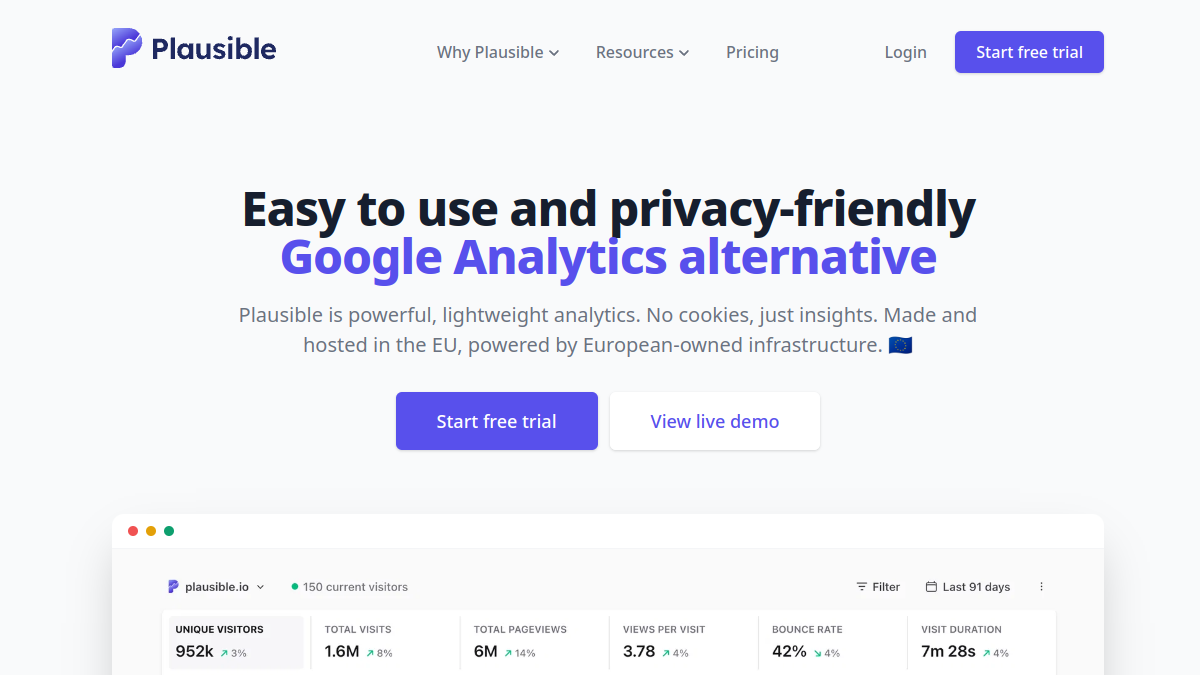
Since Google forced everyone onto GA4, a lot of site owners have been quietly asking the same question: is there something simpler? Plausible is the most popular answer. Here's an honest Plausible vs Google Analytics comparison for 2026, so you can decide which actually fits your site.
The quick answer
Choose Plausible if you want simple, private, cookie-free analytics and mostly care about traffic, sources, and top pages. Choose Google Analytics (GA4) if you need deep, free analytics — especially e-commerce funnels and Google Ads attribution — and you're willing to deal with its complexity and privacy overhead. For most blogs, small businesses, and content sites, Plausible is the better day-to-day tool; for data-heavy e-commerce and ad-driven sites, GA4's depth (and price of zero) is hard to give up.
What is Plausible?
Plausible is a lightweight, privacy-first web analytics tool. It's open-source, EU-hosted, and cookieless, showing your key metrics — visitors, sources, pages, countries, and goals — on a single, readable dashboard. Because it doesn't use cookies or collect personal data, you can usually run it without a cookie-consent banner. It's paid (from a low monthly fee), or you can self-host the open-source version for free.
What is Google Analytics (GA4)?
Google Analytics 4 is Google's free, powerful analytics platform. It offers deep, event-based tracking, audience insights, funnels, and tight integration with Google Ads and the wider Google ecosystem. It's incredibly capable — and free — but it's also famously complex, uses cookies (triggering consent requirements in many regions), samples data, and raises GDPR concerns in the EU.
Head-to-head
Ease of use
Plausible wins by a mile. Its entire dashboard fits on one screen and anyone can read it in seconds. GA4's interface is powerful but notoriously confusing, with a steep learning curve even for experienced marketers.
Privacy and cookies
Plausible wins. It's cookieless and doesn't collect personal data, so in most jurisdictions you can drop the cookie banner and avoid GDPR headaches. GA4 uses cookies and processes data through Google, which requires consent management and has faced regulatory scrutiny in Europe.
Depth of features
GA4 wins. It offers far more: detailed event tracking, custom funnels, audience segmentation, e-commerce reporting, and Google Ads attribution. Plausible deliberately keeps things simple, so if you need deep analysis, GA4 has it.
Data accuracy
Plausible has an edge for many sites: because it's cookieless and not blocked by as many ad blockers or consent rejections, it often counts more of your actual visitors. GA4 can undercount due to blockers and consent, and it samples data at scale.
Price
GA4 wins on sticker price — it's free. Plausible is paid (or free if you self-host). But "free" GA4 has hidden costs in setup complexity, consent management, and time. For many, Plausible's small fee buys back hours and peace of mind.
Performance
Plausible wins: its tracking script is tiny (under 1 KB), versus GA4's much heavier footprint, so it has less impact on page speed.
Which should you choose?
- Choose Plausible if you run a blog, content site, or small business, value simplicity and privacy, and want to ditch the cookie banner.
- Choose GA4 if you need advanced e-commerce tracking, Google Ads attribution, or deep custom analysis — and don't mind the complexity.
- Use both if you want GA4's depth for occasional deep dives but Plausible as your everyday, readable dashboard.
Plausible is just one option — there are other great privacy-first tools too. See our full guide to the best Google Analytics alternatives, including free ones like Matomo and Umami.
Frequently asked questions
Is Plausible better than Google Analytics?
For simplicity, privacy, and everyday traffic reporting, yes. For advanced analysis, e-commerce funnels, and Google Ads integration, GA4 is more powerful. It depends on what you need.
Do I need a cookie banner with Plausible?
Usually not. Plausible is cookieless and doesn't collect personal data, so in most jurisdictions you can run it without a consent banner — a key advantage over GA4.
Is Plausible worth paying for when GA4 is free?
For many site owners, yes: Plausible saves hours of setup and confusion, avoids consent-banner friction, and gives cleaner data. If budget is tight, you can self-host Plausible for free or use another free tool like Matomo.
The bottom line
Plausible vs Google Analytics is really simple-and-private vs powerful-and-free. If you mostly want to know how many people visit and where they come from — without cookie banners or a data-science degree — Plausible is the better tool. If you need deep, free analytics for e-commerce or ads, GA4 still wins. Match the tool to how deep you actually go.