How to Validate a Product Idea Before You Build It
How to Validate a Product Idea Before You Build It
Building a digital product has never been easier.
With artificial intelligence, no-code platforms, cloud services, and modern development tools, founders can turn an idea into a prototype in a matter of days—or sometimes hours.
But there is an important question that many founders forget to ask:
Should you build the product in the first place?
A product can be technically impressive and still fail to attract customers. You can spend months developing features, designing a beautiful interface, and preparing a launch, only to discover that the problem isn't painful enough, the market is too small, or customers already have better alternatives.
This is why product validation should happen before serious development begins.
Product validation is the process of collecting evidence to determine whether a product idea solves a meaningful problem for a specific group of people and has enough potential to justify further investment.
The goal isn't to predict the future with absolute certainty. No framework can guarantee that a startup will succeed.
The goal is much simpler:
Reduce uncertainty before you invest significant time and money.
Why Product Validation Matters
One of the biggest mistakes founders make is falling in love with their solution before understanding the problem.
An idea can feel exciting because it is technically interesting or because new technology makes it possible. But excitement from the founder is not evidence of market demand.
A better approach is to start with the customer.
Ask:
What problem are they experiencing?
How frequently does it happen?
How painful is the problem?
What are they doing about it today?
Are they already spending money or time to solve it?
What would make them switch to a different solution?
If people already spend money, time, or effort trying to solve a problem, that's an important signal.
If nobody cares about the problem, adding more features probably won't fix it.
1. Define the Problem Before the Solution
Before building anything, write down the problem in simple language.
Avoid starting with:
“I want to build an AI platform that helps users do X.”
Instead, describe the customer's situation:
“People in this specific situation struggle with X, which causes Y and costs them Z.”
This difference is important.
A feature describes what your product does. A problem describes why someone might need it.
For example, imagine an entrepreneur wants to create an AI tool for startup founders.
The feature might be:
“An AI tool that analyzes startup ideas.”
The underlying problem could be:
“Early-stage founders struggle to determine whether an idea has enough market potential before spending weeks building it.”
The second statement gives you something you can actually validate.
You can investigate whether founders experience this problem, how they currently solve it, and whether they would pay for a better process.
2. Identify a Specific Customer
Another common mistake is trying to build for everyone.
“Entrepreneurs” is a broad audience.
“People interested in technology” is even broader.
A strong validation process starts with a specific customer profile.
For example:
Indie hackers launching their first SaaS
Solo founders building AI products
Freelancers turning services into software
Small businesses looking for automation
Startup founders validating a new business idea
A specific audience makes research much easier.
You can find these people in online communities, professional networks, forums, social media, newsletters, and existing product communities.
You can then study their questions, frustrations, workflows, and purchasing behavior.
The objective isn't to guess what customers want.
The objective is to observe what they already do.
3. Research Real Market Signals
Market research is one of the most valuable parts of product validation.
Fortunately, AI can make this process much faster.
You can use AI to organize information, summarize customer feedback, identify recurring complaints, compare competitors, generate research questions, and discover patterns across large amounts of information.
However, AI should be treated as a research assistant—not as proof that your idea will succeed.
Real market signals are more valuable.
Look at:
Customer reviews
Reddit discussions
Product Hunt conversations
Competitor reviews
Online communities
Search behavior
Existing products
Customer complaints
Feature requests
Pricing pages
Job postings
Industry reports
Look for repeated evidence.
If dozens of people independently describe the same frustration, that is much more meaningful than a single positive comment.
4. Analyze Existing Alternatives
Before launching a new product, understand what customers already use.
Your competitors aren't necessarily just companies offering exactly the same product.
An alternative could be:
A competing SaaS
A spreadsheet
A Notion template
A manual process
An agency
A freelancer
An internal company workflow
Doing nothing
This last point is particularly important.
If customers don't consider their problem important enough to solve, your biggest competitor may simply be the status quo.
Study existing solutions and ask:
What do customers like about them?
What do customers dislike?
What features are missing?
What is too expensive?
What is too complicated?
Which customer segment is underserved?
This research can help you discover a market gap.
You don't always need a completely original idea. Sometimes you simply need a better solution for a specific customer.
5. Find Your Differentiation
Once you understand the market, determine why someone would choose your product.
Your differentiation could come from:
A simpler workflow
A lower price
Better user experience
Faster results
A specific niche
Better integrations
Better support
A unique methodology
Better automation
A more focused customer experience
Be careful with vague claims such as “better,” “smarter,” or “more powerful.”
Good positioning explains exactly why the product is different and who it is different for.
For example:
Instead of:
“The best AI validation tool.”
You could position the product as:
“A 60-minute validation sprint for founders who want evidence before building their next SaaS or AI product.”
The second message immediately communicates the audience, use case, and outcome.
6. Test the Offer Before Building Everything
You don't need a complete product to test whether people are interested.
You can test an offer with:
A landing page
A waitlist
A pre-order
Direct outreach
Customer interviews
A small paid experiment
A community post
A prototype
A simple demo
The key is to measure behavior.
There is a big difference between:
“That sounds interesting.”
and:
“I want to try it.”
There is an even bigger difference between:
“I want to try it.”
and:
“Here is my payment.”
The stronger the commitment required from the customer, the stronger the validation signal can be.
This doesn't mean every founder needs to sell a product before building it.
It means you should actively look for evidence instead of relying entirely on opinions.
7. Use AI Without Losing Critical Thinking
AI is extremely useful for product validation.
It can help you brainstorm customer segments, create research questions, analyze reviews, summarize competitor positioning, identify recurring themes, generate interview scripts, and structure your findings.
But there is a danger.
If you ask an AI:
“Is my startup idea good?”
you may receive an intelligent-sounding answer that confirms your assumptions.
That isn't validation.
A better approach is to ask AI to challenge your idea.
For example:
What assumptions must be true for this idea to succeed?
What evidence would prove this idea is weak?
What are the strongest alternatives?
Why might customers refuse to pay?
Which customer segment has the strongest pain?
What would make this product unnecessary?
What competitors already solve this problem?
AI becomes much more useful when it helps you challenge your assumptions rather than confirm them.
8. Score the Opportunity
After researching the problem, customer, market, competition, and offer, it helps to score your idea.
You can evaluate factors such as:
Market Demand
Is there evidence that people actively want a solution?
Problem Severity
How painful is the problem?
Customer Access
Can you realistically reach the people who experience it?
Competition
Are existing alternatives strong, weak, expensive, or difficult to use?
Differentiation
Do you have a meaningful reason for customers to choose you?
Willingness to Pay
Is the problem valuable enough that customers might spend money to solve it?
Execution Difficulty
Can you realistically build and operate the product?
A scoring system doesn't magically make the decision objective, but it forces you to examine the idea from multiple perspectives.
9. Decide: Build, Modify, or Kill
At the end of the validation process, you need to make a decision.
There are three useful outcomes.
BUILD
The evidence is strong enough to justify moving forward.
You have identified a meaningful problem, a reachable customer, a potential market, and a reasonable opportunity.
MODIFY
The problem appears interesting, but something needs to change.
Maybe the target customer is wrong.
Maybe the positioning isn't clear.
Maybe the market is smaller than expected.
Maybe the product needs a different business model.
Modification isn't failure. It is often the natural result of good validation.
KILL
The evidence isn't strong enough to justify further investment.
This can be difficult emotionally, especially when you are attached to the idea.
But discovering a weak opportunity before spending six months building it can be a major success.
The purpose of validation isn't to prove that every idea is good.
It's to find out which ideas deserve your time.
A Practical Product Validation Sprint
A structured validation process can make this entire exercise much easier.
Instead of randomly browsing competitors, asking AI questions, and collecting notes across different documents, you can follow a repeatable framework.
A practical validation sprint can cover:
The validation mindset
Problem definition
Customer identification
AI-powered market research
Market-gap analysis
Idea scoring
Offer testing
AI research prompts
Build / Modify / Kill decision
A concrete action plan
The advantage of a structured process is that it turns a vague idea into a series of questions that can actually be investigated.
You don't need to spend weeks trying to become a market research expert.
You need a focused process that helps you find the most important evidence quickly.
Validate Before You Build
The best product ideas are not necessarily the most innovative.
They are often the ideas connected to a real problem, a specific customer, and a market willing to pay for a solution.
Technology can help you build faster.
AI can help you research faster.
But neither can replace good judgment.
Before you invest weeks or months into your next SaaS, AI tool, digital product, or startup, take the time to validate the opportunity.
Don't build what you hope people want. Validate what they actually need.
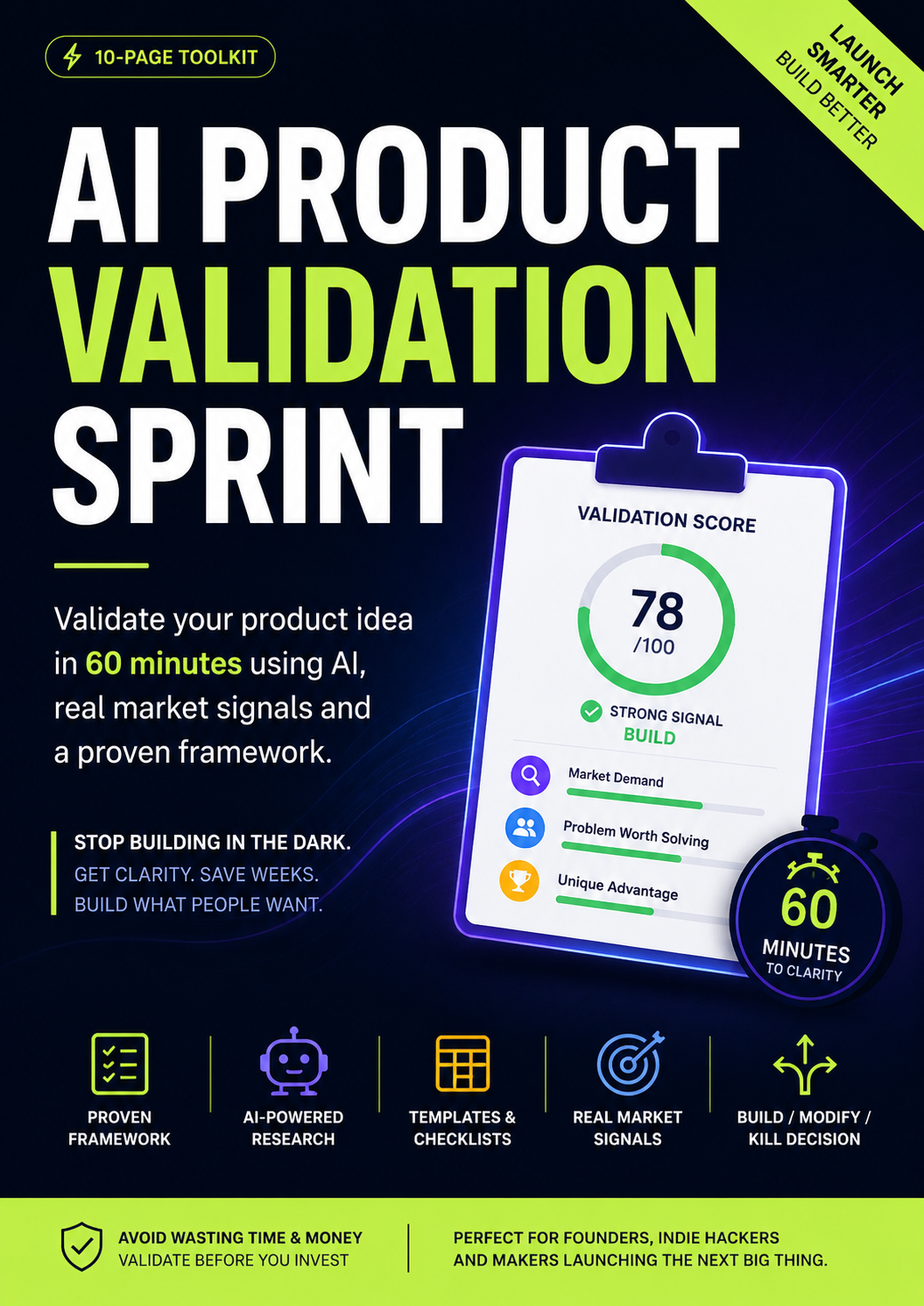
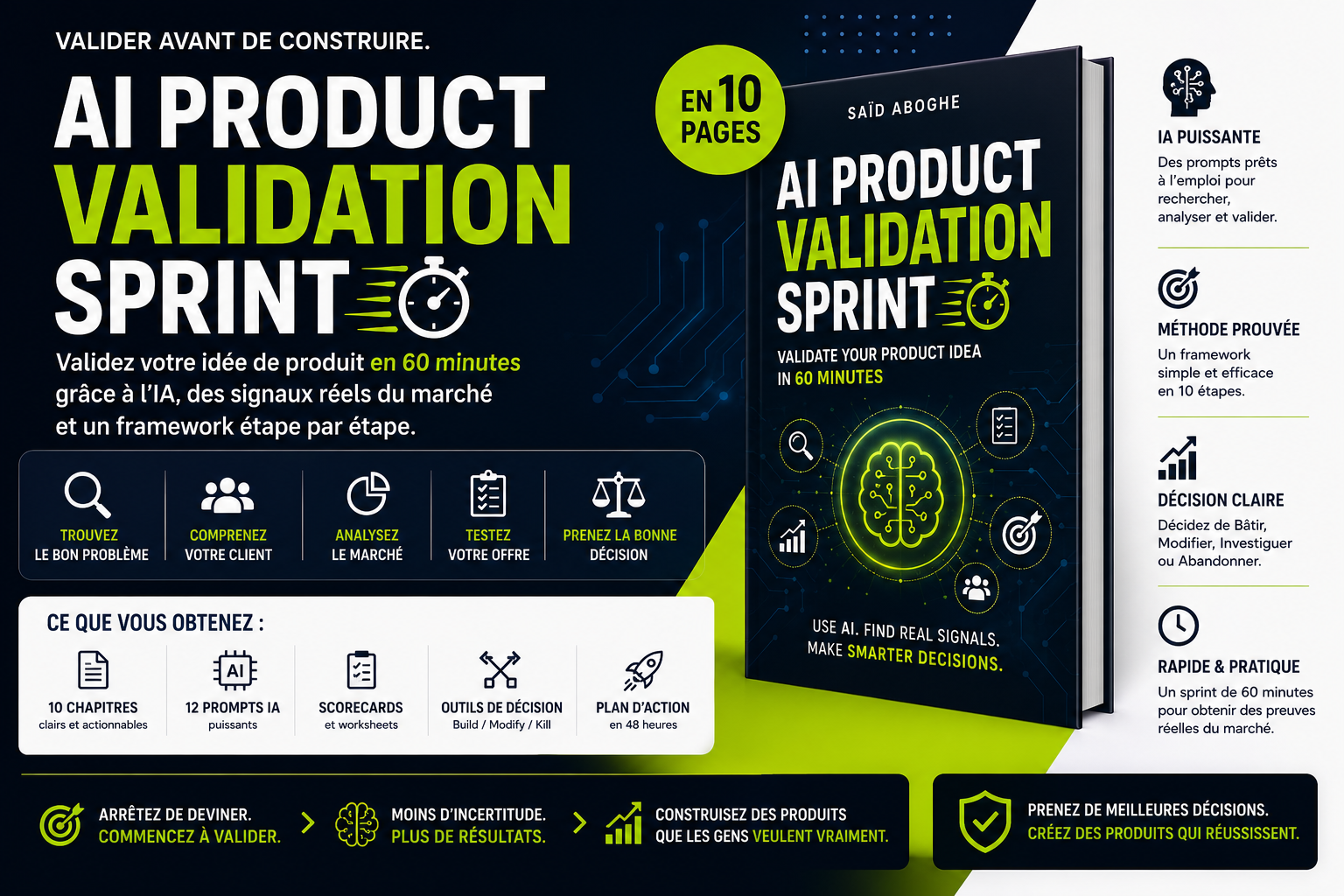
The AI Product Validation Sprint was created for founders, indie hackers, and makers who want a practical way to investigate an idea before committing significant resources.
The 10-page toolkit combines AI research prompts, customer problem analysis, market-gap checklists, validation scorecards, offer testing tools, and a Build / Modify / Kill decision framework.
It is designed to help you move from:
Idea → Problem → Customer → Market → Evidence → Decision
The objective isn't perfect certainty.
It's better evidence, less uncertainty, and smarter product decisions.
Before you build your next product, validate the opportunity first.