The Best Langfuse Alternatives in 2026 (LLM Observability)
Tolodora Editorial Team
Tolodora's editorial team — we research, compile and regularly update these software guides from public sources and product documentation.
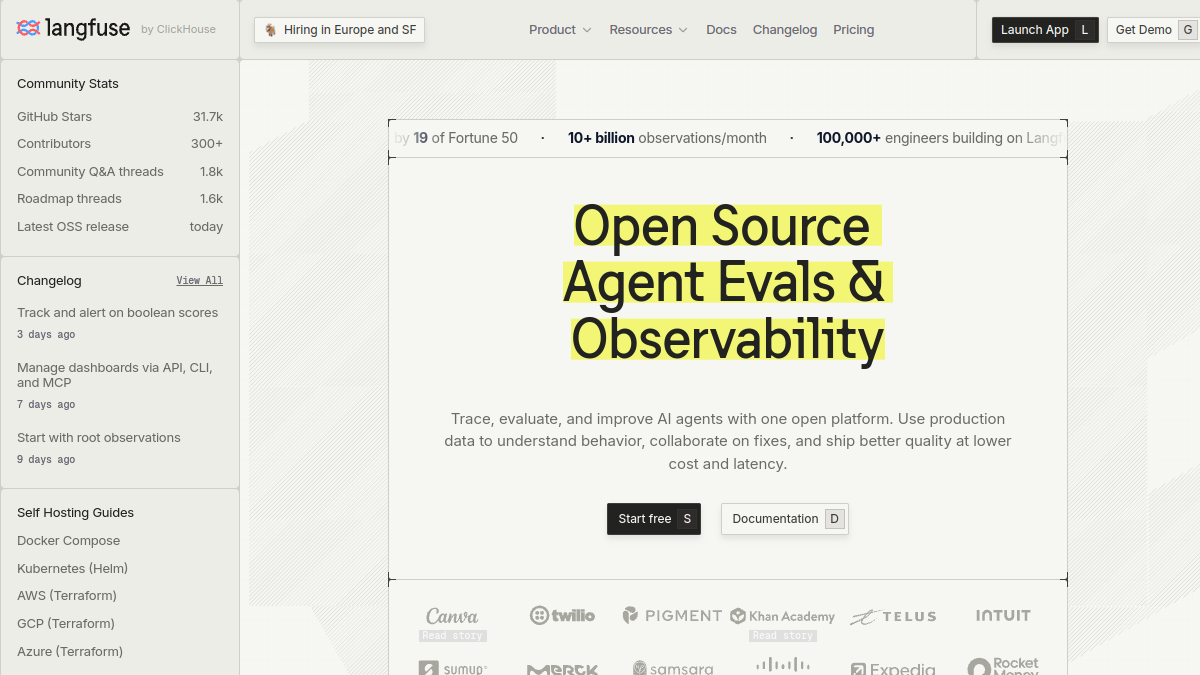
Langfuse gave developers open-source tracing, evals and analytics for LLM apps. It's excellent, but depending on your framework, whether you want a fully managed service, a proxy-based setup, or the deepest evaluation tooling, another platform may fit better.
These all help you trace, debug, evaluate and monitor LLM applications in production; they differ on openness, integration style and eval depth.
We rated every pick on four things — pricing and value, functionality, ease of use, and support. Here's the rundown.

Comparing against the original?
See Langfuse's profile, rating & reviews on Tolodora →
| # | Tool | Best for | Rating |
|---|---|---|---|
| 1 | LangSmith | Teams building on LangChain who want the most integrated tracing, testing and eval workflow. | 4.3/5 |
| 2 | Helicone | Teams that want painless, proxy-based LLM logging and cost control with minimal code changes. | 4.4/5 |
| 3 | Arize Phoenix | ML/AI engineers who want open, standards-based tracing and rigorous evaluation. | 4.3/5 |
| 4 | Portkey | Teams running many models/providers who want a gateway with monitoring built in. | 4.4/5 |
| 5 | Traceloop | Teams standardised on OpenTelemetry who want vendor-neutral LLM tracing. | 4.2/5 |
| 6 | Braintrust | Teams that treat evals as core — systematically testing prompts and models before and after deploy. | 4.2/5 |
LangSmith
- Pricing
- 7.8/10
- Functionality
- 9.2/10
- Ease of use
- 8.6/10
- Support
- 8.4/10
What I like
Deep, first-party tracing and evaluation for LLM apps — especially LangChain/LangGraph — with prompt management and datasets built in.
Best for
Teams building on LangChain who want the most integrated tracing, testing and eval workflow.
That focus makes it a natural fit for many your business. LangSmith (by LangChain) is a leading observability and evaluation platform. It traces chains and agents in detail, manages prompts and datasets, and runs evals — with unmatched LangChain integration, though it's framework-agnostic. The natural choice if your stack is already LangChain.
Helicone
- Pricing
- 9.2/10
- Functionality
- 8.6/10
- Ease of use
- 9.4/10
- Support
- 8.2/10
What I like
Add observability by changing one base URL — instant logging, caching, cost tracking and analytics, with an open-source, self-hostable core.
Best for
Teams that want painless, proxy-based LLM logging and cost control with minimal code changes.
Helicone is the easiest to adopt: route requests through its proxy (a one-line change) and get logging, caching, rate limiting, cost analytics and tracing. It's open-source and self-hostable, making it a low-friction, budget-friendly Langfuse alternative for monitoring LLM usage. It's a common pick among your business comparing their choices.
Arize Phoenix
- Pricing
- 9.4/10
- Functionality
- 9.0/10
- Ease of use
- 8.0/10
- Support
- 8.2/10
What I like
Open-source LLM tracing and evaluation built on OpenTelemetry, with strong tools for debugging RAG, retrieval and agent quality.
Best for
ML/AI engineers who want open, standards-based tracing and rigorous evaluation.
Phoenix (by Arize AI) is an open-source observability and eval tool grounded in OpenTelemetry standards. It shines at diagnosing RAG and agent issues, with built-in evaluators and a strong debugging UI. A great Langfuse alternative for teams that value open standards and deep eval capability. For your business, it's one of the stronger options on this shortlist.
Portkey
- Pricing
- 8.8/10
- Functionality
- 8.8/10
- Ease of use
- 9.0/10
- Support
- 8.4/10
What I like
An AI gateway plus observability — one proxy gives you logging, caching, fallbacks, load balancing and analytics across 250+ models.
Best for
Teams running many models/providers who want a gateway with monitoring built in.
It tends to suit your business that want exactly this balance. Portkey combines an LLM gateway with observability: route across providers with fallbacks and caching, then get full logs, traces and cost analytics. If you want reliability features (routing, retries) alongside monitoring, it's a powerful, low-code Langfuse alternative.
Traceloop
- Pricing
- 9.0/10
- Functionality
- 8.4/10
- Ease of use
- 8.4/10
- Support
- 8.0/10
What I like
Open-source instrumentation (OpenLLMetry) on OpenTelemetry, so your LLM traces flow into tools you may already use — plus its own dashboards.
Best for
Teams standardised on OpenTelemetry who want vendor-neutral LLM tracing.
That focus makes it a natural fit for many your business. Traceloop builds on OpenLLMetry, an open-source, OpenTelemetry-based standard for LLM tracing. That means you can send traces to existing observability backends or Traceloop's own platform, with evals and monitoring. A strong choice for teams that want open, portable instrumentation.
Braintrust
- Pricing
- 8.0/10
- Functionality
- 9.0/10
- Ease of use
- 8.4/10
- Support
- 8.4/10
What I like
Evaluation-first: a polished workflow for building eval datasets, scoring outputs, comparing prompts/models and shipping with confidence.
Best for
Teams that treat evals as core — systematically testing prompts and models before and after deploy.
Plenty of your business land on it after weighing the field. Braintrust centres on evaluation and experimentation: create datasets, score model outputs, compare versions and catch regressions, alongside logging and observability. If rigorous, repeatable evals are your priority (not just tracing), it's an excellent Langfuse alternative.
The verdict
Building on LangChain and want the tightest integration? LangSmith. Prefer a drop-in proxy for logging and caching? Helicone or Portkey. Need rigorous ML-grade observability and evals? Arize Phoenix or Braintrust.
Frequently asked questions
What is the best open-source Langfuse alternative?
Arize Phoenix and Helicone both offer open-source, self-hostable options, and Traceloop's OpenLLMetry is open-source instrumentation built on OpenTelemetry standards.
Which alternative is best for LangChain apps?
LangSmith, from the LangChain team, offers the deepest native integration for tracing and evaluating LangChain/LangGraph applications — though it works with any stack too.
Do I need to change my code to use these?
It varies: proxy-based tools like Helicone and Portkey need only a base-URL change, while SDK-based tools (LangSmith, Phoenix, Braintrust) use lightweight instrumentation or decorators.
Keep exploring
Building one of these alternatives?
List your tool on Tolodora and get discovered by buyers comparing options.
Launch Your Product