Best Project Management Software for Remote Teams (2026)
For a remote team, project management software isn't a nice-to-have — it's the shared workspace that replaces the office. Without a clear system, distributed work descends into endless status meetings, lost context and 'who's doing what?' confusion across time zones. The right tool keeps everyone aligned on what's happening and what's next, enables asynchronous work, and cuts the meeting overload that plagues remote teams.
This guide covers the best project management software for remote teams in 2026 — from clean, adopt-anywhere tools to flexible all-in-ones. We'll focus on what matters when your team is distributed: visibility, async collaboration, and keeping everyone aligned without living in meetings.
What remote teams need from project management software
- Clear visibility — everyone sees what's happening and what's next.
- Async-friendly — work and communicate without needing to be online at once.
- Task ownership & deadlines — clear who owns what, by when.
- Docs & context — information lives in the tool, not in someone's head.
- Easy adoption — a tool the whole distributed team will actually use.
- Integrations — connect with chat, docs and the rest of your stack.
The best project management software for remote teams
| Tool | Best for | Standout |
|---|---|---|
| Asana | Clean, reliable team PM | Intuitive, great for adoption at scale |
| ClickUp | All-in-one, feature-rich | Tasks, docs, goals & more in one |
| Monday.com | Visual, customisable workflows | Colourful boards & dashboards |
| Notion | Docs + project management | A flexible workspace and knowledge base |
| Trello | Simple visual boards | Dead-simple Kanban anyone can use |
| Basecamp | Calm, async-first teams | Simple, flat-priced, less noise |
Asana — clean and reliable
Asana hits the sweet spot between capable and approachable, handling tasks, projects, timelines and workloads through a clean interface a distributed team will actually adopt. For most remote teams that want reliable, smooth project management, it's a trusted default.
ClickUp — the feature-rich all-in-one
ClickUp packs tasks, docs, goals, whiteboards and more into one platform, which appeals to remote teams wanting to consolidate tools. Powerful and flexible, with a bit more setup — great for teams that want everything in one place.
Monday.com — visual and customisable
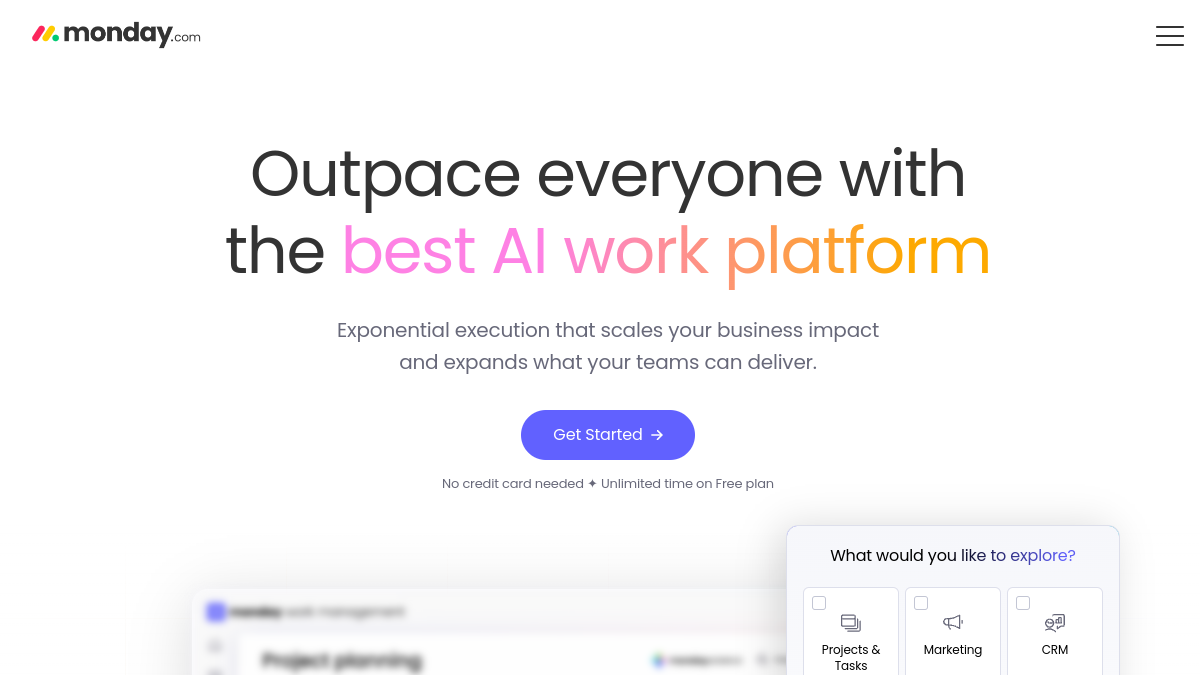
Monday.com offers colourful, customisable boards and dashboards that make status obvious at a glance — helpful for async visibility. Highly configurable and great for teams that think visually.
Notion — docs and project management
Notion shines for remote teams that live in documents, combining a flexible wiki and knowledge base with light project management. Keeping context and docs alongside tasks is a big async advantage for distributed teams.
Trello — simple visual boards
Trello is project management stripped to friendly essentials — cards on a board anyone can use in minutes. For a small remote team or straightforward workflow, its simplicity is a feature.
Basecamp — calm and async-first
Basecamp is deliberately calm and simple, with to-dos, messages, docs and check-ins designed to reduce noise and support async work, at flat pricing. For remote teams that want less chaos and fewer meetings, it's refreshing.
How to choose the right one
Want clean, reliable PM your team will adopt? Asana. An all-in-one to consolidate tools? ClickUp. Visual, customisable workflows? Monday.com. Docs and knowledge alongside tasks? Notion. Simple boards? Trello. Calm, async-first with flat pricing? Basecamp. The most important thing for a remote team is that everyone actually uses it — favour clarity and adoption over maximum features.
Getting your remote team onto it
Start with one real project and a simple structure — clear tasks, owners and due dates — rather than an elaborate setup no one maintains. Establish norms: work lives in the tool (not in DMs), every task has an owner and a due date, and status is updated so no one has to ask. Put context and docs in the tool so information is async-accessible across time zones. Once the basics are a habit, add automation, dashboards and integrations. Consistency of use matters far more than sophistication for a distributed team.
Common remote project management mistakes
Relying on chat for everything. Work gets lost in DMs. Keep tasks and decisions in the PM tool where they're visible.
No clear ownership. Distributed work needs clarity. Every task should have one owner and a due date.
Too many status meetings. If the tool shows status, you don't need to meet to ask. Let visibility replace meetings.
Context trapped in people's heads. Remote teams need written context. Document decisions and information in the tool.
Over-configuring. A tool with 40 custom fields nobody fills in gets abandoned. Start simple and add structure as needed.
Async work: replacing meetings with visibility
The biggest shift for a successful remote team is moving from synchronous coordination — everyone in meetings — to asynchronous work, where progress happens without everyone being online at once, and project management software is the engine of that shift. When every task has a clear owner, status and due date visible to all, people stop needing status meetings to find out what's happening; they simply look. When decisions, context and documents live in the tool (whether in Notion, Asana, ClickUp or Basecamp), a teammate in a different time zone can get what they need without waiting for someone to wake up and answer. This async visibility is what makes distributed work across time zones actually productive rather than a game of waiting and overlap-hunting. It also protects deep work: fewer meetings and interruptions mean more time to focus, which is one of remote work's biggest potential advantages. The teams that struggle remotely usually try to recreate the office with constant meetings and chat pings; the teams that thrive lean into async, using their PM tool as the single source of truth so work moves forward around the clock. Building that discipline — updating the tool, writing things down, trusting visibility over meetings — is the core skill of high-performing remote teams, and the right software makes it natural rather than forced.
Keeping a distributed team aligned and connected
Beyond task management, remote teams face two ongoing challenges — staying aligned on priorities and staying connected as people — and your project management tool helps with both. On alignment, features like goals, portfolios and dashboards (in tools like Asana, ClickUp and Monday.com) let everyone see not just their tasks but how those tasks ladder up to the team's priorities, so distributed people row in the same direction without a manager constantly reiterating it. Regular, lightweight check-ins built into the tool (Basecamp's automatic check-in questions are a nice example) keep everyone informed and give quieter team members a voice, replacing the ambient awareness an office provides. On connection, keeping communication and updates visible in shared spaces — rather than siloed in private chats — builds the transparency and trust that remote teams need, and celebrating completed work and milestones in the tool helps a distributed team feel its progress together. Alignment and connection don't happen automatically when people are scattered across cities and time zones; they have to be intentionally built, and a well-used project management tool provides the shared visibility, goals and rhythm that hold a remote team together. Combined with async discipline, this is what lets a distributed team perform like a co-located one — often better — while enjoying the flexibility remote work offers.
Frequently asked questions
What is the best project management tool for a remote team?
Asana is an excellent default for most remote teams — clean, reliable and easy to adopt across a distributed group. ClickUp suits teams wanting an all-in-one, Notion is great for doc-heavy teams, and Basecamp is ideal for calm, async-first teams. The best tool is the one your whole team will consistently use.
Which tool is best for asynchronous work?
Basecamp is designed around calm, async-first work with built-in check-ins, and Notion excels at keeping context and docs async-accessible. Really, any of these tools supports async work well if your team commits to keeping tasks, status and decisions visible in the tool rather than in meetings and DMs.
How does project management software reduce meetings?
By making status and progress visible to everyone, so people don't need to meet just to find out what's happening. When every task has an owner, due date and current status, and context lives in the tool, most status meetings become unnecessary — the team simply checks the tool, freeing time for focused work.
Choosing a tool your whole team will actually adopt
For a remote team, the most important factor in choosing project management software isn't the feature list — it's adoption, because a tool only creates the shared visibility that remote work depends on if everyone actually uses it consistently. A powerful platform that half the team ignores is worse than a simple one everyone updates, since partial adoption leaves gaps where work hides and trust erodes. This is why tools like Asana, Trello and Basecamp — known for being clean and easy — often outperform more powerful but complex options for distributed teams: they lower the friction of keeping things updated. When evaluating options, involve the team, pick something that matches how they naturally work, and start with a simple setup rather than an elaborate structure that feels like a burden. Establish clear, shared norms — work lives in the tool, every task has an owner and due date, status stays current — and lead by example so the tool becomes the reliable single source of truth. Integrations with the chat and docs your team already uses also boost adoption by reducing tool-switching. The best remote teams treat their project management tool as a shared commitment, not just software: everyone keeps it current because everyone depends on its visibility. Choosing for adoption — clarity, ease and fit over raw power — and reinforcing the habit is what turns a PM tool from shelfware into the backbone of a high-functioning distributed team.
The bottom line
The best project management software for a remote team keeps everyone aligned and enables async work, replacing status meetings with clear visibility. Choose Asana for clean reliability, ClickUp for an all-in-one, Monday.com for visual workflows, Notion for docs plus tasks, Trello for simplicity, or Basecamp for calm, async-first work. Keep work visible, lean into async, and your distributed team will thrive.
Building a tool for this niche? List it free on Tolodora and get found by buyers searching for exactly what you make — with a do-follow backlink, real reviews and buyer-intent traffic.