The 8 Best Software for Estate Planning Attorneys in 2026
Estate planning is, at its heart, a document-drafting practice. Wills, revocable and irrevocable trusts, powers of attorney, healthcare directives, funding documents — each client's plan is a package of complex, interdependent documents that must be accurate, compliant with state law, and tailored to the client's family and assets. Drafting these from scratch is slow and error-prone; assembling them from proven, maintained templates is fast and reliable. That's why the right estate planning software — especially document-assembly software — is transformative for these firms, letting an attorney produce a complete, high-quality plan in a fraction of the time.
Estate planning also involves nurturing prospects (people delay this work), guiding clients through decisions, and increasingly, ongoing client relationships and plan updates. So the best estate planning stack combines document assembly with intake/CRM and practice management. Below are the 8 best software tools for estate planning attorneys in 2026.
Why estate planning attorneys need specialized software
- Complex, interdependent documents. A single plan involves many documents that must be consistent with each other and with state law. Document-assembly software generates them together from one intake, ensuring consistency and saving hours.
- Legal accuracy and maintenance. Estate planning documents must reflect current law; maintained template libraries reduce the risk of using outdated provisions.
- Client intake and decisions. Gathering family, asset and wishes information through structured questionnaires drives both the documents and the advice.
- Nurturing and relationships. Prospects procrastinate, and clients need plan reviews and updates over time, so CRM and ongoing engagement matter.
Software that automates document assembly and structures intake lets an estate planning firm deliver more plans, more consistently, with less drafting labor.
What to look for in estate planning software
- Document assembly/automation — generate wills, trusts and ancillary documents from a client questionnaire, ideally with maintained, state-specific templates.
- Structured client intake — questionnaires that capture family, assets and wishes and drive the documents.
- Practice management — matters, calendaring, billing (often flat-fee) and payments.
- CRM and nurturing — follow up with prospects who delay and stay in touch for plan reviews.
- Client portal and e-signature — for gathering information and (where allowed) signing.
- Compliance and updates — templates kept current with law.
1. WealthCounsel — best estate planning document drafting
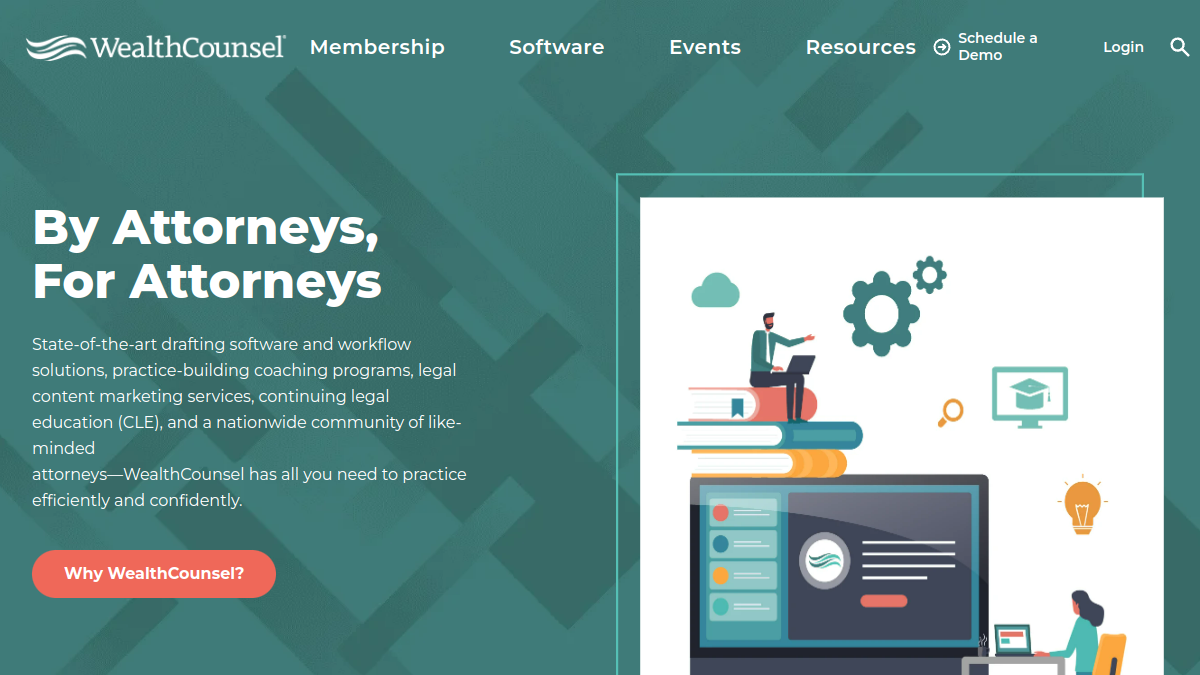
WealthCounsel is a leading document-drafting platform for estate planning attorneys, offering sophisticated, maintained document assembly for wills, trusts and related documents, plus education and a professional community. Its depth in estate planning drafting — producing complex, consistent, compliant documents from structured input — makes it a standout for firms that want purpose-built assembly rather than generic templates. For serious estate planning practices, it's a category leader in the drafting engine that sits at the core of the work.
2. Gavel (formerly Documate) — best modern document automation
Gavel is a powerful, flexible no-code document-automation platform that lets firms build their own intelligent questionnaires and generate documents — including estate planning packages — from client answers. For firms that want to automate their own templates and even offer online intake or client-facing document workflows, Gavel is a modern, customizable choice that can dramatically cut drafting time.
3. Clio — best all-round practice management
Clio is the market-leading cloud practice management platform and a solid estate planning backbone for matters, calendaring, billing (including flat-fee), online payments, trust accounting, a client portal and a huge integration ecosystem — often paired with a document-assembly tool like WealthCounsel or Gavel and an intake CRM. For firms that want a proven, flexible platform to run the practice while a specialist tool handles drafting, Clio is the safe, extensible choice.
4. Lawmatics — best legal CRM & nurturing
Estate planning prospects notoriously procrastinate, so nurturing and follow-up drive revenue. Lawmatics is a legal-specific CRM built for intake, marketing automation and long-term nurturing — instant follow-up, drip campaigns, e-sign engagement letters, and marketing-ROI reporting, plus the ability to re-engage past clients for plan reviews. For estate firms, its nurturing capabilities are especially valuable given the long, education-driven sales cycle.
5. MyCase — best affordable all-in-one
MyCase is a budget-friendly all-in-one practice management platform with case management, document automation, client communication, billing and online payments. For smaller estate planning firms that want an affordable practice-management core — paired with a dedicated drafting tool — it's a strong, cost-effective option, with a client portal that helps gather the information estate plans require.
6. Smokeball — best document automation within practice management
Smokeball combines practice management with strong document automation and automatic time capture. For estate planning firms that want document generation and matter management in one platform (rather than a separate assembly engine), its automation produces documents from case data efficiently, while automatic time capture and billing round out the operations. A good fit for firms wanting an integrated approach.
7. An AI assistant (ChatGPT / Claude) — best for drafting support & client communication
AI assistants help estate planning attorneys draft client-friendly explanations of complex concepts (trusts, tax strategies, probate), summarize client information, and produce first drafts of correspondence and educational materials. They complement — not replace — document-assembly software, which should drive the actual legal documents. Used carefully, verifying output and protecting confidentiality, a tool like ChatGPT or Claude improves client communication and cuts drafting time on non-document work. See our ChatGPT vs Claude comparison.
8. A client portal & e-signature layer
Estate planning requires gathering detailed, sensitive family and financial information and reviewing documents with clients. A secure client portal and e-signature (built into Clio, MyCase, or added separately) make it easier for clients to complete questionnaires, upload documents and review their plan, while keeping sensitive information secure. Note that execution formalities for wills and certain documents vary by state, so confirm what can be signed electronically in your jurisdiction.
How to build your estate planning stack
A powerful, common setup is: a document-assembly tool at the core — WealthCounsel for maintained estate planning drafting or Gavel for customizable automation — plus a practice management platform (Clio or MyCase) to run matters and billing, Lawmatics for intake and nurturing, and an AI assistant for client communication. Document assembly is the biggest lever in estate planning, so start there, then add practice management and CRM. Some firms prefer an integrated approach (Smokeball's automation within practice management) to reduce the number of tools.
How much does estate planning software cost?
Document-assembly platforms like WealthCounsel and Gavel charge a subscription that reflects the drafting value they provide — often the most important spend for an estate firm given how much drafting time they save. Practice management platforms (Clio, MyCase) charge a per-user monthly fee, and a legal CRM adds a monthly cost. AI assistants are around $20/month per user. For most estate planning firms, the document-assembly tool delivers the biggest ROI: producing complete, consistent plans in a fraction of the drafting time lets an attorney serve more clients profitably, easily covering the software cost.
Common mistakes estate planning firms make with software
The biggest is drafting from scratch or unmaintained templates instead of using a maintained document-assembly system, which is slower and riskier for compliance. Second is weak intake questionnaires, leading to back-and-forth and inconsistent documents. Third is neglecting nurturing — estate prospects procrastinate, and firms that don't follow up lose them, while those that stay in touch win the work and future plan reviews. Fourth is using AI to draft the actual legal documents rather than document-assembly software — AI is great for client communication and explanations, but the legal instruments should come from a maintained, compliant assembly system. Fifth is ignoring plan-review relationships, missing recurring revenue from updating clients' plans over time.
Should you offer online or DIY-plus-attorney estate planning?
A growing trend is estate planning firms offering a more streamlined, partly online experience — clients complete intake online, the firm assembles documents automatically, and the attorney reviews and advises. Document-automation tools like Gavel make this possible by letting you build client-facing questionnaires and automated document workflows, while you retain the essential attorney review and counsel. This can widen your market to clients who want convenience and lower cost, without abandoning the professional judgment that distinguishes an attorney-drafted plan from a pure DIY template. If you explore this, keep the lawyer firmly in the loop — the value (and the ethics) rest on real legal advice and review, not just generated documents. Done well, a streamlined online-plus-attorney model can grow volume while maintaining quality.
Building recurring revenue with plan reviews and maintenance
One of the biggest missed opportunities in estate planning is the ongoing relationship. Life changes — marriages, births, deaths, asset changes, moves and law changes — mean plans should be reviewed and updated periodically, yet many firms never follow up after the initial engagement. A CRM like Lawmatics lets you nurture past clients and prompt them for reviews, and some firms offer membership or maintenance programs that provide updates and periodic reviews for a recurring fee. This turns a one-time transaction into a lasting relationship with recurring revenue, and it genuinely serves clients whose plans would otherwise drift out of date. Software that tracks review dates and automates outreach makes this practical to run across your whole client base.
What is the best free estate planning software?
There isn't a robust free document-assembly platform for attorneys, but practice-management tools like MyCase offer free trials, and general AI assistants have free tiers for client communication. The document-assembly engine (WealthCounsel or Gavel) is the key paid investment for an estate firm, since its drafting-time savings quickly outweigh the cost by letting you serve more clients.
Frequently asked questions
What is the best software for estate planning attorneys?
WealthCounsel is the best purpose-built estate planning document-drafting platform, Gavel is best for customizable document automation, and Clio or MyCase are the best practice-management cores. Most firms pair a drafting tool with practice management and Lawmatics for nurturing. The best depends on your drafting approach and firm size.
Which software drafts wills and trusts?
WealthCounsel offers sophisticated, maintained document assembly for wills, trusts and related documents, and Gavel lets you automate your own templates. These generate complex, consistent estate planning documents from structured input, saving enormous drafting time.
Can AI draft estate planning documents?
AI is best used for client-friendly explanations, correspondence and summaries — not for drafting the actual legal instruments, which should come from maintained document-assembly software for compliance and consistency. Always verify any AI output and keep the attorney responsible.
Is there affordable estate planning software?
MyCase is an affordable practice-management core, and firms can pair it with a document-assembly tool. Gavel offers flexible automation, and general AI assistants are inexpensive for communication. The document-assembly tool is usually the key investment given its drafting-time savings.
Why do estate planning firms need a CRM?
Estate planning prospects tend to procrastinate, and the sales cycle is long and education-driven, so nurturing and follow-up (via a CRM like Lawmatics) convert more prospects and re-engage past clients for plan reviews — recurring revenue many firms miss.
Can estate planning documents be signed electronically?
It varies by state and document type — some documents allow e-signature while wills and certain instruments have specific execution formalities. Use e-signature where permitted, and confirm the rules in your jurisdiction before relying on electronic execution.
Do estate planning firms need trust accounting?
If your firm holds client funds — retainers, or funds in connection with administration or funding work — then yes, compliant trust (IOLTA) accounting is essential, and your practice management platform should handle it or integrate cleanly with accounting software. Even flat-fee estate planning practices benefit from clean financial tracking of engagements, payments and any advanced costs. Clio, MyCase, Smokeball and Rocket Matter all include or support trust accounting, so if client funds are part of your workflow, make it a requirement when choosing. Getting trust accounting right isn't just good practice — it's an ethics and compliance obligation, and software that enforces the guardrails (separate ledgers, reconciliation, no commingling) protects both your clients and your license.
How do I choose estate planning software?
Start with your drafting engine, since document assembly is the biggest lever — evaluate WealthCounsel for maintained estate drafting or Gavel for customizable automation. Then choose a practice management core (Clio for an all-rounder, MyCase for value) for matters, billing and trust accounting, add a CRM like Lawmatics to nurture procrastinating prospects and prompt plan reviews, and use an AI assistant for client communication. Take advantage of free trials and demos, and prioritize the tools that save the most drafting time and convert the most prospects — those two levers drive an estate practice's profitability.
Which is better, WealthCounsel or Gavel?
They serve different needs. WealthCounsel offers maintained, sophisticated estate planning document assembly with education and a professional community — ideal if you want proven, compliant templates for wills and trusts out of the box. Gavel is a flexible, no-code automation platform for building your own questionnaires and document workflows — ideal if you want to automate your own templates or offer client-facing intake. Many firms choose WealthCounsel for maintained drafting; those wanting maximum customization or online workflows lean toward Gavel.
The bottom line
Estate planning is a drafting practice, so the biggest win is document-assembly software — WealthCounsel for maintained estate drafting or Gavel for customizable automation — at the core of your stack. Add a practice management platform (Clio or MyCase), Lawmatics to nurture procrastinating prospects, and an AI assistant for client communication. Automate the documents, nurture the relationships, and your firm will deliver more high-quality plans profitably. Compare more software on Tolodora to build your shortlist.