The 8 Best Software for Personal Injury Lawyers in 2026
Personal injury is one of the most software-dependent areas of law. A single PI case can span months or years and involve medical records from multiple providers, liens, insurance negotiations, expenses, expert reports and a settlement that has to be distributed precisely. Multiply that by a caseload of dozens or hundreds, and it's clear why personal injury case management software — not a generic CRM — is essential. The right platform keeps every case moving, every deadline safe, and every dollar of settlement accounted for.
PI is also a marketing-heavy, lead-driven business: cases are valuable, competition is fierce, and speed-to-lead directly affects revenue. So the best PI stack combines powerful case management with aggressive intake and CRM. Below are the 8 best software tools for personal injury lawyers in 2026, plus how to choose and combine them.
Why personal injury firms need specialized software
Generic practice management can run a PI firm, but purpose-built PI software handles the things that actually make or break these cases:
- Medical records and providers — tracking requests, receipts and bills across many providers per client is a huge, ongoing task.
- Case phases and deadlines — PI matters move through defined stages (treatment, demand, negotiation, litigation, settlement), each with its own tasks and deadlines.
- Negotiations and case value — tracking offers, demands, liens and expenses so you know each case's real value and net to client.
- Settlement accounting — distributing a settlement accurately across fees, liens, medical bills and the client, with a clean trust-accounting trail.
- High-volume intake — signing the right cases fast, since a missed lead is a lost, valuable case.
Software built for PI encodes this workflow so nothing is forgotten and your team runs cases consistently, whether you have five open files or five hundred.
What to look for in PI software
- PI-specific case management — medical treatment tracking, providers, liens, expenses and settlement/negotiation tools.
- Strong intake and CRM — instant lead follow-up, e-sign retainers, referral tracking and marketing analytics.
- Deadline and task automation — stage-based task lists so every case follows your best process.
- Reporting — case value, pipeline, settlement and marketing ROI reporting to run the business.
- Document automation and e-signature — generate demands, letters and retainers fast.
- Integrations — with texting, e-sign, accounting and medical-record retrieval services.
- Trust accounting — compliant handling of settlement funds.
1. CASEpeer — best purpose-built for personal injury
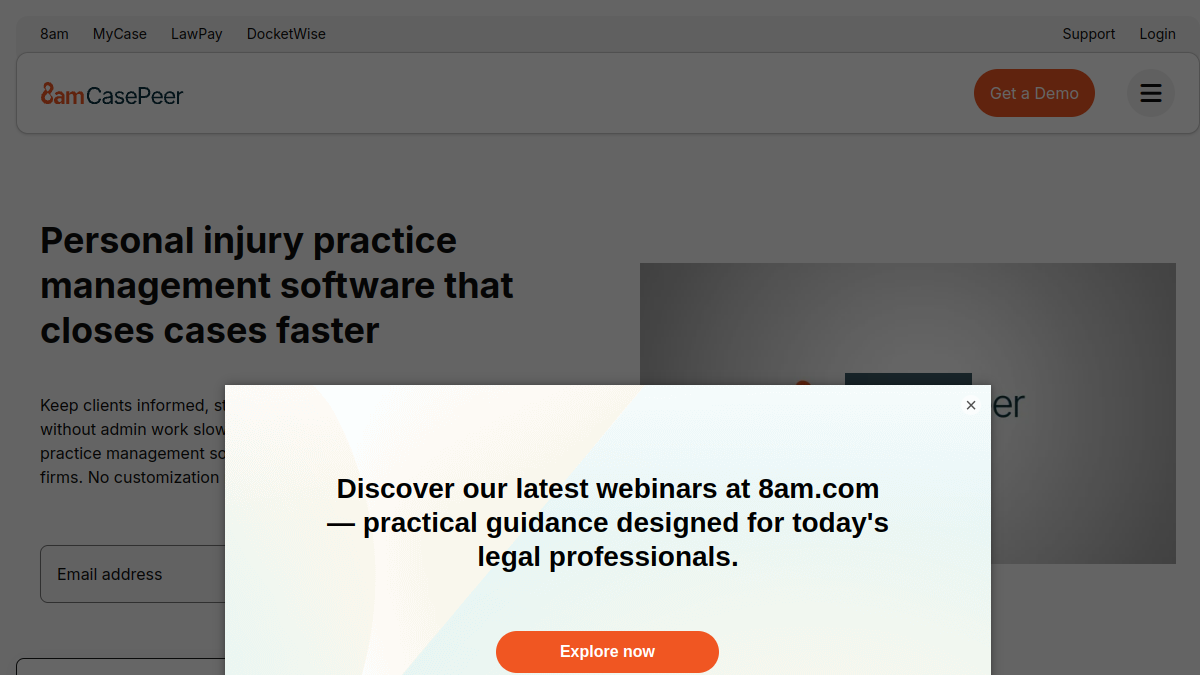
CASEpeer is designed specifically for personal injury firms, and it shows. It structures cases around the PI lifecycle — treatment, medical records, negotiations, litigation and settlement — with tools for tracking providers, liens, expenses and case value, plus reporting and task automation aligned to how PI firms actually work. For a plaintiff PI practice that wants software that already 'thinks' in PI terms rather than a generic tool you configure yourself, CASEpeer is a standout.
2. Filevine — best powerful, customizable case management
Filevine is a powerful and highly customizable case/matter management platform widely used by personal injury and mass-tort firms. It handles documents, deadlines, communication, and complex case data, with strong automation and reporting, and it flexes to fit sophisticated workflows. For larger or growing PI firms that need depth and customization — and want one platform to run complex caseloads — Filevine is a leading choice.
3. Clio — best all-round with a huge ecosystem
Clio is the market-leading cloud practice management platform, and while it's not PI-specific, its depth, integrations and reliability make it a common PI backbone — especially paired with PI-focused add-ons or Clio Grow for intake. It handles matters, calendaring, documents, billing, payments, trust accounting and a client portal, with the largest integration ecosystem in legal. For firms that value flexibility and a proven, well-supported platform, Clio is the safe pick.
4. Litify — best enterprise platform for larger firms
Litify is an enterprise-grade legal platform (built on Salesforce) used by larger personal injury and plaintiff firms that need scale, deep customization and powerful reporting across intake, case management and operations. It's more of an investment and better suited to bigger organizations, but for high-volume PI firms that have outgrown standard tools, it offers enterprise power and analytics.
5. MyCase — best affordable all-in-one
MyCase is a budget-friendly all-in-one practice management platform with case management, client communication (including texting), document automation, billing and payments. For smaller PI firms that want solid, affordable case management without an enterprise price, it's a strong option — especially combined with a dedicated intake tool for the marketing side.
6. Lawmatics — best legal CRM & intake for lead conversion
Because PI cases are valuable and competitive, intake and speed-to-lead are everything. Lawmatics is a legal-specific CRM built for exactly this — instant lead follow-up, marketing automation, e-sign retainers, referral and marketing-ROI tracking. Paired with a case management platform (CASEpeer, Filevine or Clio), it plugs the most expensive leak in a PI practice: valuable leads that don't get signed fast enough.
7. An AI assistant (ChatGPT / Claude) — best for drafting & summarizing
General AI assistants are increasingly useful in PI work: summarizing lengthy medical records and depositions, drafting demand letters and correspondence, and organizing case facts. Used carefully — verifying every output and protecting confidentiality — an assistant like ChatGPT or Claude can save your team hours on the drafting and review that fills a PI caseload. See our ChatGPT vs Claude comparison for which suits legal work.
8. A medical-records & document layer
Retrieving and organizing medical records is one of PI's biggest time sinks. Whether through your case management platform's features or a dedicated records-retrieval and document-management service, streamlining how records are requested, received, summarized and attached to the case pays off enormously across a caseload. Increasingly, AI helps summarize those records into usable chronologies.
How to build your personal injury stack
A powerful, common setup is: a PI-focused case management platform (CASEpeer for a purpose-built fit, Filevine for customization and scale, or Clio for flexibility) as your core, Lawmatics for intake and lead conversion, and an AI assistant for drafting and summarizing records. Larger firms may move to Litify for enterprise scale. Start with the case management core, then add intake automation — the two together drive both efficiency and revenue.
A note on trust accounting and ethics
PI settlements involve client funds, liens and precise distributions, so compliant trust accounting is essential — make sure your platform (or its integrations) handles it correctly. And as with any firm using AI, protect client confidentiality, verify AI output (never rely on AI-generated case citations without checking), and keep attorneys responsible for all work and decisions.
How much does personal injury software cost?
PI software spans a wide range. Purpose-built case management like CASEpeer and flexible platforms like Clio charge a per-user monthly fee, generally in the mid range, with CASEpeer priced for its PI focus and Clio for its ecosystem depth. Powerful, customizable platforms like Filevine sit higher and are quoted based on firm size and needs, and enterprise platforms like Litify are a significant investment suited to larger firms. A legal CRM (Lawmatics) adds a monthly cost that, given the value of a single signed PI case, usually returns many times over. AI assistants are around $20/month per user. For a small-to-mid PI firm, budget for a case management platform plus an intake CRM as your two core costs; the efficiency and — crucially — the additional signed cases from faster intake typically dwarf the software spend.
How to switch PI case management software safely
Migrating a PI firm is higher-stakes because of active cases, medical records and trust balances, so plan carefully. Start by exporting and auditing your matter, contact, document and financial data, then map fields to the new system. Rebuild your PI workflow — case phases, task lists, document templates and demand-letter templates — in the new platform before go-live. Migrate closed and dormant matters in bulk, but consider moving active, time-sensitive cases in a controlled batch or running parallel briefly so nothing in litigation is disrupted. Reconcile trust accounting carefully during the switch. Involve your vendor's migration team — CASEpeer, Filevine, Clio and others offer onboarding and data-migration support — and train staff on the exact daily PI workflows (intake, records, negotiations, settlement) rather than every feature.
Common mistakes PI firms make choosing software
The most expensive mistake is under-investing in intake — PI cases are valuable and competitive, and a slow or leaky intake process loses cases worth far more than any software. Second is choosing a generic tool with no PI structure and then spending months configuring medical-record, lien and settlement workflows a purpose-built platform includes out of the box. Third is ignoring reporting: without case-value, pipeline and marketing-ROI reporting, you can't see which marketing works or where cases stall. Fourth is weak trust-accounting discipline, which creates compliance risk when distributing settlements. Fifth is relying on AI output unverified — using AI to summarize records is great, but every summary and any legal citation must be checked by a human.
Case management vs CRM: do you need both?
Yes, for most PI firms. A case management platform (CASEpeer, Filevine, Clio) runs the case after you sign it — medical records, deadlines, negotiations, settlement. A legal CRM (Lawmatics) runs everything before you sign — capturing leads, following up instantly, e-signing retainers and tracking marketing ROI. They solve different problems, and PI firms lose the most money at the intake stage, so pairing a strong case management tool with a dedicated intake CRM is the highest-return setup. Some platforms include basic intake (Clio Grow, CASEpeer's intake), which may suffice for smaller firms, but competitive PI markets usually justify a dedicated CRM.
Do you need medical-records retrieval software too?
Medical records are the lifeblood — and the biggest bottleneck — of a personal injury case. Requesting, chasing, receiving, organizing and summarizing records from multiple providers per client eats enormous staff time. Many PI firms add a dedicated records-retrieval service (which orders and follows up on records for you) or use their case management platform's records-tracking features to keep every request and receipt organized against the case. Increasingly, AI tools help by turning hundreds of pages of records into a clean medical chronology and bill summary in minutes, which is invaluable for building demands and evaluating case value. Whether you outsource retrieval, use built-in tracking, or add AI summarization, streamlining records handling is one of the highest-leverage improvements a PI firm can make — it directly speeds up demands and settlements across your entire caseload.
Solo and small PI firms: where to start
If you're a solo or small PI firm, you don't need an enterprise platform on day one. Start with one PI-friendly case management tool — CASEpeer for a purpose-built PI workflow or Clio for flexibility — and a strong intake process, even a simple one, so you never lose a valuable lead to slow follow-up. Add ChatGPT or Claude to summarize records and draft demands. As your caseload and marketing grow, layer in a dedicated intake CRM like Lawmatics to convert more leads, and consider Filevine or Litify only when your volume and complexity truly demand enterprise power. Growing your stack in step with your caseload keeps costs sensible while ensuring the fundamentals — organized cases and fast intake — are solid from the start.
Frequently asked questions
What is the best software for personal injury lawyers?
CASEpeer is the best purpose-built PI case management tool, Filevine is best for powerful customization and scale, and Clio is the best flexible all-rounder. Most firms pair one of these with Lawmatics for intake. The best depends on your firm's size and how PI-specific you want the workflow.
Do personal injury firms need PI-specific software?
For medical-record tracking, liens, negotiations and settlement accounting, PI-specific tools like CASEpeer or Filevine help enormously by encoding the PI workflow. Generic tools like Clio can work well too, especially with add-ons, but purpose-built software saves configuration time.
Which tool is best for personal injury intake?
Lawmatics is purpose-built for legal intake and marketing automation, converting valuable PI leads fast with instant follow-up and e-sign retainers. CASEpeer, Filevine and Clio Grow also offer intake features. Speed-to-lead is critical in competitive PI markets.
What software do big personal injury firms use?
Larger PI and plaintiff firms often use Filevine or Litify (enterprise, Salesforce-based) for their scale, customization and reporting, frequently paired with dedicated intake and marketing tools. Smaller firms tend to use CASEpeer, Clio or MyCase.
Can AI help with personal injury cases?
Yes — AI assistants summarize medical records and depositions, draft demand letters and correspondence, and organize case facts, saving significant time. Always verify AI output, protect confidentiality, and never rely on AI-generated legal citations without checking them.
How much does personal injury software cost?
PI case management platforms typically charge a per-user monthly fee that varies with capability, intake CRMs add a monthly cost, and enterprise platforms like Litify are a larger investment. For most firms, the efficiency and captured cases more than justify the cost.
The bottom line
Personal injury runs on organized cases and fast intake. Build your stack around a strong PI case management platform — CASEpeer for purpose-built fit, Filevine for power, or Clio for flexibility — add Lawmatics to convert valuable leads instantly, and use an AI assistant to summarize records and draft faster. Get those pieces right and your firm handles more cases, more profitably, with fewer things falling through the cracks. Explore more software on Tolodora to compare options.