What Is Vibe Coding? The Complete 2026 Guide (and the Best Tools)
"Vibe coding" went from an offhand phrase to one of 2026's defining tech terms in about a year. If you keep seeing it and nodding along without being 100% sure what it means, this guide will make you fluent — what it is, where it came from, the tools that do it, and, just as importantly, where it falls apart.
What is vibe coding?
Vibe coding is building software by describing what you want in plain language and letting an AI write the code. Instead of typing every line yourself, you prompt, run, look at the result, and refine — you "vibe" your way to a working program. In its purest form, you barely read the code at all; you steer by describing outcomes and reacting to what the AI produces.
The term was popularized in early 2025 by AI researcher Andrej Karpathy, who described a loose, conversational style of programming where you "fully give in to the vibes" and lean on the model. The phrase caught fire because it named something thousands of people were already starting to do.
Where did the term come from?
Vibe coding didn't appear from nowhere. It's the natural endpoint of a few converging trends: coding assistants got dramatically better, AI "agents" learned to run and fix their own code, and prompt-to-app tools made it possible to generate entire applications from a sentence. Karpathy simply gave the emerging behavior a memorable name, and the developer community — plus a wave of non-developers — ran with it.
How does vibe coding work?
The core loop is deceptively simple:
- Describe what you want in natural language: "Build a landing page with a headline, a features section, and an email signup form."
- The AI generates the code — and, in agentic tools, runs it and even sets up the project for you.
- You look at the result (the running app, not necessarily the code), then say what to change: "Make the header sticky and the button green."
- Repeat until it works the way you want.
The mental shift is the whole point: you're managing intent and outcomes rather than syntax. You describe the destination; the AI figures out the turns. For small projects, some people genuinely ship working apps without reading a single function — hence the "vibe."
The best vibe coding tools in 2026
Different tools sit at different points on the spectrum, from "help me write real code" to "build me an app from a prompt."
AI-first code editors
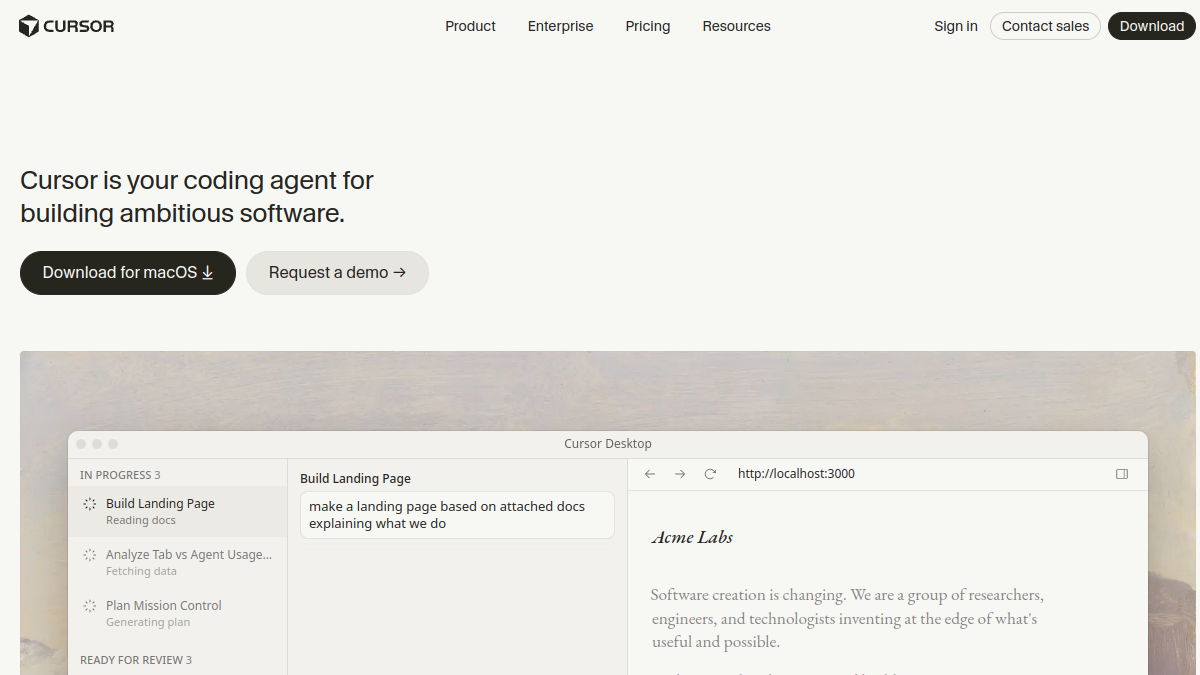
- Cursor — the power-user favorite. A VS Code-style editor with deep AI baked in; strong on real, existing codebases.
- GitHub Copilot — the incumbent, embedded across editors and GitHub itself, now far more agentic than its autocomplete origins.
Coding agents
- Claude Code and similar terminal/agent tools — AI that reads your whole project, makes multi-file changes, runs commands, and fixes its own mistakes.
Prompt-to-app builders
- Lovable, Bolt, and v0 — describe an app or UI and get a working web app back, often deployable in a click. Great for non-coders and rapid prototypes.
- Replit — build, run, and deploy from the browser with an AI agent doing much of the heavy lifting.
Each targets a slightly different user, from a founder spinning up a prototype over lunch to a senior engineer speeding up serious work.
A quick example of vibe coding in action
Say you want a simple expense tracker. Traditionally you'd scaffold a project, choose a framework, write the UI, wire up state, add storage, and debug for hours. Vibe coding compresses that:
- You: "Make a single-page expense tracker where I can add an item with a name and amount, see a running total, and delete items."
- The AI generates the whole thing and runs it.
- You: "Save the list so it persists after refresh, and format the total as currency."
- The AI updates it. A few iterations later, you have a working tool — and you mostly described, rather than wrote, it.
Is vibe coding actually good? The honest pros and cons
The truthful answer is it depends entirely on the stakes.
Where vibe coding shines
- Prototypes and MVPs — get a working idea in front of people fast.
- Internal tools and one-offs — scripts and dashboards that don't need to be bulletproof.
- Learning and unblocking — explore an unfamiliar language or library by building with it.
- Landing pages and simple sites — quick, cheap, good enough.
Where it gets risky
- Production systems — real users, real data, real consequences.
- Security-sensitive code — AI can introduce vulnerabilities that look perfectly fine.
- Anything you'll maintain for years — code you don't understand is code you can't fix later.
The dirty secret is that AI-generated code often looks right and fails in the edge cases. If you never read it, you can't catch the subtle bug, the missing validation, or the security hole. That's why professionals still review the output — they just write less of it by hand.
Best practices for vibe coding without regretting it
- Match the method to the stakes. Full vibe mode for throwaway prototypes; careful review for anything that ships.
- Read the important parts. You don't need every line, but understand the data flow, auth, and anything touching money or user data.
- Test as you go. Ask the AI to write tests, then actually run them.
- Use version control. Commit often so you can roll back when a "quick change" breaks everything.
- Keep security in mind. Never vibe-code secrets, payments, or authentication without a careful review.
Will vibe coding replace programmers?
Not the way the headlines imply. What's changing is the job, not its existence: developers are becoming editors and architects of AI-generated code rather than line-by-line typists. Understanding systems, debugging, security, and judgment matter more than ever — because someone has to catch what the AI gets wrong. We went deep on this in will AI replace developers?
Vibe coding also connects to the broader rise of AI agents — systems that don't just answer but take actions toward a goal, which is exactly what a coding agent does when it edits, runs, and fixes your project.
Frequently asked questions
Who coined the term 'vibe coding'?
It was popularized by AI researcher Andrej Karpathy in early 2025, describing a relaxed, conversational way of programming where you lean heavily on AI and focus on outcomes rather than code.
Can non-programmers really vibe code?
Yes, for simple projects. Prompt-to-app tools like Lovable, Bolt, and v0 let non-coders build working web apps by describing them. The limits show up with complexity, scale, and anything that must be secure or reliable.
Is vibe-coded software safe to ship?
Only if it's reviewed. Vibe coding is excellent for prototypes and internal tools; for production — especially anything with user data, payments, or authentication — treat the AI's output as a draft that a human must read, test, and secure.
The bottom line
Vibe coding is a real and genuinely useful shift: a faster way to get from idea to working software by collaborating with an AI. Treat it as a powerful accelerator — not a replacement for understanding what your code does — and it's one of the best productivity upgrades available in 2026. Vibe the prototypes; review the things that matter.