Why View Count Is the Wrong Way to Spot a Viral Video (and What to Measure Instead)
Every content team has lived the same scene. Someone drops a TikTok in the group chat with the caption "this did 4 million, we need to do this." The team spends two days producing a version of it. It gets 1,200 views. Nobody understands what went wrong, and the next reference gets picked the same way.
The problem is not the execution. The problem is the way the reference was chosen. View count, the metric everyone uses to decide what is "viral," is almost useless for deciding what to copy. Here is why, and what actually works instead.
## View count measures the account, not the video
When a video gets 4 million views, there are two very different explanations. Either the video did something exceptional, or the account that posted it already has 3 million followers and every video it posts lands somewhere between 2 and 6 million.
From the outside, both look identical. A number, a fire emoji, a screenshot in your team's chat. But only the first case tells you anything about the content. In the second case, the video is just an average Tuesday for a big account. Copying its format teaches you nothing, because the format is not what produced the views. The audience was already there.
This is the trap most teams fall into. Sorting by views is really sorting by follower count with extra steps. You end up studying the largest accounts in your niche, whose content is often the least instructive, because they can post almost anything and the algorithm will serve it to a warm audience of millions.
## The signal you actually want: outperformance against a baseline
The question worth asking is not "how many views did this get?" but "how many views did this get compared to what this account normally gets?"
A creator with 8,000 followers who usually does 3,000 views per video and suddenly hits 400,000 has done something the algorithm rewarded on its own merits. There was no warm audience to carry it. The hook, the format, the sound, the topic, something in that video made strangers stop scrolling and made TikTok or Instagram push it to people who had never heard of the account.
That is a 130x multiplier over baseline. It is the single most informative event you can find in a niche, and it is completely invisible if you sort by raw views, because 400,000 does not make the top of any list next to the accounts doing millions.
Measuring against a baseline changes the entire picture:
- Small accounts become the most valuable sources of insight, not the least.
- A big account's routine post stops looking like a hit.
- You can compare a post from a 5k account with a post from a 500k account on the same scale.
- You catch formats early, while they are still working on cold audiences, rather than three weeks later when a mega account picks them up.
## How to calculate a baseline properly
The idea is simple, but the details matter, and getting them wrong produces false positives that waste your team's time.
### Use a rolling window, not a lifetime average
An account's performance drifts. A creator who blew up six months ago has a very different "normal" today than they did last year. If you average every video they ever posted, the old numbers pollute the baseline. Use the last 15 to 30 posts, or the last 60 to 90 days, whichever gives you enough data without going stale.
### Use the median, not the mean
Viral posts are outliers by definition, and outliers wreck averages. If an account has one 2 million view video among twenty 10,000 view videos, the mean is roughly 110,000, which makes the account's normal posts look like failures and the next real breakout look modest. The median ignores the spike and gives you the real "typical" post. Compare new posts against that.
### Give a post time to breathe
A post 30 minutes old with 500 views is not a signal. Platforms distribute content in waves, and a video can sit quietly for a day and then take off. Wait at least 24 hours before judging a post, and keep re-checking for several days. A lot of the most interesting breakouts happen on the second or third day, when the platform tests the content on a wider cold audience.
### Set a real threshold
What counts as outperformance? In our experience, 3x the median is where things start getting interesting, and 10x or more is where you should drop what you are doing and study the post. Anything under 2x is noise. Set your threshold and stick to it, or you will drown in "kind of good" posts.
### Watch out for baselines that are rising
There is one subtle failure mode. An account whose views are climbing steadily week over week will keep tripping your threshold, because every new post beats a median that has not caught up yet. This is growth, not virality. It is worth knowing about, but it is a different signal. Flag it separately, or you will keep chasing accounts that are simply on an upward trend.
## What to do once you have found a real breakout
Detection is half the job. The reason most teams never get value from "viral research" is that they stop at the screenshot. Finding a post that did 50x its baseline is only useful if you can explain why and reproduce the mechanism.
Break the post down into parts a creator can actually act on:
1. The first three seconds. What is on screen, what is said, what text appears. Most viral videos win or lose here.
2. The hook type. Is it a question, a contradiction, a bold claim, a visual pattern interrupt, a "wait for it"? Name it, so you can reuse it.
3. Pacing. How many cuts in the first 10 seconds? How long is the video? Where are the retention drops likely to be?
4. On-screen text and captions. Is the video readable with sound off? Most feed viewing is muted.
5. The sound. Original audio, trending sound, or voiceover? A trending sound can account for a big part of the reach, and it is the easiest element to swap in.
6. The structure. Setup, payoff, call to action. Where does the loop close?
Once you have this, you do not hand your creator a link and say "make this." You hand them a brief: the hook type, the pacing target, the structure, the sound, and two or three reference clips. That is the difference between copying a video and reusing a formula.
## Doing this at scale
Everything above can be done by hand for a handful of accounts. The moment you monitor 50 or 200 accounts across TikTok and Instagram, it stops being possible. Pulling post counts every day, maintaining rolling medians per account, re-checking posts over several days, and then analyzing each breakout is a full-time job, and it is not a job anyone enjoys.
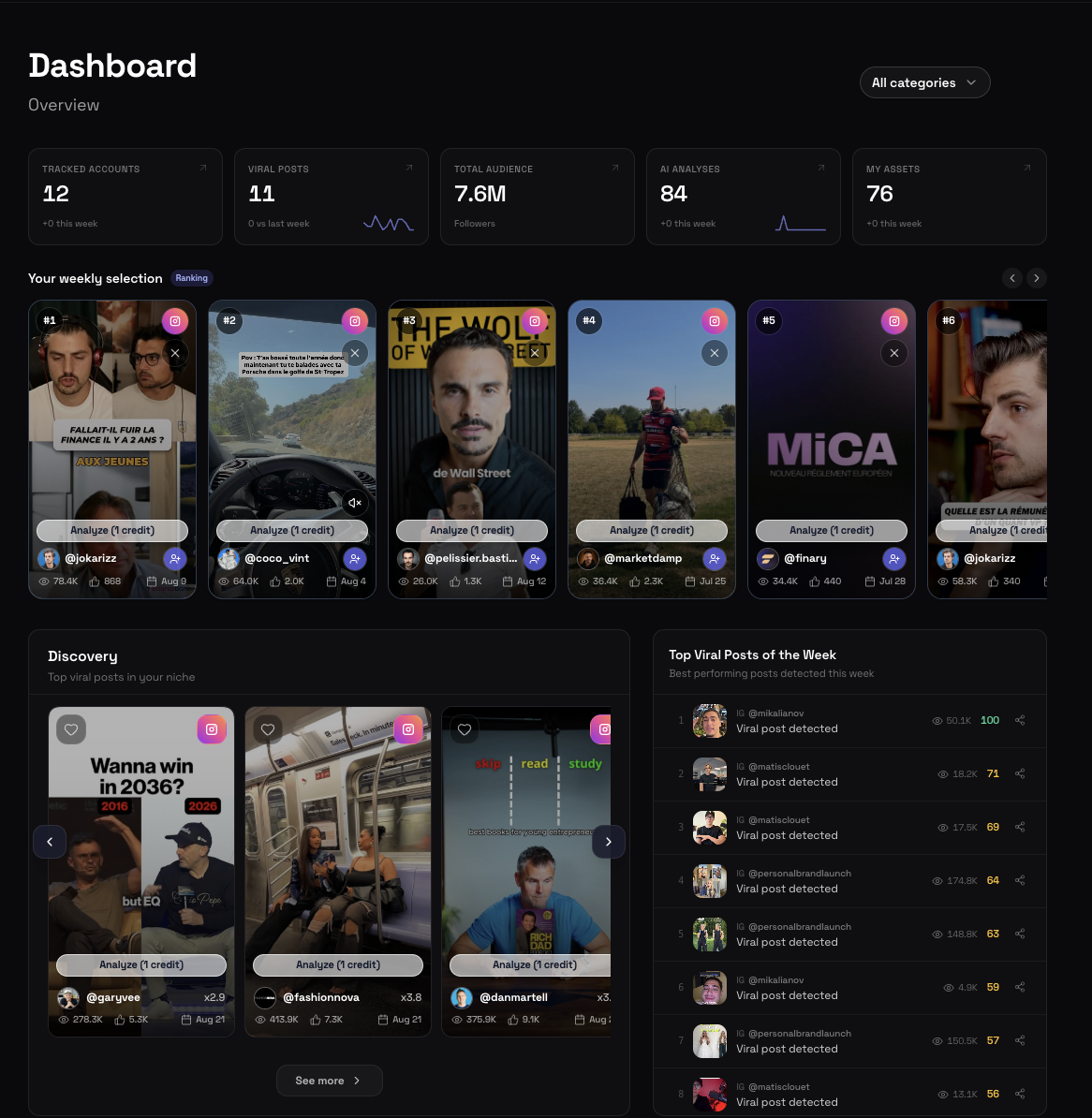
This is the problem we built [Viral Manager](https://viral-managers.com) to solve. It monitors the accounts in your niche, computes a baseline per account, flags the posts that genuinely outperform it, and keeps a copy of the media so the reference does not vanish when the original gets deleted. AI analysis then breaks each breakout down into the elements above, and any post can be turned into a brief assigned to a creator and tracked through to publication. But the method works whether or not you use a tool. A spreadsheet with per-account medians and a daily check is already a massive improvement over sorting by views.
## The short version
- Raw view count tells you how big an account is, not how good a video is.
- Measure every post against its own account's baseline. A 130x post from a small account is worth more than a 1x post from a huge one.
- Use a rolling window, the median, a 24 hour minimum age, and a threshold of at least 3x.
- Separate real breakouts from accounts that are simply growing.
- Once you find one, decompose it into hook, pacing, text, sound and structure, and brief that, not the link.
Do this consistently and your team stops guessing. The references you pick will be the ones that worked on cold audiences, which is exactly what you need your own content to do.