Why I Built ADOKVA: A Privacy-First Way to Find Connection Far From Home
Living far from home changes the meaning of distance.
A city can be thousands of kilometres away, but the strongest feeling is often not the physical distance. It is the absence of familiar voices, shared memories, local expressions and people who understand where you came from without a long explanation.
That feeling became the starting point for ADOKVA.
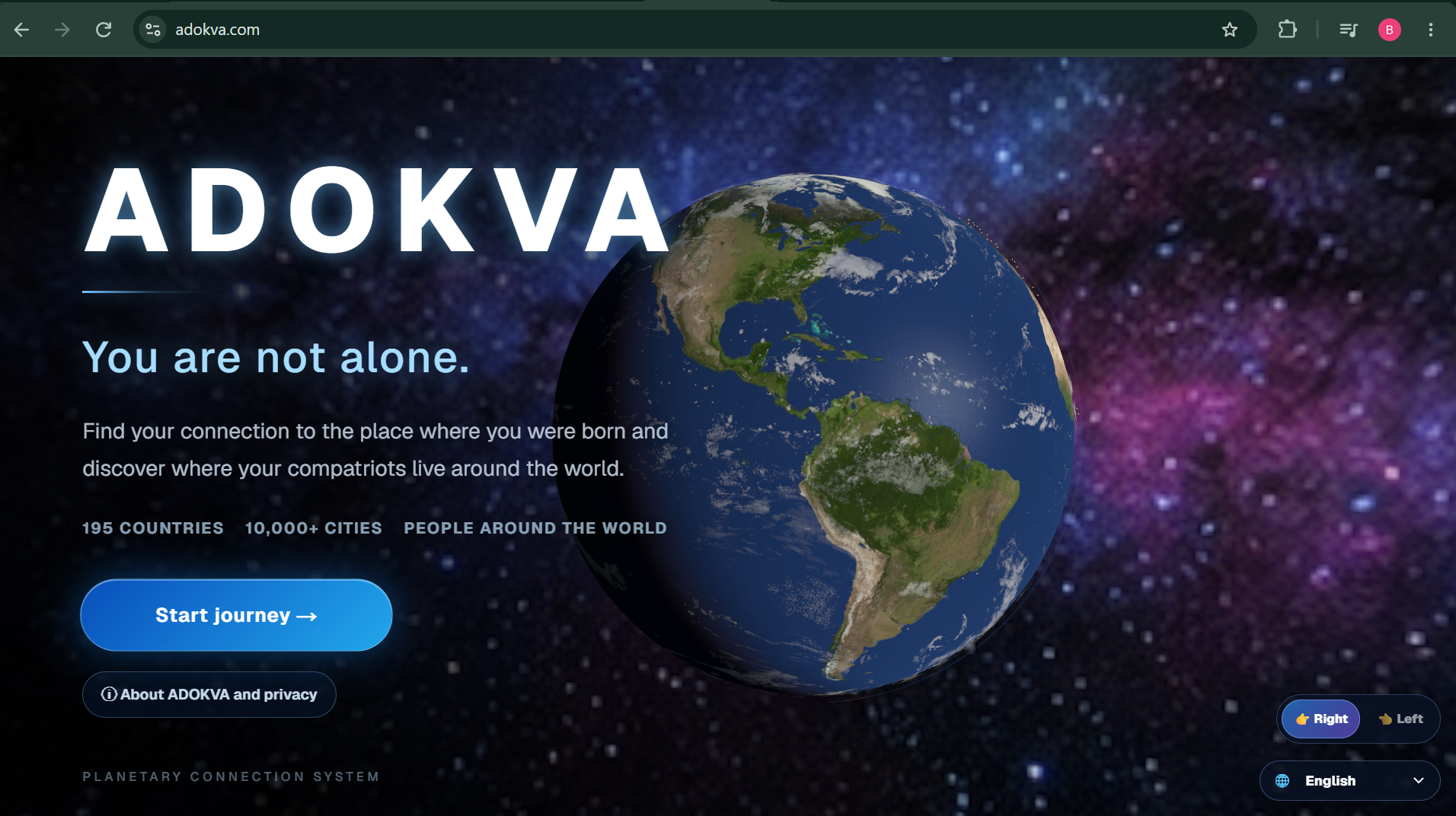
ADOKVA is a privacy-first interactive 3D experience for exploring the connection between the place where a person was born and the place where life has taken them. Its central message is simple:
You are not alone.
## The question behind ADOKVA
Millions of people live far from their hometowns. Some move for work, education or family. Others emigrate, travel for long periods or begin a completely new life in another country.
Existing maps are excellent at showing roads, borders and distances. Social networks show profiles, photos and posts. Messaging applications help people communicate once they already know whom they want to contact.
But I kept returning to a different question:
What if a map could show the human connection between home and the rest of the world?
Not the exact location of an individual. Not their private address. Not a public profile containing personal information. Instead, a wider picture of how people from the same hometown have spread across the planet.
I wanted to create something that could make a person in an unfamiliar city feel that their personal journey was part of a larger human story.
That idea became ADOKVA.
## Why use a 3D globe?
The Earth is more than decoration in ADOKVA. It is the main interface and an important part of the idea.
A list of cities can provide information, but it does not communicate the scale of migration. A traditional form can collect two locations, but it cannot express the emotional distance between them.
A globe can.
When people see their hometown and current city on Earth, the route becomes visible. A personal story that previously existed only in memory appears as a real path across countries, oceans and time zones.
ADOKVA begins with Earth, but the experience can move outward into the Solar System and deeper space. This change in scale is intentional. From far away, national borders disappear. Political divisions become invisible. Earth becomes one shared home.
That perspective supports the core message of the project: people may be separated by enormous distances, but they remain connected by places, memories and experiences.
The visual journey is designed to create curiosity before asking the user to do anything complicated. The first interaction should feel like exploration rather than registration.
## What ADOKVA does today
ADOKVA is currently an early-stage independent product.
The experience begins with a simple invitation to start a journey. The user can explore an interactive Earth, choose a language and adjust the interface for right- or left-handed use.
The concept is built around two questions:
Where were you born?
Where do you live now?
These two locations create a personal route across the globe. Instead of presenting migration as a row in a database, ADOKVA turns it into a visible journey.
The platform is designed around global coverage, including 195 countries and more than 10,000 cities. The goal is not only to support major capitals. Smaller hometowns matter because belonging is often connected to a very specific place rather than an entire country.
The current version focuses on the visual experience, the technical foundation and the privacy model. It is not presented as a finished social network, and it does not pretend to contain a huge established community.
This distinction is important. ADOKVA is being developed openly and gradually. The purpose of the early version is to discover whether people understand the idea, feel something when they see their route and want to continue exploring.
## Privacy is not an additional feature
Location-based products can easily become invasive.
A service may begin with a useful map and gradually request precise GPS coordinates, a full legal name, a phone number, photographs, contacts and continuous access to a person’s movements.
ADOKVA is being designed from a different starting point.
The product does not need to know a person’s street, building or apartment. A city is enough to represent the connection. Precise real-time location is unnecessary for the central experience.
Public profiles are also not required for the initial concept. A person should be able to explore their connection to home without immediately exposing their identity to strangers.
This creates an important design challenge. ADOKVA should help people feel the presence of others without turning human beings into publicly searchable points on a map.
The planned approach is based on several principles:
- Collect only the information required for the experience.
- Use cities rather than precise addresses.
- Avoid making personal information public by default.
- Make visibility and communication voluntary.
- Explain clearly what information is used and why.
- Present aggregated connections wherever possible.
- Do not create artificial pressure to reveal more data.
Privacy limits can make product development more difficult, but those limits can also produce better ideas.
Instead of asking, “How much information can we collect?”, ADOKVA asks, “What is the minimum information needed to create a meaningful connection?”
## A connection is more important than a profile
Many digital products begin by asking users to create a profile. They request a photograph, biography, list of interests and links to other social networks before the person has experienced any value.
ADOKVA begins with a place.
A hometown can carry an extraordinary amount of meaning. It can represent childhood, language, food, family, friendships, traditions and a particular view of the world.
Two people from the same place may recognise that connection before knowing anything else about each other.
This does not mean that everybody from the same city will become friends. It means that a shared origin can provide a natural first point of understanding.
ADOKVA is not intended to compete with large social networks by adding another feed, another collection of likes or another reason to publish personal photographs.
The intended path is simpler:
Planet → place → people → connection.
If communication is introduced, it should happen only when people choose it. A person could remain an anonymous part of an aggregated number or voluntarily indicate that they are open to receiving a greeting.
The product should respect both types of users: those who want to connect and those who only want to see the wider story of their hometown.
## The technical challenge of an immersive web experience
Building an interactive 3D world inside a browser creates a different set of problems from building a conventional landing page.
Textures, backgrounds, planetary objects, animation and WebGL rendering can produce a strong visual experience, but they also require careful optimisation.
A scene that loads quickly on one phone may take much longer on a laptop using a slow network or a distant VPN connection. High-resolution Earth textures can consume significant memory after decoding. Several large resources loaded simultaneously can delay the first useful interaction.
This has influenced an important technical principle for ADOKVA: the first meaningful frame should not depend on every high-quality asset being available.
The application should display a recognisable lightweight Earth first. Additional textures, clouds, night lights and other visual details can arrive later as optional improvements.
This progressive approach is especially important for a global product. A platform about people across the world cannot assume that every visitor has a new device, a fast connection or direct access to the nearest content delivery network.
Performance is therefore not only an engineering metric. It is part of accessibility.
The early testing process has included desktop browsers and mobile Safari, warm and cold loads, different network routes and careful examination of how individual textures and JavaScript files arrive.
These tests have already shown that visual ambition must be balanced with reliability. A beautiful planet has little value if the visitor waits several minutes before they can interact with it.
## What the early version has taught me
The first lesson is that a strong visual reaction is valuable, but it is not enough.
People can look at the globe, say that it is beautiful and then leave. A product needs to make the next action clear.
For ADOKVA, that action should not be another decorative animation. It should move the visitor closer to the central question:
Where are my people?
The second lesson is that trust must come before growth.
It would be easy to fill the interface with impressive fictional numbers or pretend that a large community already exists. That could produce a stronger screenshot, but it would damage the long-term relationship with users.
Real aggregate numbers must come from real participation. Demonstration information must be clearly identified as demonstration information.
The third lesson is that the product should not become a conventional social network simply because social features are familiar.
Profiles, comments, followers, likes and public posts may increase activity, but they can also bury the original purpose of the product.
ADOKVA should remain focused on belonging, place and voluntary connection.
## What comes next
The immediate goal is to make the core journey fast, reliable and understandable on different devices.
After that foundation is stable, the most important product work is to make Earth feel alive without compromising privacy.
Possible future steps include:
- A simple “I am here” signal attached to a city rather than a precise location.
- Honest aggregate counts showing how people from one hometown are distributed.
- Voluntary visibility for people who are open to communication.
- Meaningful notifications, such as new connections appearing in a selected city.
- A travel mode for people temporarily visiting another place.
- Better navigation from Earth to country, city and community levels.
- Lightweight greetings that do not expose private contact details.
- Clear controls for deleting information or becoming invisible.
These ideas will be tested gradually. Not every feature belongs in the final product.
The central test for every addition will be the same:
Does this help people feel connected while respecting their privacy?
## Building in public
ADOKVA is an independent project, and the early version will continue to evolve through real feedback.
I am especially interested in hearing from people who live far from home, members of diaspora communities, frequent travellers and anyone who has experienced the strange combination of freedom and loneliness that can come with starting life in a new place.
I also welcome feedback from developers and designers working with WebGL, progressive loading, internationalisation, privacy-first products and large global location datasets.
The project does not need empty praise. It needs honest answers:
- Does the idea make sense immediately?
- Does the globe strengthen the emotional experience?
- Would you want to see where people from your hometown live?
- What would make you return after the first visit?
- What information would you feel comfortable sharing?
- What would make you distrust a product like this?
Those answers will determine what ADOKVA becomes.
## You are not alone
ADOKVA began with a personal feeling, but the idea is universal.
People leave home for different reasons. Some move by choice. Others move because circumstances give them no alternative. Some quickly build a new community, while others continue to feel disconnected years later.
Technology cannot replace friendship, family or a genuine human relationship.
But it can create a moment of recognition.
It can show that a hometown is not only a point left behind. Its people continue moving, living and creating new stories across the world.
ADOKVA is an attempt to make those invisible connections visible — carefully, honestly and without demanding unnecessary personal information.
If you have ever looked at a map and wondered where your people are, ADOKVA was built from the same question.
Explore the project at https://www.adokva.com/