Why Most Practice Tests Fail (And How Verified Handbook Citations Fix Them)
Every year, millions of Americans prepare for high-stakes licensing and certification examinations. Whether an aspiring teenager or new resident studying for a state DMV driver permit test, an IT technician pursuing CompTIA A+, Network+, or Security+, a healthcare worker preparing for the Certified Nursing Assistant (CNA) exam, or an entrepreneur studying for a real estate salesperson license, the stakes could not be higher. Earning these credentials unlocks personal mobility, career advancement, higher hourly wages, and legal authorization to practice in regulated professions.
Yet despite the availability of countless free quiz apps, shared flashcard decks, and online study portals, first-time failure rates remain staggeringly high. In many US states, between 35% and 50% of applicants fail their DMV driver knowledge exam on their first attempt. Professional IT certification candidates routinely spend hundreds of dollars on retake vouchers after falling short on tricky performance-based questions and scenario-based simulations. Healthcare aides frequently struggle with clinical gotchas and state-specific safety regulations.
When candidates fail, they often blame test anxiety, bad luck, or lack of study hours. But in educational psychology and psychometrics, research consistently points to a different culprit: the poor structural quality of the practice materials candidates rely on. In this comprehensive guide, we examine the systemic flaws in modern exam prep, explore the cognitive science of psychometric test design, and demonstrate why verified handbook citations and balanced distractors are essential for passing on your very first attempt.
The Hidden Pitfalls of Crowdsourced and AI-Generated Exam Prep
Most candidates begin their preparation by searching for free practice tests online or downloading popular mobile quiz apps. While convenient, the majority of these platforms suffer from three severe architectural flaws that actively harm a student's preparation.
1. The Pervasiveness of Generative AI Hallucinations
The explosion of generative artificial intelligence has led to an influx of automatically generated study apps. While large language models can produce fluent prose, they lack grounded legal and statutory authority. In regulatory testing, details are everything. A driver manual in California outlines distinctly different blood alcohol concentration penalties, right-of-way protocols at four-way stops, and minor permit curfew restrictions than handbooks in Texas, Florida, or New York.
When an AI model generates practice questions without cross-referencing the current official state handbook, it frequently invents plausible-sounding rules, conflates statutes from different jurisdictions, or cites obsolete legal limits. When students memorize these hallucinated answers, they enter the testing center with false confidence, only to be disqualified on questions where state law differs from generic AI assumptions.
2. Flawed Distractor Design and Artificial Giveaways
In multiple-choice testing, the incorrect answer options are known as distractors. In professionally engineered psychometric exams, distractors are carefully calibrated to reflect common candidate misconceptions and legitimate edge cases. Creating realistic distractors requires deep subject-matter expertise.
Unfortunately, crowdsourced quiz repositories and low-budget test banks rely on flawed distractor construction. The most common error is the length bias giveaway: test creators make the correct answer detailed, nuanced, and long, while making the incorrect options short, generic, or obviously absurd. Test-takers quickly develop unconscious test-taking heuristics. They choose the longest option or eliminate the obvious filler without ever mastering the underlying concept. When faced with the real state examination—where all four options are identical in length, tone, and grammatical structure—their artificial shortcuts collapse.
3. The Absence of an Authoritative Standard of Truth
When a candidate misses a question on a generic quiz app, they are usually shown a brief one-line explanation or merely told that Option C was correct. The candidate has no way of verifying whether the provided rationale is accurate, which handbook edition it came from, or which section of the legal code governs the scenario. This lack of transparency breeds uncertainty and prevents deep remediation.
The Psychometrics of Effective Testing: Why Citations and Balanced Distractors Matter
To pass a standardized licensing exam, candidates cannot rely on passive recognition. They must build robust mental models capable of applying principles to novel scenarios. This requires practice materials built to rigorous psychometric standards.
The Role of Balanced Distractor Engineering
Properly constructed practice tests maintain strict parity among all answer choices. Each distractor must:
Match the grammatical structure and sentence length of the correct answer.
Represent a legitimate, documented misconception or common cognitive error.
Avoid absolute qualifiers such as "always", "never", "only", or "completely", which serve as artificial giveaways to savvy test-takers.
Test true domain knowledge rather than syntactic cleverness.
When distractors are properly balanced, students can no longer game the question. They are forced to actively process the scenario, evaluate the competing choices, and retrieve the correct rule from memory.
Why Verified Handbook Citations Are the Gold Standard
The single most critical innovation in modern test preparation is the integration of verified handbook citations. Every single practice question must be directly grounded in the official publication issued by the governing regulatory body:
For DMV Permit Tests: Exact chapter, section, and page citations from the current year state driver handbook.
For CompTIA IT Certifications: Exact objective and sub-domain mappings from the official CompTIA blueprint (such as Objective 1.2 or 3.4).
For Nursing & CNA Exams: Direct alignment with state nurse aide candidate bulletins and OBRA clinical safety regulations.
For Real Estate & Trades: Specific references to state licensing laws, contract statutes, and building code standards.
Grounded citations transform a practice test from a simple memory drill into an educational learning system. When a student answers a question—correctly or incorrectly—they can immediately view the precise handbook excerpt that establishes the legal fact. This eliminates ambiguity, reinforces statutory facts, and teaches students exactly how official examiners interpret the rules.
How Active Recall and Error-Driven Learning Rewire the Brain
Decades of cognitive science research, including the pioneering work of Roediger and Karpicke on the testing effect, demonstrate that active retrieval practice produces dramatically superior long-term retention compared to passive rereading or flashcard browsing.
1. The Testing Effect and Memory Consolidation
When you attempt to retrieve an answer from memory, your brain strengthens the neural pathways associated with that concept. The cognitive struggle of choosing between four plausible options signals to the brain that the information is critical, facilitating synaptic consolidation. Simply reading through a handbook does not engage this retrieval mechanism; testing yourself repeatedly against realistic distractors does.
2. Immediate Rationale-Driven Feedback
The timing of feedback is vital. Delayed scoring (seeing results only at the end of a 50-question block) allows erroneous reasoning to take root. By contrast, immediate feedback that explains why the chosen distractor was incorrect—backed by a verified statutory citation—allows candidates to correct their cognitive errors in real time. Error-driven learning turns mistakes into the most memorable lessons of the study session.
3. Diagnostic Weak-Spot Remediation
A well-structured practice platform does not treat all questions equally. By categorizing questions into specific domains (such as Road Signs vs Right-of-Way, or Network Troubleshooting vs Security Protocols), candidates can quickly pinpoint the exact sub-disciplines where their mastery is lagging. Focusing study time exclusively on weak domains produces exponential score improvements in minimum hours.
A Step-by-Step Blueprint for Passing Any Licensing Exam
To maximize your chances of passing on your first attempt, follow this proven four-step preparation blueprint:
Take an Unassisted Diagnostic Baseline Test: Before reading hundreds of handbook pages, start with a 20-question diagnostic exam under realistic conditions. Do not look up answers. This baseline reveals your natural strengths and exposes critical gaps in your foundational knowledge.
Read the Handbook Through the Lens of Citations: Instead of reading your official driver manual or certification guide like a novel, use your practice citations as study anchors. When you encounter a citation in a practice question, open that exact page in your handbook. Reading the surrounding context deepens your understanding of related rules that may appear on test day.
Practice Without Time Pressure Before Simulating Test Day: Begin your study sessions in an untimed practice mode with immediate rationales enabled. Take time to read every explanation, even for questions you answered correctly. Once you consistently score 85% or higher across all domains, switch to timed full-length exam simulations to build speed and stamina.
Maintain an Error Log: Every time you miss a question, document the concept in a personal review log. Note the question topic, the misconception that led to your mistake, and the official handbook rule that governs it. Reviewing your error log 24 hours before your official exam ensures you will not repeat identical mistakes on the real test.
Conclusion and Sourced Study Resources
Licensing and certification exams are designed to protect public safety, ensure professional competence, and maintain industry standards. Passing them is an essential milestone that opens doors to new careers, higher earnings, and greater independence.
Do not gamble your exam fee, time, and confidence on unverified question dumps or hallucinated quiz apps. Demand practice materials built with balanced distractors, verified handbook citations, and transparent explanations.
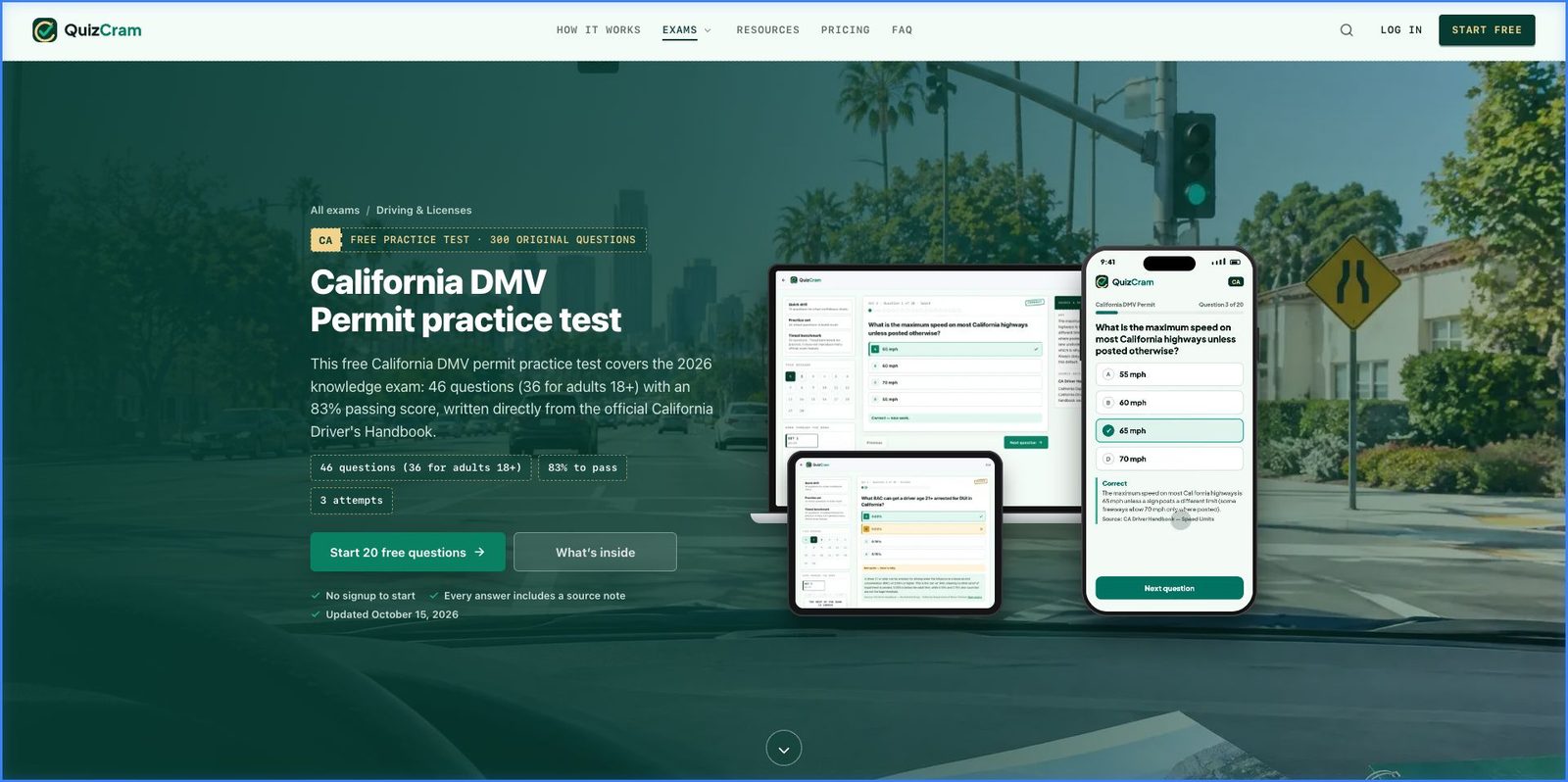
For candidates preparing for state DMV permit tests, CompTIA IT certifications, CNA healthcare exams, and state vocational trades, QuizCram provides free 20-question diagnostic exams with direct official handbook citations for over 50 US licensing tests. Explore the free diagnostic tests today and pass your licensing exam with complete confidence.