E2B
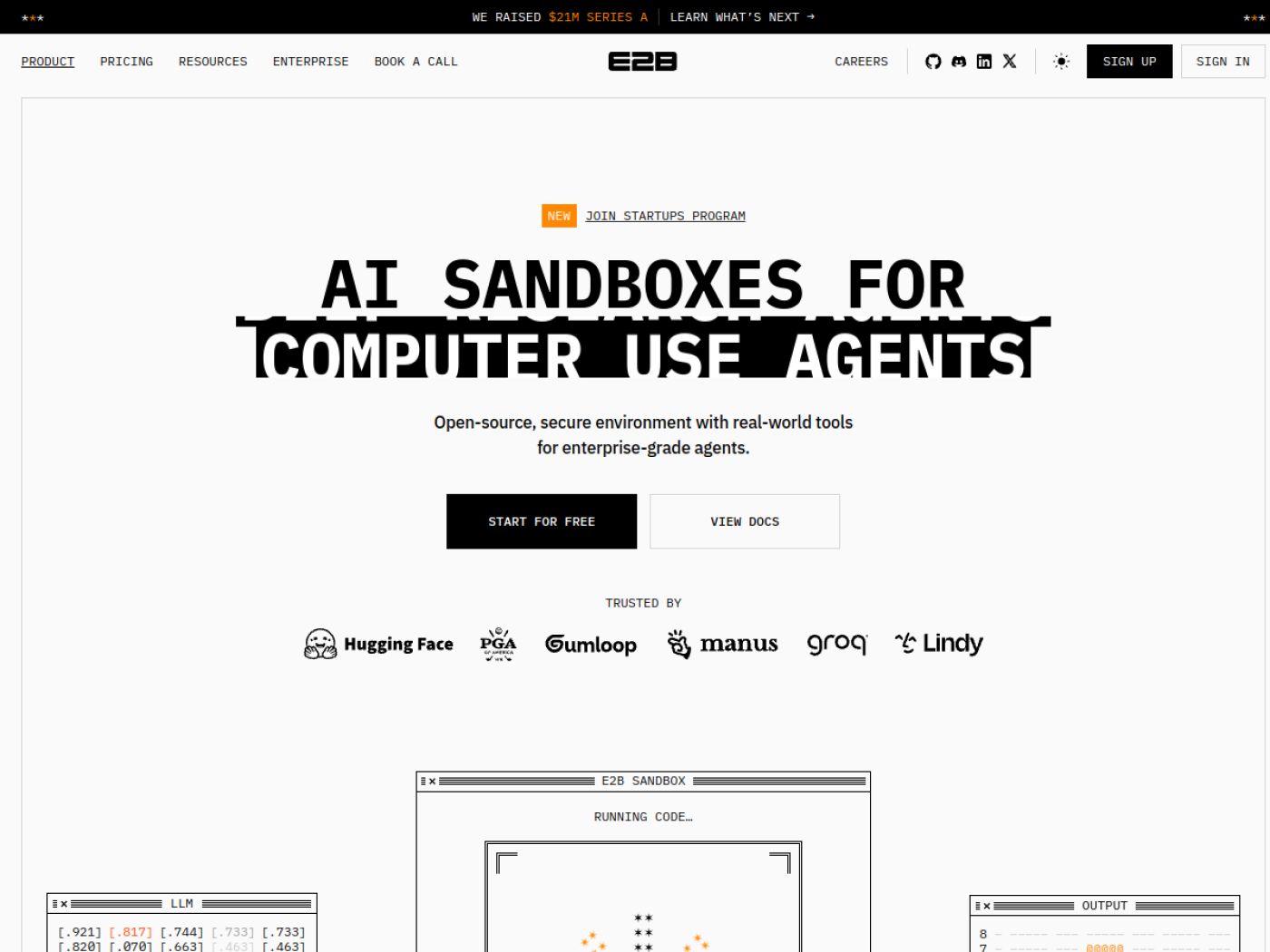
SoftwareOpen-source, secure cloud sandboxes that let AI agents run code and use real tools safely.
About E2B
The moment you let an AI agent actually run code, you have a serious problem: you can't just execute arbitrary AI-generated code on your own servers and hope for the best. E2B solves exactly that — it provides open-source, isolated cloud sandboxes where AI agents can securely execute code and use real-world tools, safely walled off from everything else.
A safe place for agents to run code
E2B gives AI agents isolated sandbox environments to run Python, JavaScript and other languages inside microVM-based containers powered by Firecracker technology (the same isolation tech behind serverless platforms). That means an agent can write and execute code, install packages, read and write files, and use a terminal — all without any risk to your infrastructure. For anyone building agentic AI, that secure execution layer is a foundational, hard-to-build-yourself piece.
Fast and long-running
Performance is a big deal for agent workflows, and E2B delivers sub-200ms startup times so spinning up a sandbox doesn't bottleneck your agent, plus support for sessions up to 24 hours for longer, stateful tasks. It integrates with major LLM providers including OpenAI, Anthropic, Mistral and Meta's models, so it drops into whatever AI stack you're using. It pairs naturally with vector databases like Weaviate and Qdrant in the broader agent infrastructure toolkit.
Built for real agent use cases
E2B is designed for the workloads people are actually building: deep-research agents, data-analysis tools, coding assistants and reinforcement-learning systems. Anywhere an AI needs to genuinely do things — run a calculation, execute a script, manipulate files — rather than just talk, E2B is the safe environment where that happens.
Open and enterprise-ready
Being open source means transparency and the option to inspect or self-host, while the platform is built to enterprise-grade standards for companies deploying agents in production. That combination is increasingly what serious AI teams look for.
Who it's for
E2B suits enterprise companies, AI startups and developers building agentic workflows — anyone whose AI needs to execute code and use tools securely rather than merely generate text.
Pricing
E2B is freemium with paid tiers (including a Pro plan) for heavier usage; you can start free to build and test your agents' code execution before scaling up. Being open source, self-hosting is also on the table for teams that want full control.
Bottom line: E2B is the secure, open-source sandbox layer for AI agents — fast, isolated microVMs where agents can safely run code and use real tools, making it foundational infrastructure for anyone building serious agentic applications.
Tags
Ratings & reviews
No ratings yet
Be the first to rate E2B — your honest take helps others decide.
- No reviews yet — be the first to rate E2B.
Similar softwares

Nitroindexer
Bulk URL indexing and Google index checks for SEO professionals.
Vectoree
Give your coding agent a backend — models, auth, database and storage in one cloud.

Embarko
Paste one prompt into Claude Code, Cursor or Codex and your agent deploys the app to a live HTTPS URL. No signup before your first deploy.
Compare E2B
Similar software
Daytona
Secure, elastic sandboxes that run AI-generated code with sub-90ms starts and full isolation.
NeuraKeep
Auditable, source-cited memory for AI agents with review-gated durable updates, conflict visibility, and preserved failure lessons.
Moltgate
Turn AI agent ideas into paid offers. Learn what sells, then automate what repeats.

LaunchNest LN
LaunchNest LN is a product launch platform for SaaS, AI tools, and developer products. Discover new products, launch your own, and grow with a global community.

Browserbase
Headless browser infrastructure for AI agents and automation — run reliable, scalable browsers in the cloud via API.

Flowise
An open-source, drag-and-drop tool for visually building LLM apps, chatbots and AI agents without heavy coding.
Related reads

Text Differ: A Simple and Powerful Online Text Comparison Tool
Compare two versions of text, code, or documents instantly with Text Differ. Discover its key features, comparison modes, and practical uses.
The 5 Best Open-Source Authentication Tools in 2026
Open-source auth lets you own your users' data and avoid per-user pricing. Here are the five best self-hostable authentication tools in 2026, compared.
The 6 Best Vector Databases in 2026 (for RAG & AI Search)
Vector databases power RAG, semantic search and AI memory. Here are the six best in 2026 — from managed Pinecone to open-source Qdrant, Weaviate and Chroma — with who each is for.
Community discussion (0)
Ask questions, share tips, or compare notes with other E2B users.