Hookdeck
SoftwareReliable infrastructure for receiving, transforming and routing webhooks and events — without managing it yourself.
About Hookdeck
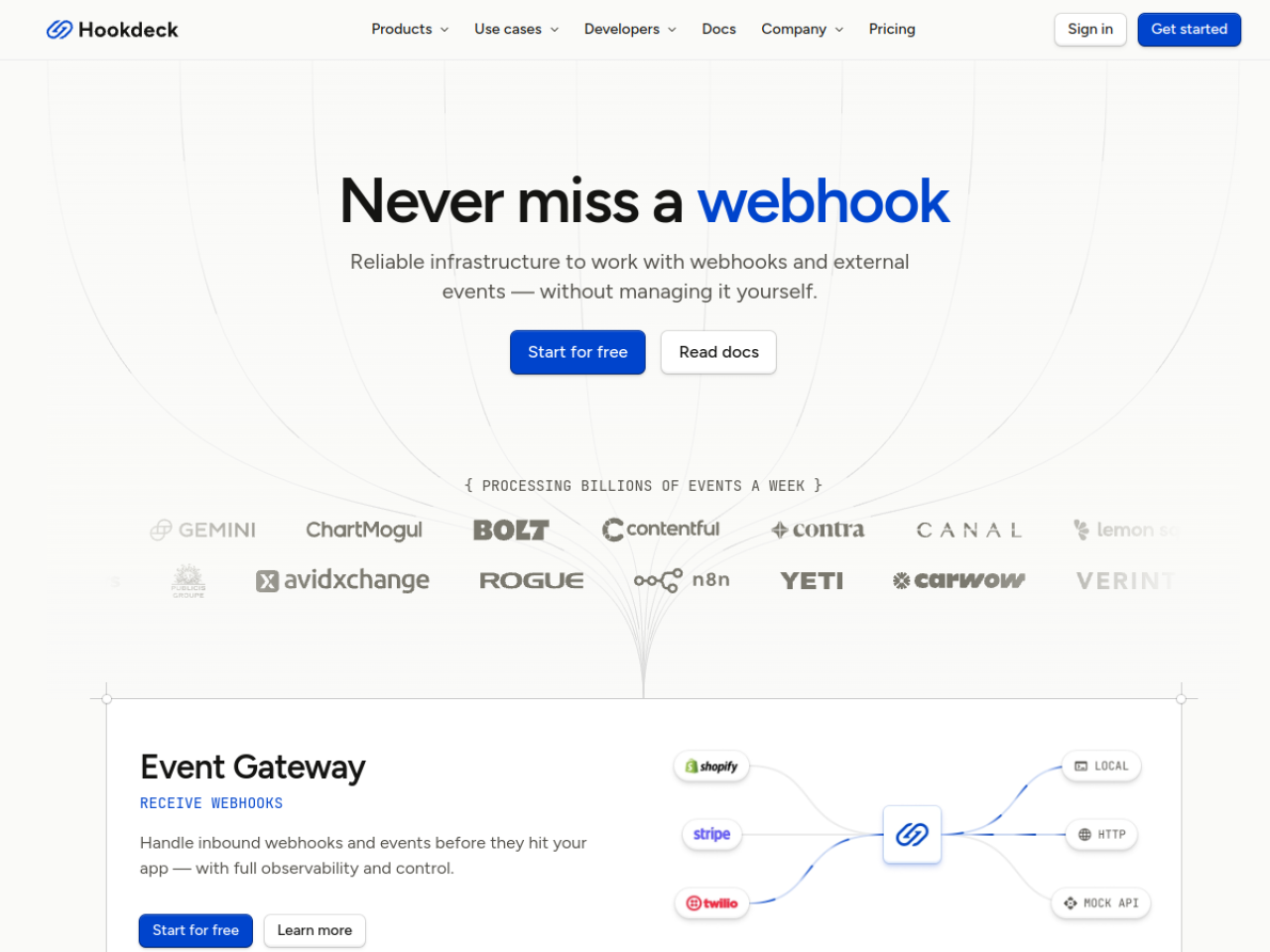
Hookdeck is infrastructure for webhooks and event-driven systems — it receives, transforms, routes and reliably delivers events, both inbound and outbound, so developers don't have to build and babysit that plumbing themselves. It's a developer-first platform for handling webhooks at any scale, from a side project to billions of events.
What is Hookdeck?
Hookdeck sits between the services that emit events and the applications that consume them, giving teams full observability and control over event flow. Its Event Gateway handles inbound webhooks — receiving, transforming and routing them before they hit your app — while Outpost provides outbound webhook delivery, so you can both consume and send webhooks reliably from one platform.
Who it's for
Hookdeck is built for developers and teams building APIs, SaaS and PaaS products who need dependable webhook handling — whether they're just starting to receive events or already processing them at massive scale. It's for anyone who has felt the pain of dropped, duplicated or hard-to-debug webhooks and wants that solved as infrastructure rather than as fragile in-house code.
Key features
- Event Gateway: receive, transform and route inbound webhooks
- Outpost: open-source outbound webhook delivery, managed or self-hosted
- CLI for receiving and debugging webhooks on localhost
- Console for previewing and inspecting payloads (no account needed)
- Radar for monitoring third-party webhook latency with alerts
- Multi-destination routing and full event observability
- MCP server compatibility (Cursor, Claude and other MCP clients)
- Spike protection and backpressure management
Reliability as a feature
Webhooks fail in quiet, painful ways — a downstream outage, a traffic spike, a silently dropped event. Hookdeck is built to prevent that, claiming 99.999% uptime with spike protection and backpressure management so bursts don't overwhelm your app, and automatic retries so transient failures don't lose data. Live production metrics are published via API and a status dashboard, so the reliability claims are verifiable rather than marketing.
Built for how developers actually work
Hookdeck's tooling meets developers where they are. The CLI forwards and debugs webhooks straight to localhost, the Console lets you preview and inspect payloads with no account required, and Radar monitors third-party webhook latency and alerts you when a provider slows down. Together they turn webhook debugging — normally a frustrating guessing game — into something observable and controllable.
Inbound, outbound and agent-ready
By covering both the Event Gateway for inbound and Outpost for outbound (which is open source and self-hostable), Hookdeck handles the full webhook lifecycle in one place instead of two separate stacks. It's also MCP-server compatible, so it works with AI clients like Cursor and Claude, and it carries deep compliance — SOC 2 Type II, HIPAA, SSO, MFA, GDPR and more — making it viable for regulated, enterprise environments.
Pay for what you process
Hookdeck uses usage-based pricing for both the Event Gateway and Outpost, with published comparison matrices, so costs track the volume of events you actually handle rather than a fixed seat count. That suits the reality of webhook traffic, which is spiky and scales with your product — a small project pays little, and the platform grows with you into high volume without forcing an early enterprise commitment. Because Outpost is open source, teams that prefer to self-host the outbound side can do that too.
Why choose Hookdeck
For any team that depends on webhooks and is tired of building and maintaining brittle event plumbing, Hookdeck is a strong, developer-first choice. Its inbound and outbound coverage, serious reliability guarantees, excellent debugging tools and enterprise compliance make it a practical way to handle events at any scale — and to stop losing sleep over dropped webhooks.
Tags
Ratings & reviews
No ratings yet
Be the first to rate Hookdeck — your honest take helps others decide.
- No reviews yet — be the first to rate Hookdeck.
Similar softwares

FeatQ
Feature-request board for software teams: users vote, your coding agent pulls the top request as a spec over MCP, voters get emailed when it ships.

Nitroindexer
Bulk URL indexing and Google index checks for SEO professionals.
Vectoree
Give your coding agent a backend — models, auth, database and storage in one cloud.
Compare Hookdeck
Similar software
SchemaShield
Catch breaking database schema changes before deployment with deterministic impact analysis and compatibility actions.
Svix
Webhooks as a service — reliable sending, retries, monitoring and a customer portal, so you don't build it yourself.
Courier
A multichannel messaging platform to orchestrate notifications across email, SMS, push, Slack and in-app.
Link Preview API
Free API for Open Graph data, title & images

Inngest
Event-driven durable functions — write reliable, multi-step background workflows in your codebase with built-in retries and flow control.
OpenStatus
An open-source status page and uptime monitoring platform to communicate incidents and prove reliability.
Related reads

Text Differ: A Simple and Powerful Online Text Comparison Tool
Compare two versions of text, code, or documents instantly with Text Differ. Discover its key features, comparison modes, and practical uses.
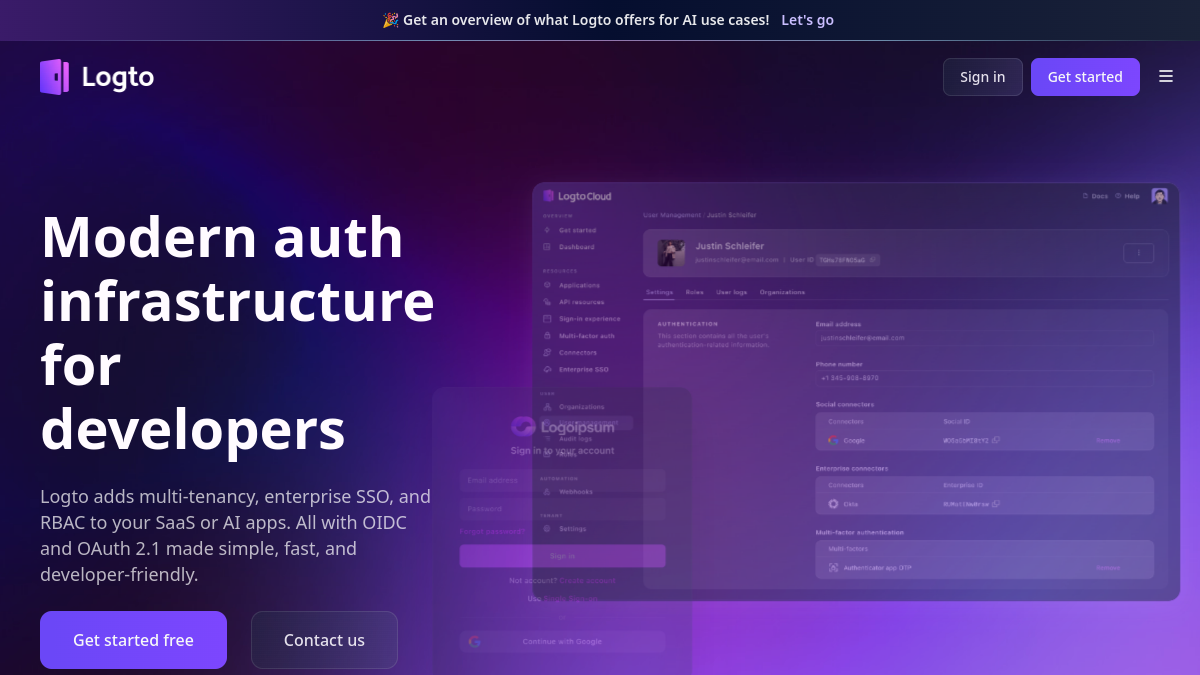
The 5 Best Open-Source Authentication Tools in 2026
Open-source auth lets you own your users' data and avoid per-user pricing. Here are the five best self-hostable authentication tools in 2026, compared.
The 6 Best Vector Databases in 2026 (for RAG & AI Search)
Vector databases power RAG, semantic search and AI memory. Here are the six best in 2026 — from managed Pinecone to open-source Qdrant, Weaviate and Chroma — with who each is for.
Community discussion (0)
Ask questions, share tips, or compare notes with other Hookdeck users.