The Best Convex Alternatives in 2026
Tolodora Editorial Team
Independent software reviews for founders and small businesses.
Convex has won fans among full-stack TypeScript developers for its reactive queries, built-in serverless functions, and database that updates the UI automatically without manual cache invalidation. But its opinionated document-database model, deployment approach, and pricing don't fit every team — some developers want Postgres under the hood, true self-hosting, or a smaller learning curve for a solo project.
Whether you're chasing a relational data model, an open-source stack you can run on your own servers, or the biggest mobile SDK ecosystem around, there's a backend platform built for that priority. If you want the short version: Supabase is the strongest all-around pick for teams that want Postgres with realtime and auth built in, Firebase remains the default for mobile-first apps backed by Google's infrastructure, and Appwrite is the top choice for teams that want a fully self-hostable, open-source alternative.

Comparing against the original?
See Convex's profile, rating & reviews on Tolodora →
| # | Tool | Best for | Rating |
|---|---|---|---|
| 1 | Supabase | Teams that want relational data, SQL, and row-level security instead of Convex's document model. | 4.1/5 |
| 2 | Firebase | Mobile-first apps that want native iOS/Android SDKs and Google's infrastructure at scale. | 4.0/5 |
| 3 | Appwrite | Teams that want Convex-style breadth of features but with full control over hosting and no vendor lock-in. | 4.1/5 |
| 4 | PocketBase | Solo developers and small side projects that want a lightweight backend without a hosted service or bill. | 3.9/5 |
| 5 | Nhost | Teams that specifically want GraphQL instead of Convex's function-call API model. | 3.8/5 |
| 6 | Hasura | Teams with an existing Postgres (or other) database that want an instant API layer rather than a full new backend. | 3.7/5 |
Supabase
- Pricing
- 8.0/10
- Functionality
- 8.8/10
- Ease of use
- 8.3/10
- Support
- 7.8/10
What I like
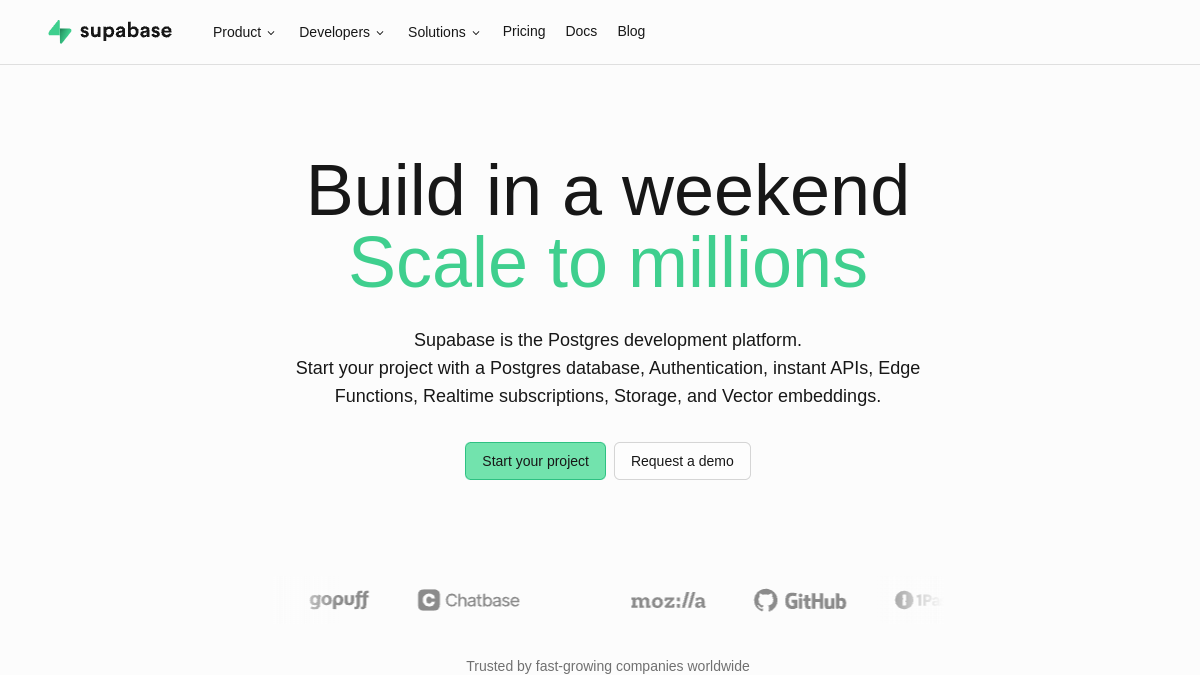
A real Postgres database with auto-generated APIs, auth, storage, and realtime subscriptions in one platform.
Best for
Teams that want relational data, SQL, and row-level security instead of Convex's document model.
Where Convex builds around its own reactive document database and TypeScript functions, Supabase is built on standard Postgres, so you keep SQL, foreign keys, and the wider Postgres tooling ecosystem. Realtime subscriptions and edge functions cover much of what draws developers to Convex, but with a more traditional relational data model and the option to self-host.
Firebase
- Pricing
- 7.0/10
- Functionality
- 8.5/10
- Ease of use
- 8.4/10
- Support
- 8.0/10
What I like
The most mature mobile SDKs on the market, backed by Google Cloud, with push notifications, crash reporting, and analytics built in.
Best for
Mobile-first apps that want native iOS/Android SDKs and Google's infrastructure at scale.
Firebase predates Convex by over a decade and has the deepest mobile feature set of any BaaS, but it trades Convex's TypeScript-native, strongly-typed developer experience for Firestore's NoSQL document model and Google Cloud's more complex pricing and IAM setup. There's no self-hosting option, unlike some Convex-adjacent tools.
Appwrite
- Pricing
- 8.4/10
- Functionality
- 8.4/10
- Ease of use
- 8.0/10
- Support
- 7.6/10
What I like
Fully open-source and self-hostable via Docker, with auth, database, storage, functions, and messaging in one deployable unit.
Best for
Teams that want Convex-style breadth of features but with full control over hosting and no vendor lock-in.
Appwrite covers roughly the same surface area as Convex — database, functions, auth, storage, realtime — but as an open-source project you can self-host with no usage caps, which Convex's managed-only model doesn't offer. The tradeoff is more infrastructure responsibility if you don't use Appwrite Cloud.
PocketBase
- Pricing
- 9.5/10
- Functionality
- 6.8/10
- Ease of use
- 9.0/10
- Support
- 6.2/10
What I like
A single self-contained binary with SQLite, auth, file storage, and a realtime API — no infrastructure to provision.
Best for
Solo developers and small side projects that want a lightweight backend without a hosted service or bill.
PocketBase is the minimalist counterpoint to Convex: instead of a managed cloud platform, you run one executable and get a working backend with an admin UI in minutes. It lacks Convex's scalable serverless functions and managed infrastructure, so it fits small projects and prototypes better than production apps at scale.
Nhost
- Pricing
- 7.4/10
- Functionality
- 8.0/10
- Ease of use
- 7.8/10
- Support
- 7.2/10
What I like
Instant GraphQL APIs over Postgres, built on Hasura, plus auth, storage, and serverless functions.
Best for
Teams that specifically want GraphQL instead of Convex's function-call API model.
Nhost pairs Postgres with Hasura's auto-generated GraphQL layer, which is a fundamentally different API style from Convex's typed function calls and reactive queries. It's a good fit if your team already thinks in GraphQL and wants subscriptions and row-level auth without hand-writing a schema layer.
Hasura
- Pricing
- 6.8/10
- Functionality
- 8.2/10
- Ease of use
- 7.4/10
- Support
- 7.4/10
What I like
Instant, high-performance GraphQL and REST APIs generated directly from an existing database schema.
Best for
Teams with an existing Postgres (or other) database that want an instant API layer rather than a full new backend.
Hasura isn't a full BaaS like Convex — it's an API layer you point at a database you already run, which makes it a better fit for teams that don't want to migrate data into a new platform. It skips Convex's bundled function runtime and reactive UI syncing in favor of GraphQL subscriptions over your own infrastructure.
The verdict
Pick Supabase for a Postgres-based all-rounder, Firebase for mobile-first apps, Appwrite for self-hosted control, PocketBase for lightweight solo projects, and Nhost or Hasura if GraphQL is a hard requirement.
Whatever you shortlist, run your real work through it for a week before committing — the right tool is the one that quietly disappears and lets you get back to it. And if you build software like this yourself, you can list it on Tolodora free.
Frequently asked questions
What is the closest alternative to Convex?
Supabase is generally considered the closest full-featured alternative, since both bundle a database, auth, storage, and realtime updates in one platform — though Supabase uses Postgres and SQL while Convex uses its own reactive document database and TypeScript functions.
Is there an open-source alternative to Convex?
Yes. Appwrite, Supabase, and PocketBase are all open-source and can be self-hosted, which Convex currently does not support since it's offered only as a managed cloud service.
Which Convex alternative is best for small or solo projects?
PocketBase is the lightest option, running as a single binary with no separate hosting bill, making it popular for prototypes and small side projects where Convex's managed infrastructure would be overkill.
Keep exploring
Building one of these alternatives?
List your tool on Tolodora and get discovered by buyers comparing options.
Launch Your Product