The Best Nhost Alternatives in 2026
Tolodora Editorial Team
Independent software reviews for founders and small businesses.
Nhost pairs a managed Postgres database with Hasura's GraphQL engine, built-in authentication, file storage, and serverless functions, positioning itself as an open-source alternative to Firebase for teams who want a relational database at the core. If you're evaluating other backend-as-a-service platforms — whether for more flexible pricing, a different data model, or a bigger ecosystem — several strong options are worth comparing.
Below we compare six of the most-searched Nhost alternatives across pricing value, support, ease of use, and functionality. For a near-identical Postgres-and-GraphQL experience with a larger community, Supabase is the closest match; for the simplest possible self-hosted setup, PocketBase is hard to beat; and for teams already committed to Google's ecosystem, Firebase remains the default choice.

Comparing against the original?
See Nhost's profile, rating & reviews on Tolodora →
| # | Tool | Best for | Rating |
|---|---|---|---|
| 1 | Supabase | Teams that want a Postgres-native BaaS with instant REST and GraphQL APIs and strong community support. | 4.3/5 |
| 2 | Firebase | Mobile-first apps that want zero infrastructure management and deep Google Cloud integration. | 4.2/5 |
| 3 | Appwrite | Developers who want an all-in-one self-hosted backend with strong Docker-based deployment options. | 4.1/5 |
| 4 | Hasura | Teams that already have a Postgres database and just need a fast, secure GraphQL layer on top. | 4.0/5 |
| 5 | PocketBase | Solo developers and small projects that want the simplest possible self-hosted backend with minimal ops overhead. | 3.9/5 |
| 6 | Convex | TypeScript teams building realtime apps who want backend logic and database queries in one reactive layer. | 4.0/5 |
Supabase
- Pricing
- 7.8/10
- Functionality
- 9.1/10
- Ease of use
- 8.9/10
- Support
- 8.4/10
What I like
Open-source Firebase alternative built on Postgres with a generous free tier and a large ecosystem.
Best for
Teams that want a Postgres-native BaaS with instant REST and GraphQL APIs and strong community support.
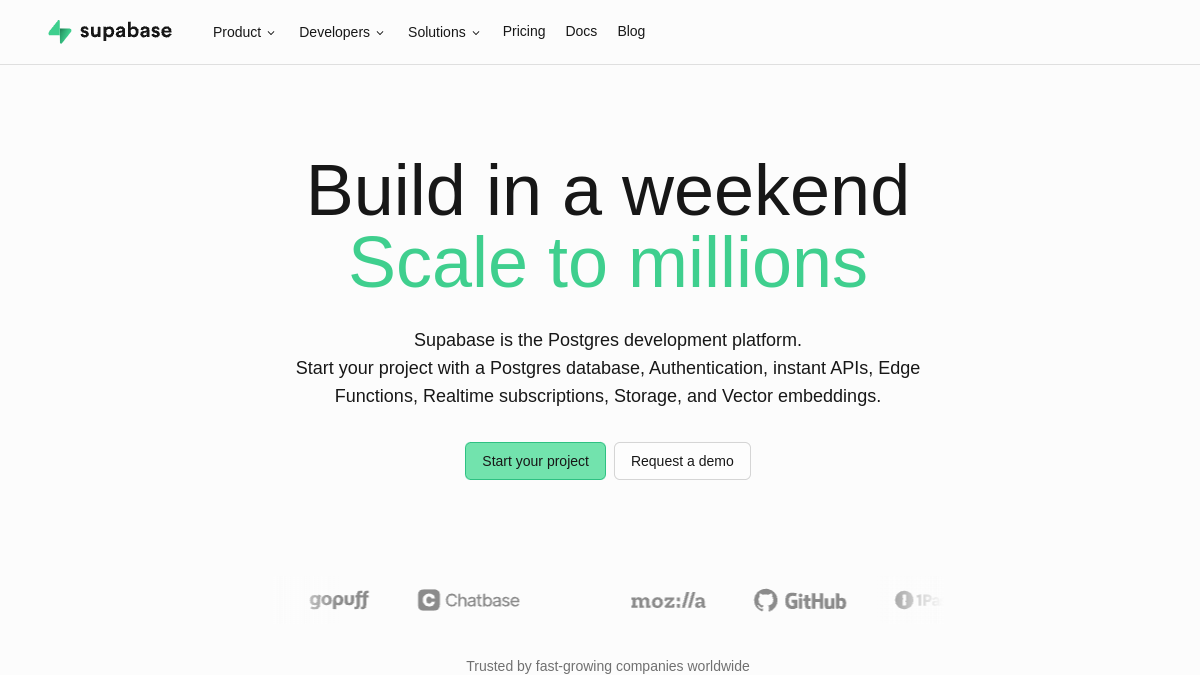
Supabase is the closest match to Nhost — both wrap Postgres with auth, storage, and realtime, but Supabase auto-generates REST APIs via PostgREST alongside optional GraphQL, and has a much larger community and job market. Nhost leans more heavily on Hasura's GraphQL engine, while Supabase feels more SQL-native for teams that prefer REST.
Firebase
- Pricing
- 6.8/10
- Functionality
- 8.7/10
- Ease of use
- 9.1/10
- Support
- 8.6/10
What I like
Google's fully managed backend platform with mature mobile SDKs and massive scale.
Best for
Mobile-first apps that want zero infrastructure management and deep Google Cloud integration.
Firebase is the original BaaS that Nhost positions itself against, but it uses Firestore, a NoSQL document store, instead of Postgres. Teams that need relational data, complex joins, or SQL portability will find Nhost's Postgres foundation a better fit than Firebase's proprietary NoSQL model.
Appwrite
- Pricing
- 8.3/10
- Functionality
- 8.2/10
- Ease of use
- 8.5/10
- Support
- 7.9/10
What I like
Self-hostable open-source backend with a polished dashboard and broad SDK coverage across languages.
Best for
Developers who want an all-in-one self-hosted backend with strong Docker-based deployment options.
Appwrite and Nhost both ship as open-source, self-hostable stacks, but Appwrite runs on MariaDB internally rather than exposing raw Postgres, trading some of Nhost's SQL flexibility for a more opinionated, batteries-included API surface. Appwrite's dashboard and self-hosting documentation are generally considered more mature.
Hasura
- Pricing
- 7.4/10
- Functionality
- 8.6/10
- Ease of use
- 7.7/10
- Support
- 8.1/10
What I like
Instant GraphQL API generator over an existing Postgres database, with fine-grained permissions.
Best for
Teams that already have a Postgres database and just need a fast, secure GraphQL layer on top.
Hasura is the GraphQL engine Nhost is actually built around, so choosing Hasura directly gets you the same query engine without Nhost's bundled auth, storage, and functions. It suits teams that want to assemble their own backend from best-of-breed pieces rather than take Nhost's opinionated full-stack bundle.
PocketBase
- Pricing
- 9.6/10
- Functionality
- 6.6/10
- Ease of use
- 9.0/10
- Support
- 5.8/10
What I like
A single-file, self-hosted backend with built-in auth, file storage, and a realtime database, and no external dependencies.
Best for
Solo developers and small projects that want the simplest possible self-hosted backend with minimal ops overhead.
PocketBase is dramatically lighter than Nhost — it ships as one Go binary backed by SQLite rather than Postgres, so it lacks Nhost's GraphQL API and horizontal scalability. It's a strong pick for prototypes and small apps, but teams expecting to scale to a full relational Postgres workload will outgrow it faster than Nhost.
Convex
- Pricing
- 7.1/10
- Functionality
- 8.3/10
- Ease of use
- 8.6/10
- Support
- 7.8/10
What I like
A reactive backend-as-a-service with TypeScript-native functions and automatic realtime query updates.
Best for
TypeScript teams building realtime apps who want backend logic and database queries in one reactive layer.
Convex takes a different architectural approach than Nhost, replacing Postgres and GraphQL with its own document-relational database and TypeScript function runtime, so there's no SQL or GraphQL layer to learn. Nhost is the better choice for teams committed to Postgres and GraphQL, while Convex suits teams who want tightly integrated, reactive TypeScript from front end to backend.
The verdict
Choose Supabase for the closest Postgres-and-GraphQL experience with a larger ecosystem, Firebase for mobile-first apps already on Google Cloud, Appwrite or PocketBase for simpler self-hosted setups, Hasura if you just need the GraphQL layer alone, and Convex for TypeScript-native realtime apps.
Whatever you shortlist, run your real work through it for a week before committing — the right tool is the one that quietly disappears and lets you get back to it. And if you build software like this yourself, you can list it on Tolodora free.
Frequently asked questions
What is the closest alternative to Nhost?
Supabase is the closest alternative, since both are open-source backend-as-a-service platforms built around a managed Postgres database with auth, storage, and realtime features, though Supabase relies on PostgREST for its REST API rather than Hasura's GraphQL engine.
Is Nhost built on Hasura?
Yes, Nhost uses Hasura as its GraphQL engine layer on top of Postgres, then adds its own authentication, file storage, and serverless functions around it, which is why choosing Hasura directly is also a valid option for teams that only need the GraphQL API.
Which Nhost alternative is best for a free or self-hosted setup?
PocketBase is the lightest self-hosted option, running as a single Go binary with SQLite, while Appwrite offers a more full-featured self-hosted stack with Docker; both can be run for free on your own infrastructure, unlike Nhost's managed cloud pricing model.
Keep exploring
Building one of these alternatives?
List your tool on Tolodora and get discovered by buyers comparing options.
Launch Your Product