The Best Sentry Alternatives in 2026 (Error Monitoring)
Tolodora Editorial Team
Tolodora's editorial team — we research, compile and regularly update these software guides from public sources and product documentation.
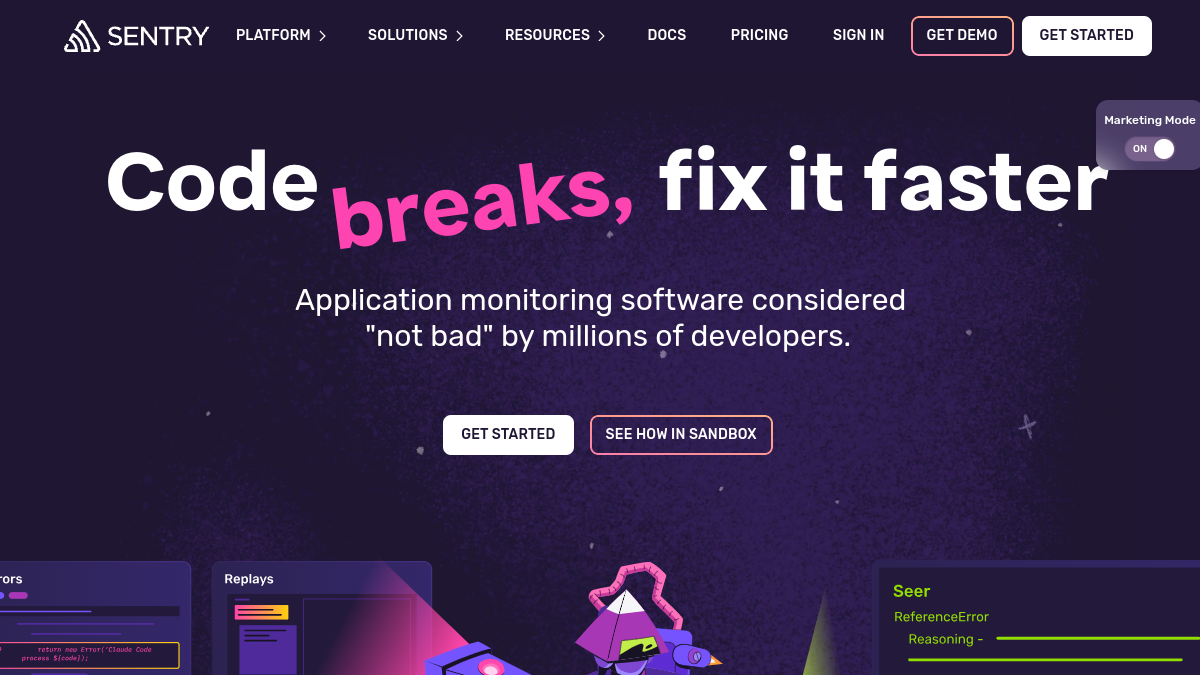
Sentry made error and performance monitoring accessible to developers. But depending on whether you want full-stack observability, session replay tied to errors, or a self-hosted, open-source option, another tool may fit your team better.
These all capture errors and help you debug production issues; they differ on scope (errors vs full observability), pricing, and openness.
We rated every pick on four things — pricing and value, functionality, ease of use, and support. Here's the rundown.

Comparing against the original?
See Sentry's profile, rating & reviews on Tolodora →
| # | Tool | Best for | Rating |
|---|---|---|---|
| 1 | Datadog | Teams that want unified, full-stack observability, not just error tracking. | 4.0/5 |
| 2 | Rollbar | Dev teams that want clean, focused error monitoring and fast triage. | 4.3/5 |
| 3 | Bugsnag | Teams (especially mobile) that want to monitor app stability and releases. | 4.3/5 |
| 4 | LogRocket | Frontend teams that want to reproduce bugs by watching real user sessions. | 4.3/5 |
| 5 | Highlight | Teams wanting open-source, full-stack monitoring with session replay. | 4.4/5 |
| 6 | GlitchTip | Budget-conscious teams that want simple, self-hostable error tracking. | 4.2/5 |
Datadog
- Pricing
- 5.8/10
- Functionality
- 9.6/10
- Ease of use
- 8.0/10
- Support
- 8.6/10
What I like
End-to-end observability — metrics, logs, traces, APM, and error tracking — across your whole stack in one platform.
Best for
Teams that want unified, full-stack observability, not just error tracking.
Datadog is the observability heavyweight: it monitors infrastructure, applications, logs, and errors together, with powerful dashboards and alerting. It's pricier and broader than Sentry, ideal when you want one platform for everything, not just application errors. Among your business, it earns its spot for the reasons above.
Rollbar
- Pricing
- 8.2/10
- Functionality
- 8.8/10
- Ease of use
- 9.0/10
- Support
- 8.6/10
What I like
Focused, real-time error tracking with great grouping, workflow integrations, and AI-assisted triage.
Best for
Dev teams that want clean, focused error monitoring and fast triage.
Plenty of your business land on it after weighing the field. Rollbar is a strong, developer-friendly Sentry alternative for error tracking: real-time alerts, smart grouping, and integrations with your workflow, plus AI features to speed up triage. If you want focused error monitoring done well, it's an excellent choice.
Bugsnag
- Pricing
- 8.0/10
- Functionality
- 8.8/10
- Ease of use
- 8.8/10
- Support
- 8.6/10
What I like
Stability-focused error monitoring with a clear stability score, strong mobile support, and good release tracking.
Best for
Teams (especially mobile) that want to monitor app stability and releases.
Plenty of your business land on it after weighing the field. Bugsnag (part of SmartBear) emphasizes application stability, with a stability score, excellent mobile SDKs, and release health tracking. For teams that care about stability metrics and mobile especially, it's a polished Sentry alternative.
LogRocket
- Pricing
- 7.8/10
- Functionality
- 9.2/10
- Ease of use
- 8.6/10
- Support
- 8.4/10
What I like
Session replay combined with error and performance monitoring — see exactly what the user did before a bug hit.
Best for
Frontend teams that want to reproduce bugs by watching real user sessions.
If you run this kind of your busines operation, it belongs on your list. LogRocket pairs error tracking with pixel-perfect session replay and frontend performance data, so you can watch the exact steps that led to an error. For debugging user-facing issues, that context is invaluable, making it a powerful Sentry alternative for frontend teams.
Highlight
- Pricing
- 9.0/10
- Functionality
- 9.0/10
- Ease of use
- 8.6/10
- Support
- 8.2/10
What I like
Open-source, full-stack monitoring with session replay, errors, logs, and traces in one — self-hostable.
Best for
Teams wanting open-source, full-stack monitoring with session replay.
Highlight (highlight.io) is an open-source alternative that combines session replay, error monitoring, logging, and tracing in one platform, with a self-host option. It's a modern, cost-effective Sentry alternative for teams that want breadth plus openness. For a your business setup, it's well worth a closer look.
GlitchTip
- Pricing
- 9.8/10
- Functionality
- 8.0/10
- Ease of use
- 8.4/10
- Support
- 7.6/10
What I like
Open-source and Sentry-SDK-compatible — self-host free, or use affordable hosted plans; a lightweight, budget error tracker.
Best for
Budget-conscious teams that want simple, self-hostable error tracking.
If you run this kind of your busines operation, it belongs on your list. GlitchTip is a lightweight, open-source error tracker that's compatible with Sentry's SDKs, so you can switch with minimal changes. Self-host it for free or use low-cost hosting. For teams that want Sentry's core error tracking without the cost, it's an excellent alternative.
The verdict
Want full-stack observability (metrics, logs, traces)? Datadog. Focused, developer-friendly error tracking? Rollbar or Bugsnag. Errors plus session replay? LogRocket or Highlight. Open-source and free? GlitchTip.
Frequently asked questions
What is the best open-source Sentry alternative?
GlitchTip is open-source and Sentry-SDK-compatible (self-host it for free), and Highlight is open-source too. Sentry itself is also open-source and self-hostable.
Which alternative offers full observability, not just errors?
Datadog provides end-to-end observability — metrics, logs, traces, and error tracking — making it a broader (if pricier) alternative to Sentry's error focus.
Which alternative combines errors with session replay?
LogRocket and Highlight pair error monitoring with session replay, so you can watch exactly what the user did before an error occurred.
Keep exploring
Building one of these alternatives?
List your tool on Tolodora and get discovered by buyers comparing options.
Launch Your Product