What Changed When Someone Paid $1 to Own the Whole Billboard
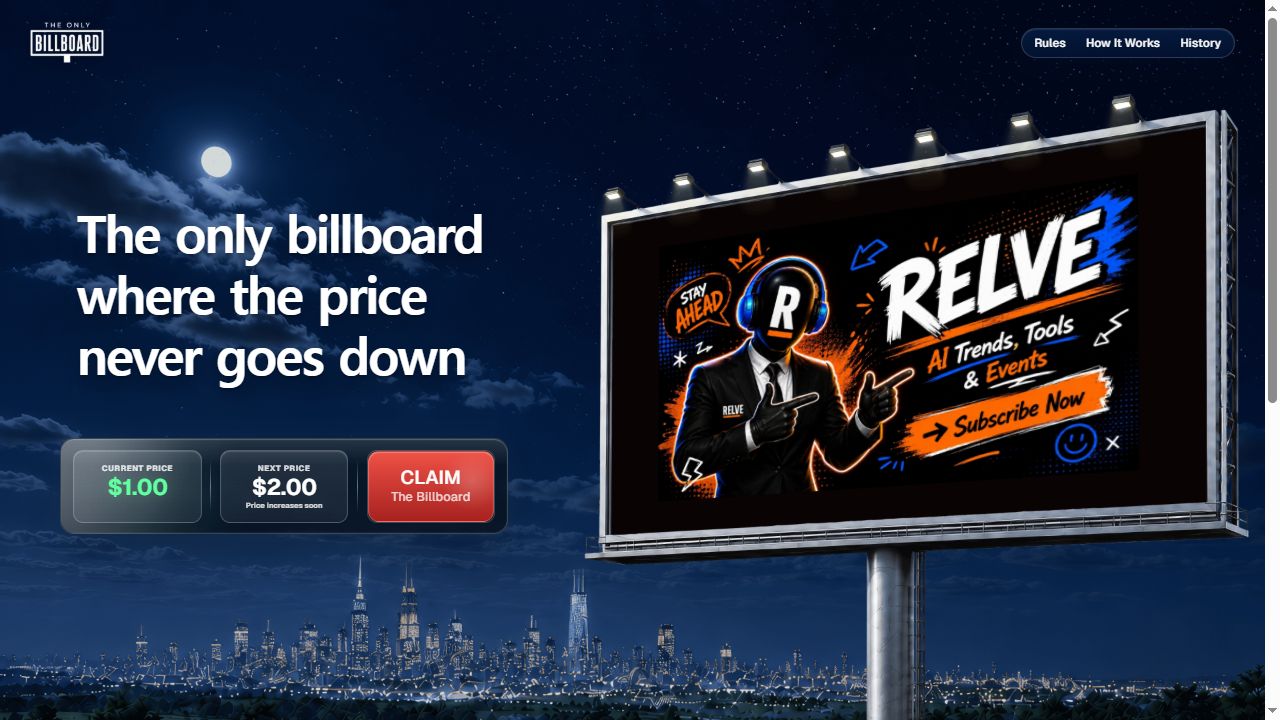
For a long time, The Only Billboard was easy to explain and strangely difficult to make real.
The rule was simple. There would be one billboard on the entire site and only one live ad on that billboard. A buyer could take the whole thing. The next buyer would replace the current owner, the price would rise by one dollar, and the displaced ad would move into a permanent History.
No grid. No inventory of a thousand identical rectangles. No auction hidden inside an ad dashboard. One visible place and one public owner.
It sounded like a finished idea, but it was not a finished story. An empty billboard does not have an owner to challenge. It does not have a reign to end. It does not show what “takeover” means because nothing has been taken from anyone yet. The mechanism existed, but the human tension did not.
Then RELVE paid $1 and became the first owner.
The amount was tiny. The change was not.
An empty object became occupied territory
Before that purchase, every explanation of the project pointed toward the future. Someone will buy it. Someone will replace them. The price will go up. The old ad will remain in History.
Future tense is expensive. It asks a visitor to do too much imaginative work.
After RELVE appeared, the same explanation became visible in the present. RELVE is on the billboard. The next takeover costs $2. If someone buys it, RELVE leaves the live spot and becomes the first entry in History.
That is a much smaller mental leap. A visitor no longer has to imagine the first half of the game. The board already has an owner. The only unanswered question is who wants to replace them.
This is the first lesson from the first sale: participation can explain a strange product better than copy.
A conventional product can often show a familiar interface and rely on the visitor to recognize the category. A new kind of public game cannot. It needs a person, brand, or object inside the mechanism. The first participant is not merely a customer. The first participant demonstrates the verb.
RELVE demonstrated “claim.” The next buyer will demonstrate “take over.”
The first buyer changed the message
The old message was mostly an invitation: be first.
That invitation has expired. Repeating it would make the site feel frozen in an earlier chapter. The useful message now is a challenge: RELVE owns the only live spot; the next person can replace them for $2.
That shift matters because “be first” and “replace the current owner” appeal to different instincts.
Being first is about novelty. Replacing someone is about comparison, nerve, timing, and a little bit of mischief. It gives the visitor a visible target. It also gives the current owner a reason to talk. RELVE can say that it holds the billboard. A challenger can say that it ended RELVE’s run. Both sides receive a story, not just an impression count.
This is why the billboard is not trying to imitate a normal display-ad marketplace. The value cannot rest only on how many people click an image today. The purchase changes the public state of the site. It creates an owner, raises the next price, and records a chapter.
The ad is part media placement, part collectible record, and part public dare.
A small price made the rule testable
The $1 first price was not meant to prove a giant advertising return. It was meant to make the first move easy enough that somebody could test the rule with real money.
Real money matters even when the amount is small. A free claim would prove that someone was willing to fill a form. A paid claim proves that someone accepted the exchange: one dollar for the whole live billboard, the right to hold it until the next takeover, and a permanent place in the project’s History.
That is a cleaner signal.
The next price is $2. It is still deliberately small, but it is not the same purchase. The second buyer will not become the first advertiser. That title belongs to RELVE. The second buyer gets a different title: the first challenger, the first takeover, and the first person to send an existing owner into History.
As the price rises, the meaning of each purchase changes with it. A later buyer is not simply paying more for the same rectangle. They are entering a longer record and taking the place from a more established line of previous owners.
Whether that growing meaning can keep pace with the price is the real experiment.
The current owner became part of distribution
Something else happened after the purchase. RELVE did not stay silent.
It posted about occupying The Only Billboard, shared an image, tagged the project, and joined the joke about how long it could hold the spot. That is more useful than a passive logo placement because the buyer has a reason to distribute the event too.
The billboard created a sentence the advertiser could use: we own the only live ad right now.
Good promotional mechanics should give every participant a sentence worth repeating. “We bought another banner” is not much of a sentence. “We are the first owner” is. “We replaced the first owner for $2” may be even better.
This does not remove the need to attract an audience. The board still needs visitors, and the buyer still deserves attention. But it changes who has a reason to help create that attention. The site and the current owner are temporarily telling the same story.
History is not decoration
The permanent History has not had a chance to do its real job yet because no takeover has happened. RELVE is still live.
When the second purchase arrives, History will stop being a promise and become proof. It will show the first owner, the first price, and the first completed reign. Every later takeover will make the archive more valuable as a record of how the experiment grew.
This is important because a normal ad disappears when its campaign ends. Its public identity is temporary. Here, losing the live position creates the permanent artifact.
The tension is intentional. The live billboard offers scarcity: one owner. History offers continuity: every former owner remains. A buyer is paying for both the present contest and the future record.
The best version of the project will make that record feel less like a table of old ads and more like a sequence of internet moments. Title, owner, price, date, duration, and the ad itself should let a visitor understand who arrived, who lasted, and who took over.
What the first sale did not prove
One purchase does not prove that the model will scale. It does not prove that the tenth price, the hundredth price, or any later price will feel justified. It does not prove that traffic will convert on its own. It does not prove that every advertiser will help spread the story.
It proved something smaller and more useful: the central action is possible, and it feels different after it happens.
The project now has a live owner. The message can be written in the present tense. The next buyer has someone to replace. The current advertiser has something specific to claim. The History has its first future entry waiting.
That is enough information to decide the next experiment.
The immediate goal is not to pretend the billboard has already become a giant advertising market. The goal is to find the person who understands the second chapter. It might be a startup, an artist, a community, an event, a strange personal message, a cause, or somebody who simply wants to be the first challenger.
The category should remain wide because the object itself is unusual. Narrow targeting too early would force a new kind of billboard back into the assumptions of ordinary ad inventory.
The next chapter costs $2
The live board is at https://theonlybillboard.com/?utm_source=tolodora&utm_medium=blog&utm_campaign=first_takeover_story
RELVE owns it now. The next takeover costs $2. When that happens, RELVE becomes the first permanent entry in History and the new buyer becomes owner number two.
The most interesting question is no longer whether anyone will ever pay for the idea. Someone did.
The question is what kind of person looks at an occupied billboard and thinks: I should be the one who replaces them.