
Metabase
SoftwareOpen-source business intelligence that lets anyone ask questions of your data and build dashboards — no SQL required.

About Metabase
Metabase is an open-source business-intelligence tool that lets anyone on a team explore data, build dashboards and get answers — without needing to know SQL. Used by 100,000+ companies, it makes analytics genuinely self-service, so business users can investigate questions themselves instead of queuing up requests to a data team for every chart.
What Metabase is
Metabase connects to your databases and gives you friendly ways to ask questions of your data: a visual, no-code query builder, natural-language querying through its Metabot AI, and interactive dashboards you can filter and drill into. It also supports governed analytics with a semantic layer, and embedded analytics you can put inside your own product — all while letting you inspect the exact query behind every answer.
Who it's for
Metabase serves data teams building governed analytics and semantic layers, business users who want to explore data without technical skills, SaaS companies embedding analytics for their customers, and organizations from startups to enterprises. Its ease of use plus depth means both a non-technical marketer and a data engineer can work in the same tool.
What it offers
- Visual, no-code query builder
- Metabot AI for natural-language querying
- Interactive dashboards with filtering and breakouts
- Data Studio semantic layer with trusted, reusable metrics
- Granular permissions and data segregation
- Embedded analytics SDK (React) with white-labeling and SSO
- Caching, staging environments and usage analytics
- 40+ data sources (Snowflake, BigQuery, PostgreSQL, MongoDB)
Analytics without a data-team bottleneck
Metabase's core value is self-service. Its visual query builder and natural-language Metabot let non-technical people answer their own data questions and build dashboards, so the data team isn't the bottleneck for every request. That frees analysts to focus on harder problems while everyone else gets faster answers — a shift that makes an organization genuinely more data-driven rather than data-dependent on a small central team.
Trust through transparency
A standout Metabase principle is that you can inspect the query behind every answer. Nothing is a black box — if a number looks off, you can see exactly how it was calculated. Combined with Data Studio's semantic layer, which curates trusted, reusable metric definitions and marks vetted sources, this builds confidence that the numbers people act on are correct and consistent, which is often the hardest part of self-service analytics.
Open source, and embeddable
Metabase is free and open source, self-hostable with a simple Docker command, which makes it fast to deploy and keeps data in your control — with paid Starter, Pro and Enterprise tiers for teams wanting more. Its embedded analytics SDK also lets SaaS companies build customer-facing dashboards right into their apps, with multi-tenant data segregation, white-labeling and SSO. That range — internal BI and embedded analytics from one tool — is unusually flexible.
Keep the whole team informed
Metabase makes sure insights actually reach people instead of sitting in a dashboard nobody opens. Subscriptions and alerts automatically send reports or notify the right people when a metric crosses a threshold, and Documents combine charts with collaborative text so analysis comes with context and narrative. For a team, that means the numbers show up where decisions happen — in an inbox, a scheduled report, a shared doc — rather than requiring everyone to remember to go look. It turns analytics from a passive resource into an active part of how the organization stays aligned.
Why choose Metabase
For teams that want approachable, trustworthy analytics without heavy engineering, Metabase is an excellent choice. Its no-code and natural-language querying, transparent "see the query" approach, governed semantic layer, broad data-source support and open-source, embeddable foundation make it a practical way to let everyone explore data and build dashboards — turning analytics from a data-team bottleneck into something the whole organization can actually use.
Built with
Open source
Tags
Ratings & reviews
No ratings yet
Be the first to rate Metabase — your honest take helps others decide.
- No reviews yet — be the first to rate Metabase.
Similar softwares
Slip
Slip helps freelancers and side hustlers track income, expenses, profit, recurring bills and estimated tax reserves.
达秘-TikTok达人建联工具
达秘-是 TikTok Shop 卖家专属工具:批量邀约私信达人、免费千万精准带货库、AI多语言话术+达人管理,多店铺运营,提 90% 效率+200%订单。
HelpSite
Simple, AI-powered knowledge-base software for public help centers, private SOPs, and sourced answers customers can trust.
Compare Metabase
Similar software

Lightdash
An open-source BI tool built on dbt that turns your data models into self-serve dashboards and metrics for the whole team.

Evidence
An open-source, code-based BI tool that builds polished data reports and dashboards from SQL and Markdown.

Baremetrics
Subscription analytics that turn your billing data into clear SaaS metrics — MRR, churn, LTV — with zero setup.

Formbricks
Open-source survey and experience platform you can self-host — run in-product surveys and own your form data outright.

Causal
A modern tool for financial modeling, forecasting and planning — a more powerful, intuitive alternative to spreadsheets.
Vectr4
Self-host Vectr4 on your VPS and track events, funnels, sessions, and journeys without sending product data to another vendor.
Related reads

Vectr4: A Self-Hosted Umami Alternative for Product Analytics
Looking for an Umami alternative? See how Vectr4 combines self-hosted analytics with event tracking, funnels, sessions, users, and customer journeys.
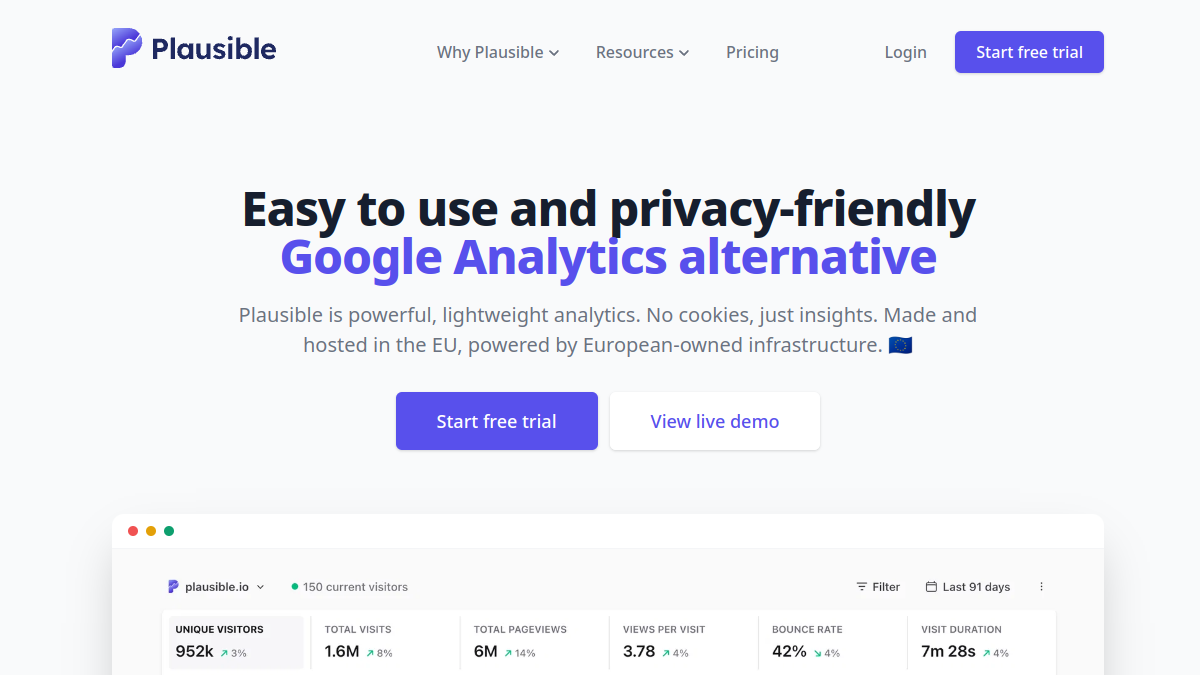
Plausible vs Google Analytics (2026): Which Should You Use?
Plausible vs Google Analytics: one is free but complex and a privacy headache, the other is simple, private, and paid. Here's an honest 2026 comparison to help you choose.
Fathom vs Plausible: Which Privacy-First Analytics Should You Use? (2026)
Both Fathom and Plausible are simple, privacy-first analytics — so which should you choose? Here's my honest comparison for 2026.
Community discussion (0)
Ask questions, share tips, or compare notes with other Metabase users.